

Quick Answer: What Shapes Chinese Culture in South Korea?
Incheon’s Chinese community grew after the port opened in 1883 and a Qing settlement was designated in 1884. Chinese merchants imported goods, and restaurants later became one of the district’s most visible businesses. [1]
- Settlement. Many long-established Chinese families in Korea trace roots to Shandong. [3]
- Food. Jjajangmyeon, noodles with a dark bean sauce, is a Korean Chinese specialty associated with Incheon. [2]
- Later arrivals. Migration from mainland China changed the makeup of the Chinese community in Korea. [3][4]
Incheon is a useful starting point for understanding a history that extends beyond the historic port.

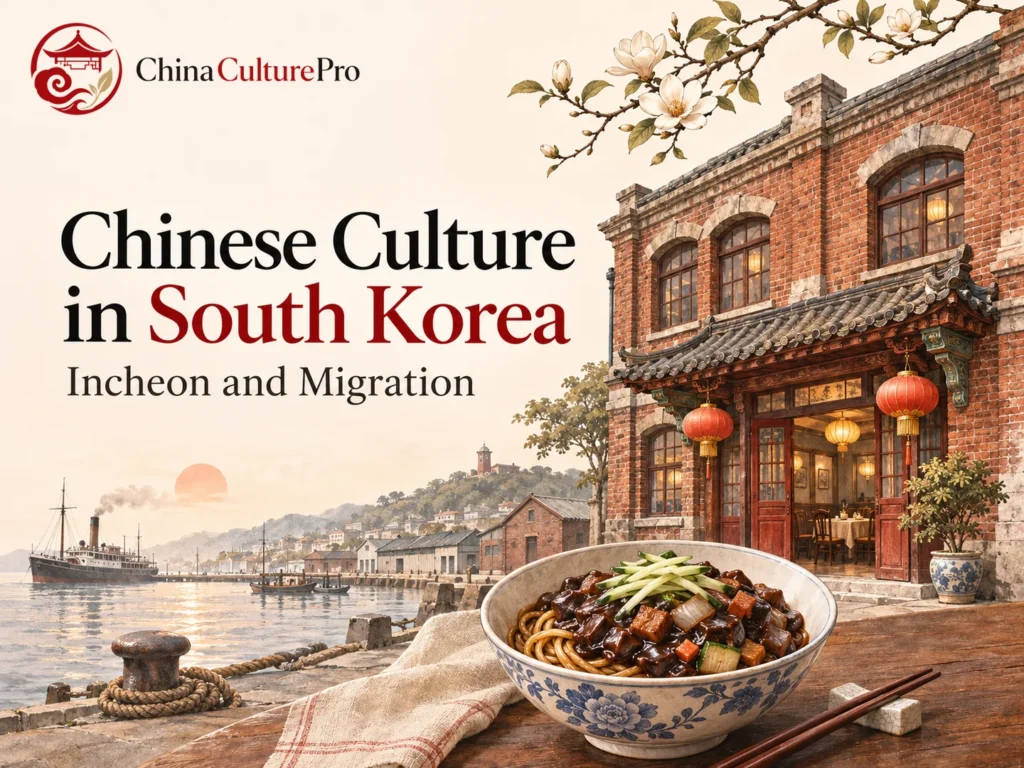
A bowl of jjajangmyeon carries a history of migration and local adaptation. The building where Incheon’s best-known Chinese restaurant once operated helps tell that story.
From an Open Port to Incheon Chinatown
After Incheon opened to foreign trade in 1883, Qing merchants established themselves near the port. A settlement designated the following year gave that trade a geographic focus. Shops sold imported goods from China. The district offers a comparison with historic Chinatowns in Japan, several of which also grew near ports opened to international commerce. [1]
How Jjajangmyeon Became Korean Chinese Food
Jjajangmyeon developed from Chinese noodle cooking into a Korean Chinese dish. Incheon’s former Gonghwachun restaurant houses a museum dedicated to the dish. Reconstructed restaurant rooms and displays of metal delivery boxes document changes in how noodles were served and reached customers. [2]
Long-Established Families and Later Arrivals
Many established Chinese families trace ancestry to Shandong, but that ancestry tells only part of the story of the ties families maintained outside Korea. Families also maintained ties to Taiwan. After South Korea and the People’s Republic of China established diplomatic relations in 1992, some established residents renewed connections with Shandong, while newer arrivals changed the makeup of the population. [3][4]
FAQs About Chinese Culture in South Korea
When did Incheon Chinatown take shape?
Its origins are tied to the 1883 opening of Incheon Port and the designation of a Qing settlement in 1884. [1]
Is jjajangmyeon a Chinese or Korean dish?
The version associated with Incheon is Korean Chinese. It grew out of Chinese noodle cooking and developed a local identity through restaurants and delivery. [2]
Sources
[1] Korea Tourism Organization. Incheon Chinatown
[2] Korea Tourism Organization. Jjajangmyeon Museum
[3] Journal of Asia-Pacific Studies. Research on Korean huaqiao and ties to Shandong
[4] University of Technology Sydney. Politics of race in East Asia: The Chinese community in South Korea