

Quick Answer: What Shapes Chinese Culture in Mexico?
Chinese communities helped develop local economies in several parts of Mexico. In Mexicali, migrants worked in the surrounding agricultural valley and ran businesses in a district known as La Chinesca. [1][2]
- Work and settlement. The Mexicali Valley and its growing border city offered different kinds of employment. [1]
- Public memory. The 1911 massacre in Torreón is a separate part of Chinese Mexican history, publicly acknowledged by Mexico’s government in 2021. [3]
- Food. Mexicali’s Chinese restaurants became part of local identity, a history the city has documented through a museum. [4]
Mexicali’s restaurant heritage and Torreón’s commemoration grew from different local histories.
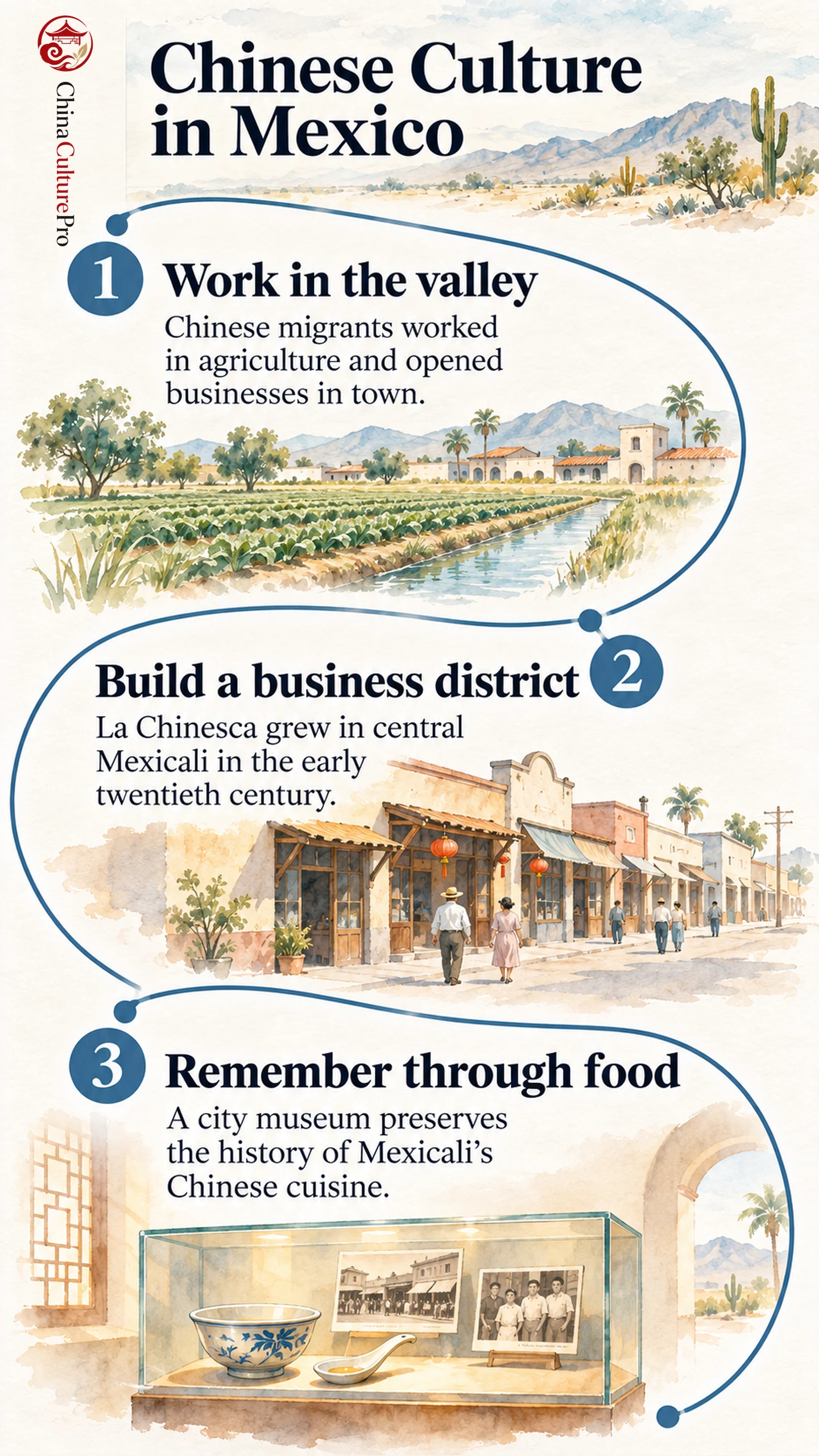
La Chinesca grew from everyday work and commerce in Mexicali. The neighborhood’s history helps explain why Chinese food became closely identified with the border city.
How La Chinesca Grew in Mexicali
Chinese migrants worked in agriculture in the Mexicali Valley and established businesses in town. Commercial development in the central district known as La Chinesca was under way by 1918. Some business networks reached beyond Baja California to Cananea in Sonora and San Francisco in California. Those ties place Mexicali in a wider history of Cantonese diaspora networks. [1]
La Chinesca was a commercial district with places for social and cultural life. Its history can be compared with other examples of Chinatown culture, where a cluster of shops also gave a community a place to gather. [1][2]
Torreón and the Public Memory of 1911
Torreón, in Coahuila, had Chinese-owned businesses and a Chinese school by the time of the Mexican Revolution. In May 1911, revolutionary soldiers killed hundreds of members of that community. In 2021, the federal government held a public ceremony acknowledging the massacre and asking for forgiveness. [3]
How Mexicali Preserves Chinese Food History
The city inaugurated a museum dedicated to Mexicali’s Chinese food in its historic center. Its focus on cooking gives everyday restaurants a place in the city’s account of its own history. The location connects food heritage to the district where businesses took root. [4]
FAQs About Chinese Culture in Mexico
What is La Chinesca?
It is Mexicali’s historic Chinese commercial district in the city center. Its growth is documented in the early twentieth century. [1][2]
Why is Mexicali associated with Chinese food?
The city’s Chinese community developed a restaurant tradition closely tied to local commerce. Mexicali has recognized that history through a museum devoted to its Chinese cuisine. [1][4]
Sources
[1] Instituto de Cultura de Baja California. Historia de los chinos en Mexicali y su valle
[2] Instituto Nacional de Antropología e Historia. Los chinos y sus actividades en Mexicali
[3] Presidencia de la República. Petición de perdón por agravios a la comunidad china en México
[4] Ayuntamiento de Mexicali. Inauguración del Museo de la Comida China de Mexicali