


Quick Answer: How Do Video Games Use Chinese Cultural Heritage?
Chinese video games can use real buildings as models, rework classical stories or turn a performance tradition into a scene a player can experience. Black Myth: Wukong draws on Journey to the West (西游记, Xīyóu Jì) and uses real architecture as a reference. Gujian 3 includes a level in the style of shadow puppetry. Genshin Impact presents an opera-inspired performance within its fictional world. Each example uses heritage for a different part of the game. [1][2][3][4][5]
- Places: An environment can borrow details from a documented temple or sculpture. [1][3]
- Stories: A game can inherit a character or world and tell a new story through it. [2]
- Performances: Puppetry or opera can shape what the player sees, hears or controls. [4][5][6]
Identify the source and then ask what the game changed to make it work on screen or in play.
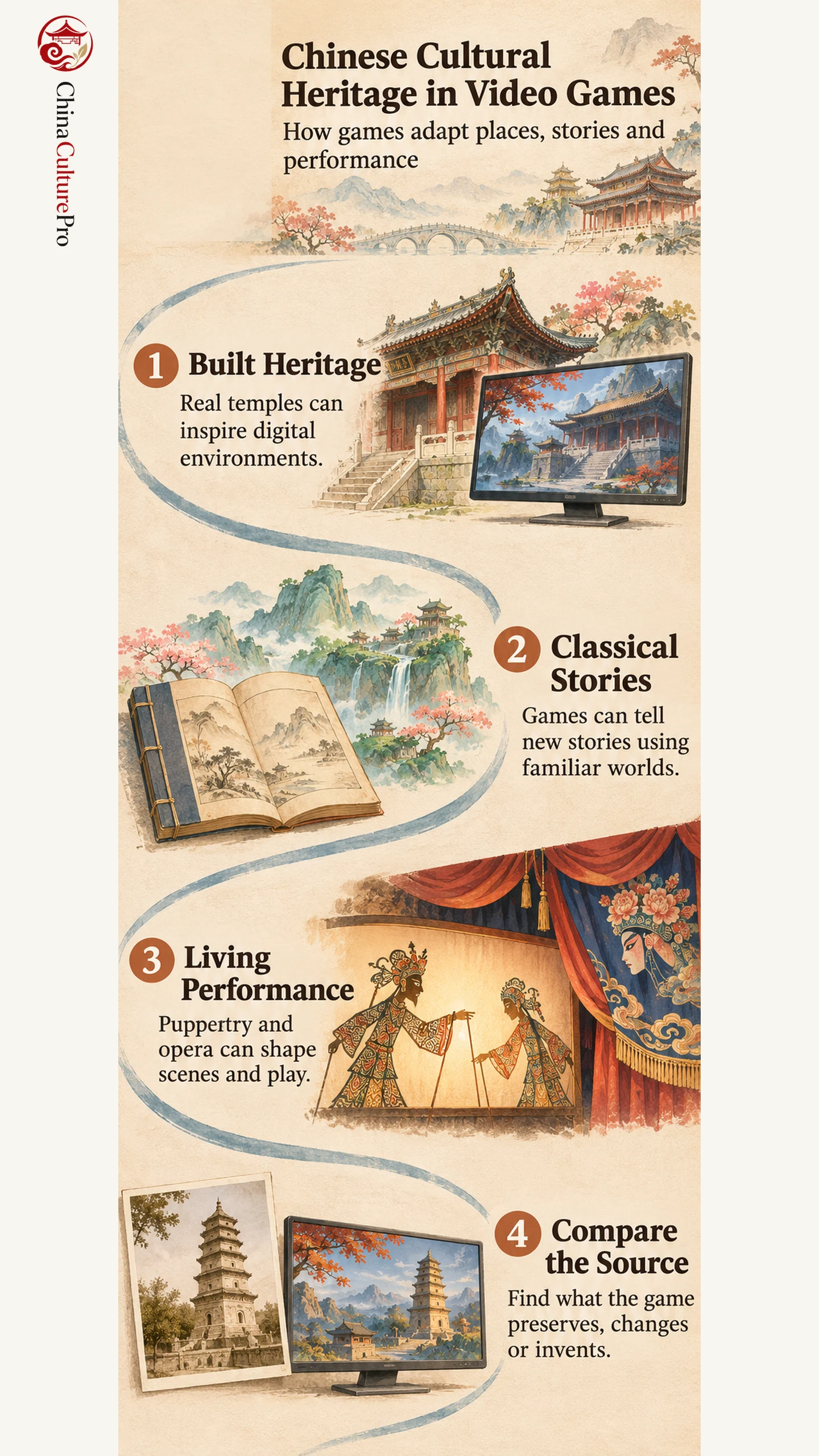
A game can send you through a temple modeled on a real building. It can also flatten the world into a stage of moving silhouettes or pause for a song. Those choices use different aspects of cultural heritage and make different demands on the player’s attention. [1][4][5][6]
What Black Myth Wukong Borrows From Real Sites
Research on Black Myth: Wukong describes how the developers used historic buildings, grottoes and statues as prototypes for digital environments. Coverage of Shanxi examples identifies Xiaoxitian Temple in Linfen, Foguang Temple in Xinzhou and Yuhuang Temple in Jincheng among landmarks that inspired scenes. A scene can carry over a roofline or sculpture and rearrange the surrounding space for play. [1][3]
Compare a feature in the game with a dated photograph or a description from the site. Start by looking for repeated architectural details. Then check where the game has changed the building’s layout, lighting or context. The guide to Chinese digital heritage projects explains a different purpose for recording a site, such as documentation and public access. [1][3]
How the Game Reworks Journey to the West
The game’s official description identifies Journey to the West as a source and calls the player character the Destined One. The Destined One encounters characters and challenges connected to the Monkey King’s legend. The novel has its own narrative and pilgrimage. A shared name or character does not tell you that both versions follow the same sequence. [2]
The guide to Journey to the West can help you place characters and episodes that feel familiar. The Sun Wukong profile follows the Monkey King’s role in the story and its wider cultural life. [2]
How Gujian 3 and Genshin Impact Use Performance
In Gujian 3, a level adopts the look of Chinese shadow puppetry (皮影戏, píyǐngxì). The player moves through a two-dimensional setting with elements of a staged performance. The guide to Chinese shadow puppetry explains the figures, stories and performance traditions that make the visual reference readable. [4]
Genshin Impact uses a different device in “The Divine Damsel of Devastation.” The game presents an opera-inspired song as a performance of a story within the fictional world. The guide to Peking opera gives context for one stage tradition that can help a listener recognize stylized delivery. The game scene selects and recombines performance features to suit its own story. [5][6]
How to Tell a Cultural Reference From a Recreation
Start by identifying which part of the game you want to trace. A named site can be compared with a collection record or heritage photograph. A performance scene can be compared with the tradition it invokes. A story can be traced to a novel or legend through an official description or scholarly source. [1][2][4][5][6]
| Example | Source It Draws On | What the Game Does |
|---|---|---|
| Black Myth: Wukong | Real buildings and the novel Journey to the West. [1][2][3] | Builds explorable settings and a new journey for its protagonist. |
| Gujian 3 | Shadow puppetry and stage traditions. [4] | Uses a shadow-play style for a level the player moves through. |
| Genshin Impact | Chinese opera performance conventions. [5][6] | Stages a sung story within the game world. |
FAQs About Chinese Cultural Heritage in Video Games
Are the temples in Black Myth: Wukong real?
Some environments use real architecture as a reference, including named temples in Shanxi. The game’s scenes can change details and surroundings for its fictional world. [1][3]
Is Black Myth: Wukong a retelling of the entire novel?
The official description names Journey to the West as a source and casts the player as the Destined One. The game tells its own story around that inheritance. [2]
Can a game teach the original performance tradition?
A game scene can introduce a visual or musical feature. A performance recording, practitioner’s explanation or museum account can show how the tradition works in its own setting. [4][5][6]
Sources
[1] Xihuan Hu, Rethinking History. Video Games and Heritage Intersect: An Investigation of Black Myth: Wukong
[2] Game Science, Steam. Black Myth: Wukong
[3] China Daily, republished by China National Intellectual Property Administration. Cultural IPs and Government Policies Make Shanxi a Magnet for Tourists
[4] Youth and Globalization. Cultural Heritage and Chinese Digital Games
[5] Genshin Impact official channel. Story Teaser: The Divine Damsel of Devastation
[6] Yixiang Que, Teresa de La Hera and Jeroen Jansz, Media and Communication. Dive Into the Past: Chinese Intangible Cultural Heritage Represented in Chinese Mobile Games