

Quick Answer: When Did Chili Peppers Reach China?
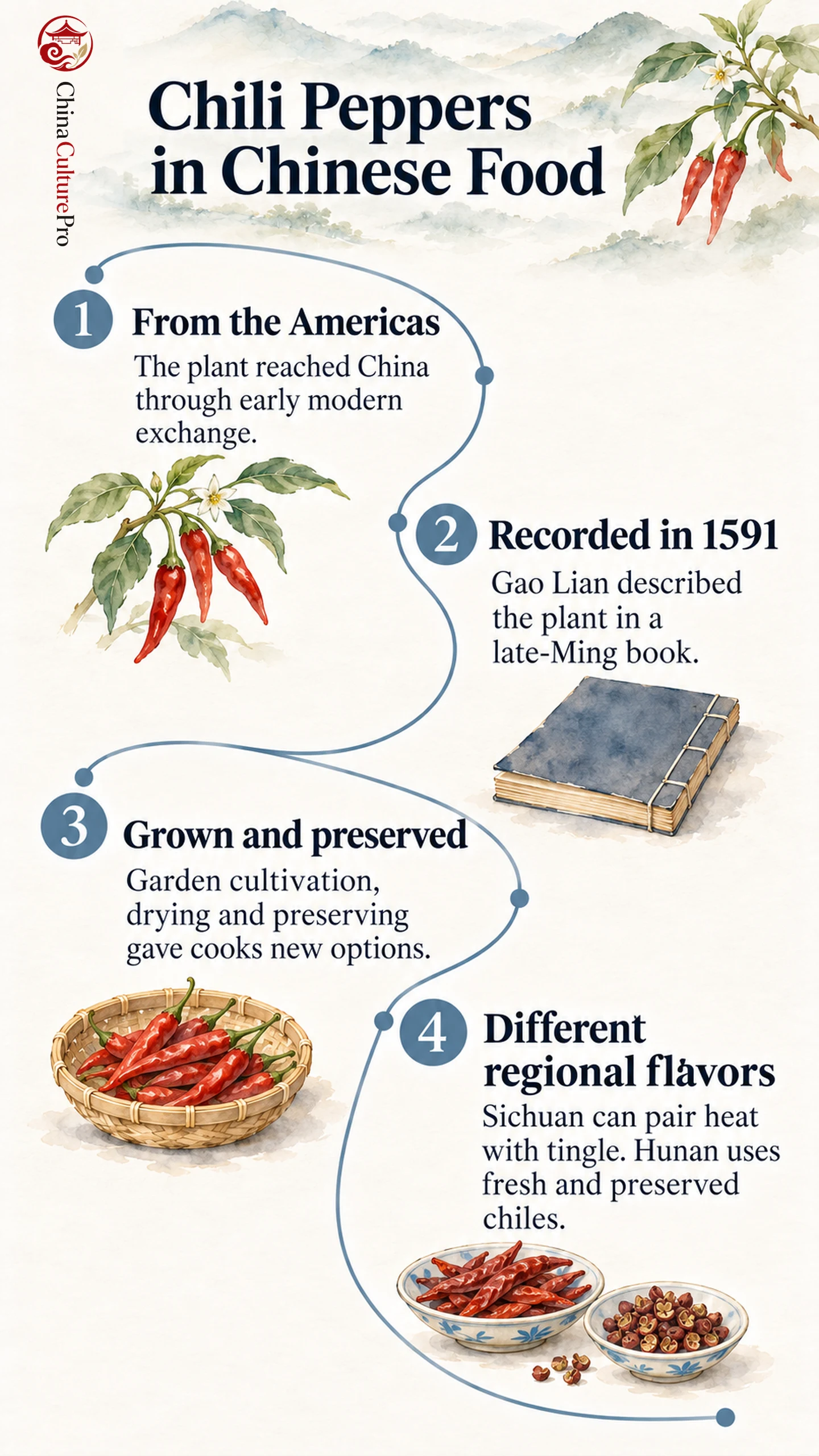
Chili peppers reached China from the Americas through early modern exchange. Gao Lian described the plant in 1591, one of the earliest securely dated Chinese records. Cooks later incorporated chiles into regional dishes and seasonings, including prominent traditions in Sichuan and Hunan.[1][2][3][5]
- First record: A written description establishes that the plant was known by then.[2][3]
- Spread: People could cultivate the peppers locally and use them in fresh or preserved forms.[2][3][5]
- Flavor: A chili’s heat differs from the tingle of Sichuan peppercorn.[4][5]
The 1591 record marks an early written appearance. Regional cooking tells the later story of adoption.[1][3]
A red chili has a familiar place in Sichuan cooking today. A late-Ming description gives us an earlier way to see it: as a striking plant whose appearance was worth recording.[1][2][3]
What the First Written Record Can Tell Us
Gao Lian’s Zunsheng Bajian (遵生八箋, Zūnshēng Bājiān), published in 1591, describes an unfamiliar pepper with red fruit. It establishes that people in China knew the plant by the late sixteenth century. It gives no precise starting date for the crop’s arrival or for regular use in kitchens.[2][3]
Historian Brian Dott proposes several introductions, including maritime connections through Southeast Asia. His reconstruction draws on early descriptions and the names people used in different areas. It leaves room for multiple arrivals and for steps in the plant’s spread that surviving texts rarely document.[1][3]
Why Cooks Kept Growing and Using Chiles
People could grow chili peppers locally after acquiring seed. Dott notes that early records suggest some cooks valued them as a readily grown seasoning where other strong flavors were more expensive. Historical sources describe only a fraction of everyday kitchen work, so the spread is easier to see across many records than to date town by town.[1][2][3]
Fresh peppers could enter a dish directly. Drying and preserving extended the ways cooks could use them, and local varieties developed over time. The guide to Chinese dried chili types explains how individual varieties are used today.[2][5]
How Sichuan and Hunan Made Chiles Their Own
| Regional example | How the pepper works |
|---|---|
| Sichuan cuisine | In the mala (麻辣, málà) flavor profile, Capsicum heat works with the tingle of Sichuan peppercorn, an older seasoning from Zanthoxylum plants.[4][5] |
| Hunan cuisine | Cooks can use fresh or preserved chiles as a prominent flavor. The form of the pepper helps determine how the heat comes through.[1][3][5] |
A chili-rich dish expresses one part of a regional cuisine. Sichuan cooks can bring out aroma and tingle in a seasoning combination, while Hunan cooks have their own ways to use the savory or sour qualities of preserved peppers. Regional identities grew around those uses over time.[1][3][4][5]
FAQs About Chili Peppers in Chinese Food
Are chili peppers native to China?
Capsicum peppers came from the Americas. An early Chinese written record dates to 1591, in the late Ming.[1][2][3]
Who brought chili peppers to China?
No single importer can be established from the surviving evidence. Dott proposes more than one introduction, including arrivals through maritime links with Southeast Asia.[1][3]
Is Sichuan pepper another kind of chili?
Sichuan peppercorn is the aromatic husk of plants in the genus Zanthoxylum. It tingles and numbs. Capsicum chiles supply a different sensation of heat.[4][5]
Sources
[1] Brian R. Dott, Columbia University Press. The Chile Pepper in China: A Cultural Biography
[2] Frontiers in Plant Science. Genetic diversity of Chinese pepper landraces and the 1591 record
[3] Brian R. Dott, Eat This Podcast. Transcript on early records, routes and uses
[4] Ethnobiology Letters. Sichuan Peppercorn and the Birth of Numbing Spices in East Asia
[5] Chinese Language Institute. Chinese chili use and vocabulary for spicy flavors