


Quick Answer: What Does Cao Mu Jie Bing Mean?
Cao Mu Jie Bing (草木皆兵, cǎo mù jiē bīng) literally means “the grass and trees are all soldiers.” It describes someone so alarmed that ordinary sights seem threatening. The image comes from the Book of Jin (晋书, Jìnshū), where Fu Jian sees human shapes in the vegetation on Mount Bagong.[1][2]
- Literal image: Grass and trees look like soldiers on a distant hillside.[1]
- Modern use: A frightened person sees danger in ordinary signs.[1][2]
- Related image: Feng Sheng He Li (风声鹤唳, fēng shēng hè lì) evokes the same fear through wind and crane calls.[3]
Look for a gap between the threat a person expects and the harmless thing they see.
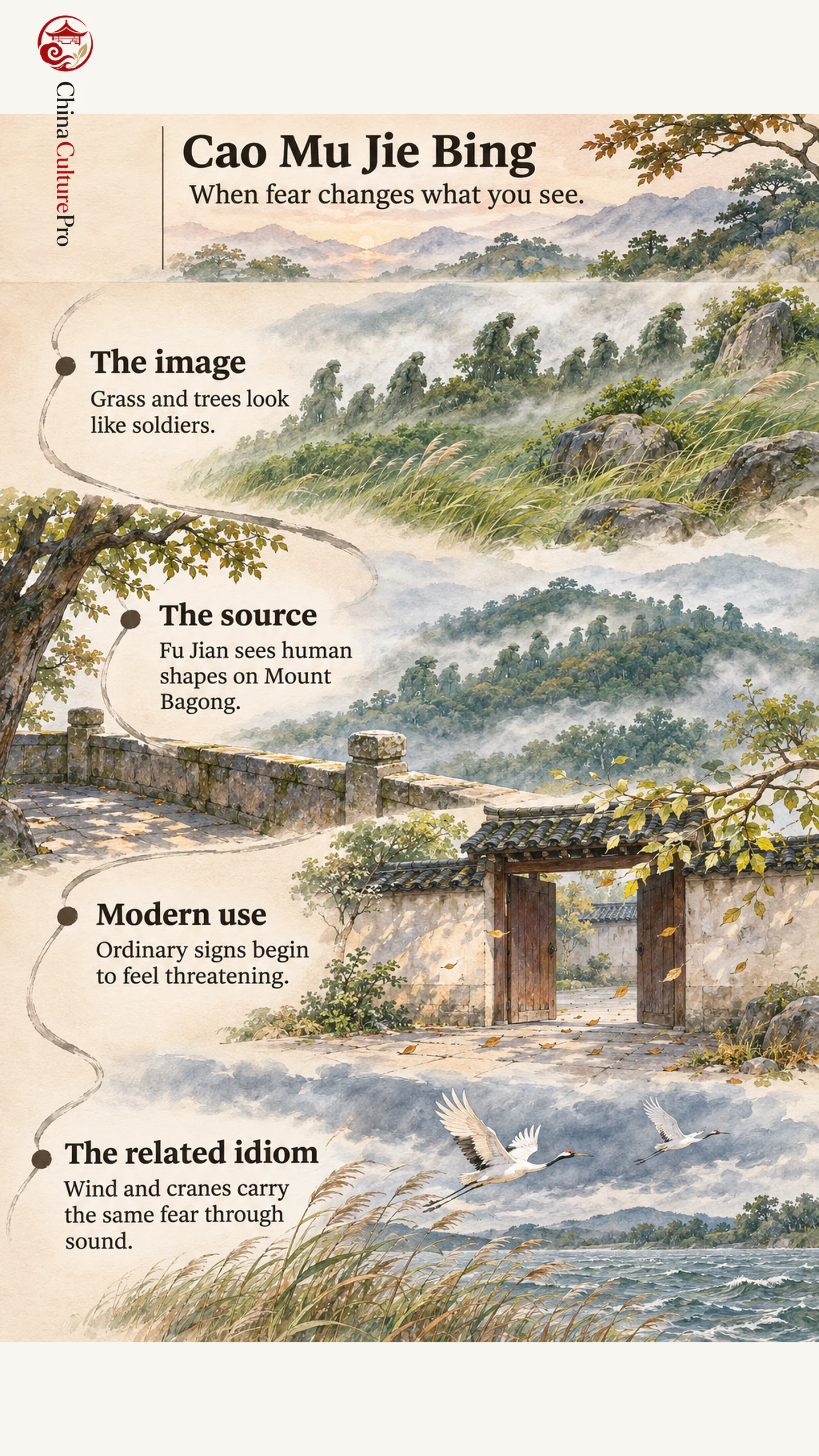
A distant tree can look like a person when someone is already looking for danger. In this Chinese idiom, the mistake spreads over a whole hillside. That scale gives the phrase its force when it describes a mood of suspicion.[1][2]
The Image on Mount Bagong
Cǎo means grass, mù means trees, jiē means all, and bīng refers to soldiers in this phrase. The line makes a statement about what the hillside looks like to the person watching it. A translation that keeps the image can say that the grass and trees all looked like enemy soldiers.[1][2]
The surprise is how ordinary the objects are. The hill itself can be still. What changes is the viewer’s judgment of shapes that would otherwise look like familiar parts of a landscape.[1]
Where the Story Appears
In the account of Fu Jian in the Book of Jin, Fu Jian and Fu Rong look out from city walls and see the well-ordered Jin forces. Fu Jian then looks toward Mount Bagong and takes human-shaped vegetation as a sign of more troops. The text marks the change in his expression as he grows afraid.[1]
The episode belongs to accounts surrounding the Battle of the Fei River. For the idiom, the decisive moment is before the defeat: a ruler surveying what he thinks he can see begins to overread the distant hill. Later readers generalized the image to describe fear and suspicion in other settings.[1][2]
How to Use Cao Mu Jie Bing Today
A novelist might write 谣言传开后,大家草木皆兵,连院门一响都觉得出了事。 After a rumor spreads, everyone is on edge. Even the sound of the courtyard gate seems to mean something is wrong. The narrative can show that a real rumor existed while the particular signal was harmless.[1][2]
The phrase is stronger than “be careful.” It usually conveys that suspicion has reached the point of distorting interpretation. “See a threat in everything” captures that effect, while “jump at every shadow” may fit a less formal translation.[1][2]
How It Differs From Feng Sheng He Li
The other Book of Jin episode comes after the defeat. Fleeing soldiers hear wind and cranes and think their pursuers have arrived. Feng Sheng He Li takes its image from that sound. Cao Mu Jie Bing takes its image from the earlier hillside.[1][3]
Later prose can pair them, using sound and sight to portray fear on all sides. An English version can retain both images when the rhythm matters, or use a phrase such as “startled by every sound and shadow” when the allusion would otherwise be obscure.[2][3]
FAQs About Cao Mu Jie Bing
What does Cao Mu Jie Bing literally mean?
The characters say that the grass and trees are all soldiers. In the story, that is how the distant vegetation looks to Fu Jian.[1]
Do the plants actually turn into soldiers?
The scene describes a mistake in perception. The vegetation resembles human figures from where Fu Jian is looking.[1][2]
What is a natural English translation?
“See a threat in everything” conveys the meaning. “Jump at every shadow” can work when the passage emphasizes how easily people are alarmed.[1][2]
Sources
[1] Taiwan Ministry of Education. Idiom dictionary entry for 草木皆兵
[2] Taiwan Ministry of Education. Revised dictionary entry for 草木皆兵
[3] Taiwan Ministry of Education. Idiom dictionary entry for 風聲鶴唳