


Quick Answer: What Are the 24 Mountains?
The 24 Mountains (二十四山, èrshísì shān) divide the compass into 24 sectors of 15° each. Here, a “mountain” is a bearing range marked on a traditional luopan (羅盤, luópán).[1][2]
- Three per compass direction: Each of the eight broad directions contains three mountains.[1][2]
- Centerline: A mountain extends 7.5° to either side of its central bearing.[1][3]
- Opposite sector: Add 180° to find the sitting bearing when the facing bearing is known. Wrap at 360°.[2][3]
The compass ring uses four trigrams, eight Heavenly Stems and twelve Earthly Branches as labels. The table uses the familiar sector codes N1 through NW3.[1][2]
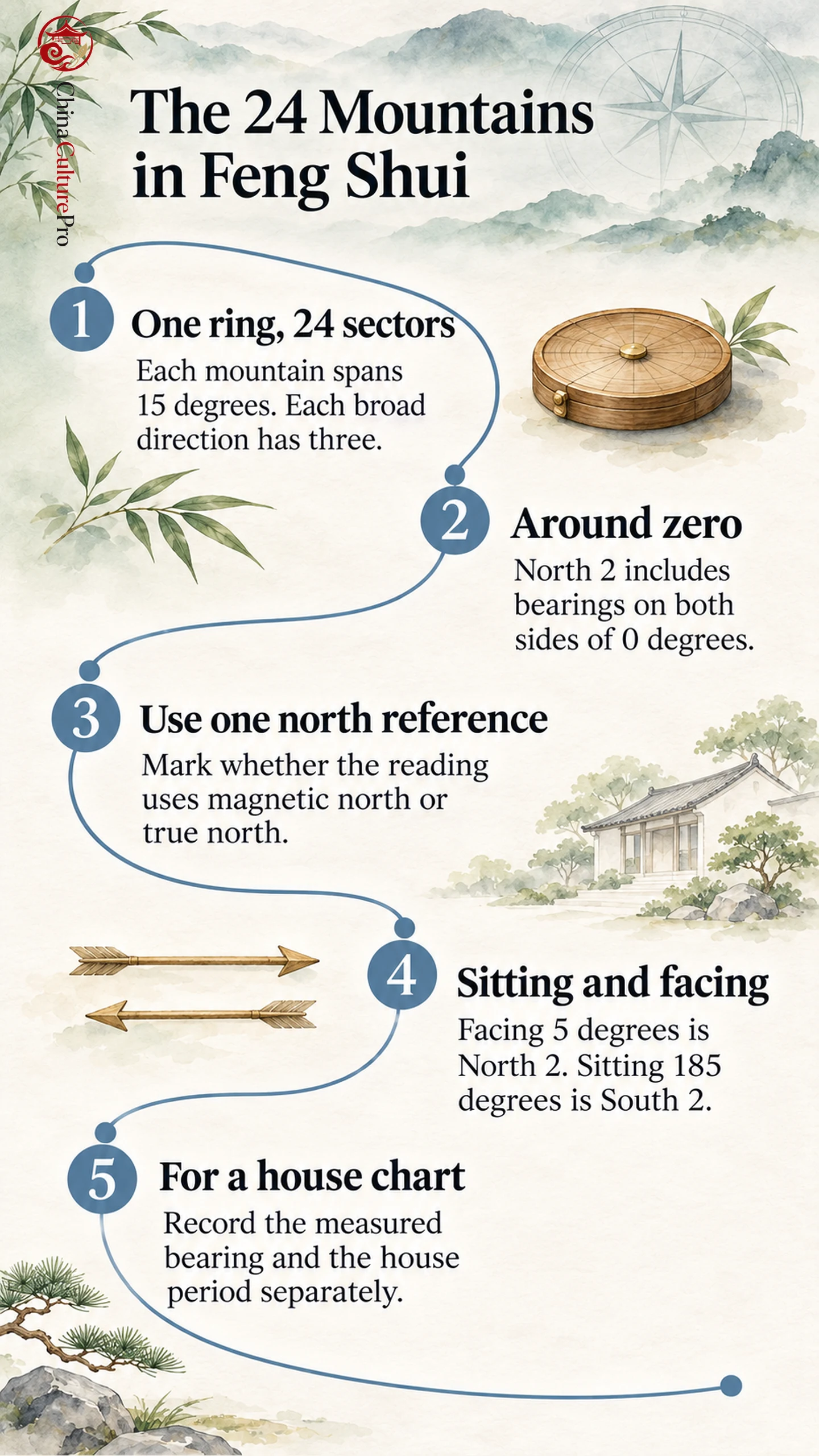
A compass bearing of 350° and a bearing of 5° both point broadly north, but they fall in different feng shui sectors. The table below gives the exact range for each sector and the direction opposite it.[1][2][3]
Full 24 Mountains Degree Chart
Bearings increase clockwise from 0° north. For this table, count a shared boundary with the sector beginning at that number. Treat a real reading on or near a boundary as uncertain. For North 2, the interval crosses 0° and includes bearings from 352.5° up to 360°, then from 0° up to 7.5°.[1][2][3]
| Code | Mountain | Center | Bearing range | Opposite |
|---|---|---|---|---|
| N1 | 壬 · Rén | 345° | 337.5°–352.5° | S1 Bing |
| N2 | 子 · Zǐ | 0° | 352.5°–7.5° | S2 Wu |
| N3 | 癸 · Guǐ | 15° | 7.5°–22.5° | S3 Ding |
| NE1 | 丑 · Chǒu | 30° | 22.5°–37.5° | SW1 Wei |
| NE2 | 艮 · Gèn | 45° | 37.5°–52.5° | SW2 Kun |
| NE3 | 寅 · Yín | 60° | 52.5°–67.5° | SW3 Shen |
| E1 | 甲 · Jiǎ | 75° | 67.5°–82.5° | W1 Geng |
| E2 | 卯 · Mǎo | 90° | 82.5°–97.5° | W2 You |
| E3 | 乙 · Yǐ | 105° | 97.5°–112.5° | W3 Xin |
| SE1 | 辰 · Chén | 120° | 112.5°–127.5° | NW1 Xu |
| SE2 | 巽 · Xùn | 135° | 127.5°–142.5° | NW2 Qian |
| SE3 | 巳 · Sì | 150° | 142.5°–157.5° | NW3 Hai |
| S1 | 丙 · Bǐng | 165° | 157.5°–172.5° | N1 Ren |
| S2 | 午 · Wǔ | 180° | 172.5°–187.5° | N2 Zi |
| S3 | 丁 · Dīng | 195° | 187.5°–202.5° | N3 Gui |
| SW1 | 未 · Wèi | 210° | 202.5°–217.5° | NE1 Chou |
| SW2 | 坤 · Kūn | 225° | 217.5°–232.5° | NE2 Gen |
| SW3 | 申 · Shēn | 240° | 232.5°–247.5° | NE3 Yin |
| W1 | 庚 · Gēng | 255° | 247.5°–262.5° | E1 Jia |
| W2 | 酉 · Yǒu | 270° | 262.5°–277.5° | E2 Mao |
| W3 | 辛 · Xīn | 285° | 277.5°–292.5° | E3 Yi |
| NW1 | 戌 · Xū | 300° | 292.5°–307.5° | SE1 Chen |
| NW2 | 乾 · Qián | 315° | 307.5°–322.5° | SE2 Xun |
| NW3 | 亥 · Hài | 330° | 322.5°–337.5° | SE3 Si |
The degree intervals subdivide the eight main feng shui directions. The central bearings are lookup references. For example, 45° is the middle of Northeast 2, while 37.5° marks the border with Northeast 1.[1][2]
How to Match a Compass Reading to a Mountain
Record the bearing and its north reference
Read the chosen facing line more than once, away from nearby metal that can disturb the compass. Mark whether the instrument uses magnetic north or true north. A conventional magnetic luopan uses magnetic north.[2][3][4]
Look up the range and find the opposite
Find the bearing in the range column. Add 180 degrees and subtract 360 degrees if needed. Read the opposite sector using the resulting number.[1][2][3]
For a facing of 5°, pick N2, Zǐ. Its sitting bearing is 185°, which falls in S2, Wǔ. Facing 350° instead gives N1, Rén, and the opposite bearing is 170°, in S1, Bǐng. These are different axes although both face broadly north. See the luopan compass guide for the different rings used in the traditional instrument.[1][3]
What the Lookup Tells You About the House
The lookup gives a label for a line you have already chosen. A Flying Star Feng Shui chart also needs the building period, and its school can specify which line counts as the facing. Record the raw degree as well as its label so a later reader can see how close the reading was to a split.[2][3]
FAQs About the 24 Mountains
Is 360° a different bearing from 0°?
They are the same north bearing. Both are at the center of N2. The label N1 belongs to the sector centered at 345°.[1][3]
Can I mix a phone’s true-north reading with a magnetic luopan bearing?
The two can differ by the local magnetic declination. Check the phone’s north setting and keep the same reference when deciding which sector contains the bearing.[3][4]
Sources
[1] American Feng Shui Institute. Stems and Branches, the 24 directions
[2] FengShuied. The 24 Mountains
[3] Nova Masters Consulting. 24 Mountains Reference
[4] NOAA National Centers for Environmental Information. Magnetic Declination