


Quick Answer: What Are Neifei and Neipiao?
Inside a wrapped cake of Pu-erh tea(普洱茶,pǔ’ěr chá), two different paper tickets may appear. Their position is the simplest way to distinguish them.[1][4]
- Neifei: The neifei(内飞,nèifēi)is a small identifying mark pressed into the tea.
- Neipiao: The neipiao(内票,nèipiào)is a loose description ticket inside the wrapper.
- Purpose: They help identify the producer or commissioned production.[1]
Neither a printed ticket nor its aged appearance independently proves authenticity, age or drinking quality.[2][4]
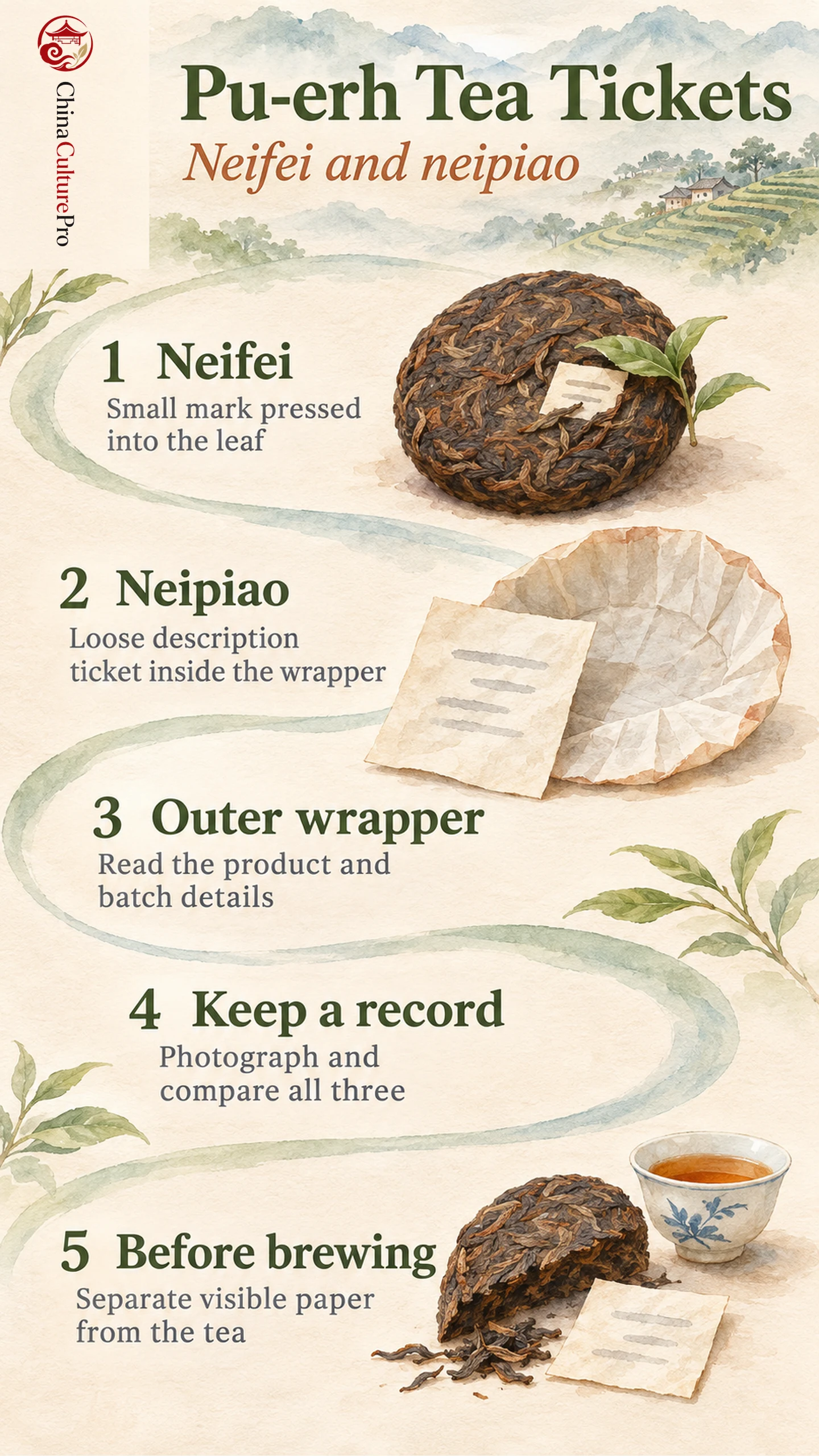
Reading the papers together is more useful than judging one isolated mark.
Neifei, Neipiao and the Outer Wrapper
| Paper | Where to find it | Common role |
|---|---|---|
| Neifei | Embedded in the tea’s surface, sometimes partly covered by leaves | Factory, brand or commissioned maker’s mark |
| Neipiao | Loose between the cake and outer paper | Producer or tea description; sometimes production information |
| Outer wrapper | Surrounding the cake | Product identity, producer details and, on many modern products, dates or batch information |
The layout and printed details vary between productions.[1][4]
The neifei is placed with the leaf during pressing, helping it remain attached when packaging is removed. The tickets can accompany different tea cakes, tuocha and bricks as compressed shapes.[5]
How to Read and Record the Tickets
- Photograph the wrapper, loose ticket and embedded mark before separating the tea. Keep the images together.
- Record the producer, product name, stated origin, production date and batch wherever they appear. A missing field on one slip may be printed elsewhere.
- Compare those details with the seller’s description. Ask the producer or seller about a mismatch rather than resolving it from paper color alone.[2]
For place names, distinguish the location of manufacture from a claim about where the leaves grew. The guide to Chinese tea origin labels explains why those statements answer different questions. Keep the original papers with the remaining cake.
What Paper Can and Cannot Prove
An embedded mark is harder to exchange than a loose flyer. Still, compare it with the other packaging and the producer’s account.[2]
Security designs also have product-specific histories. A producer’s 2021 explanation of its 2020 system describes security threads, fine printing and specialized inks. It gives two neifei sizes, 30 × 50 mm and 56 × 66 mm, selected according to the product. The same document says that three design versions were then in concurrent use. Those details demonstrate why a universal “one size, one color, one year” rule is unreliable.[3]
Check the guidance for the actual product you own.
Removing Paper Before Brewing
Lift out a loose neipiao when opening the wrapper. The neifei can be more difficult: steaming and pressing may leave it attached to the leaves or partly buried in them.[5]
You can begin with tea from another part of the cake and preserve the marked section. When you reach it, separate visible paper from the portion you intend to brew. One maker’s handling method loosens a stubborn piece with hot water, pours that water off, lets the tea cool, and then separates the paper from the softened leaves.[5]
Remove the paper before continuing to brew. For the broader preparation question, see tea rinsing in Chinese brewing and its uses.
FAQs About Pu-erh Tea Tickets
Does Every Pu-erh Cake Have a Neipiao?
No. Loose description tickets appear in some cakes, not all. Their absence alone is not enough to identify a counterfeit; compare the expected packaging for that production.[4]
Does Yellow Paper Prove a Cake Is Old?
No. Light and handling can also yellow paper, and wrappers can be replaced. Paper appearance is a clue to examine alongside production records.[2]
Can the Same Neifei Design Appear in Different Years?
Yes. A mark may remain in use across years, making a precise vintage difficult to establish from that design alone.[4]
Sources
[1] Shi Kunmu. Packaging and characteristics: neipiao and neifei
[2] Michael Wu, Chen Sheng Hao. How to Identify Authentic Pu-erh: A Buyer’s Guide
[3] Dayi Tea. Official explanation of the 2020 anti-counterfeiting labels and neifei
[4] Wu De, Global Tea Hut. The Three Eras of Puerh Tea
[5] Garret Sorensen, Mandala Tea. What Is a Nei-Fei?