


Quick Answer: When Is Mangzhong?
Mangzhong (芒种, Mángzhòng), or Grain in Ear, is the ninth of the 24 solar terms. It begins when the Sun’s apparent longitude reaches 75 degrees, around June 5 or 6. In Hong Kong’s calendar, it fell on June 5 in 2026 and falls on June 6 in 2027. [1][2][3][4]
- What the name evokes: Awned grains such as wheat and barley ripen around this seasonal marker. [4][5]
- What farmers do: Wheat harvesting and the planting or transplanting of other crops can overlap. [5][6]
- A local custom: In parts of southern Anhui, villages pray for newly transplanted rice seedlings. [5][7]
The solar date is fixed by longitude. Farm work and village observances follow local conditions.
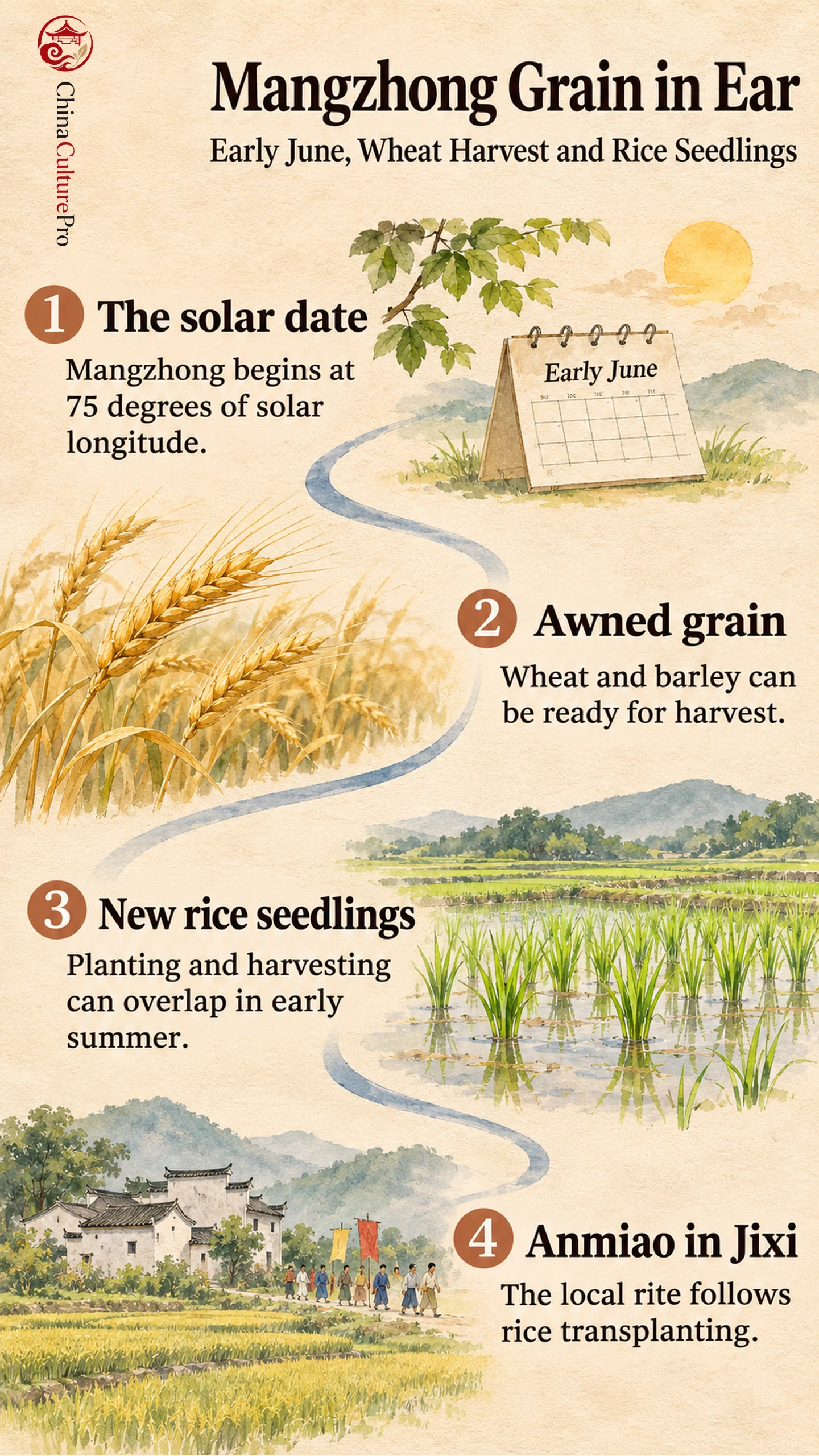
A wheat field ready for harvest and a rice field newly planted with seedlings can belong to the same stretch of early summer. Mangzhong gives a name to this overlap. In parts of southern Anhui, a village rite takes place after the rice seedlings are in the ground. [5][6][7]
Why the Date Falls in Early June
The Hong Kong Observatory lists Mangzhong as Corn on Ear. It follows Grain Full at 60 degrees and precedes the Summer Solstice at 90 degrees. In the 24 solar terms, each of those positions is 15 degrees from Mangzhong. [1]
In 2026, the term fell on day 20 of the fourth lunar month. In 2027, it falls on day two of the fifth. The Gregorian dates stay close because the term follows the Sun. The lunar day shifts because the months begin on different dates in the two years. [1][2][3]
Wheat Harvest and Rice Planting
In the term’s name, mang (芒, máng) refers to an awn, the bristle that extends from an ear of wheat, barley or another awned grain. A Chinese heritage account connects the term with ripe awned grain and the need to harvest it promptly. The early-summer period also involves sowing, transplanting and caring for crops to be harvested later in the year. [4][5]
A Shanghai account describes farmers in parts of the Yangtze region harvesting wheat and transplanting rice shoots around this time. It also records northern examples in which collecting wheat overlaps with planting beans. The exact crops depend on the growing area. Around this point in the summer solar terms, rains in the middle and lower Yangtze can also affect the work. [5][6]
Anmiao in Southern Anhui and Seasonal Plums
The Anmiao Festival (安苗节, Ānmiáo Jié) in Jixi, Anhui, is a rite for newly transplanted seedlings. The Xuancheng culture and tourism bureau records villages choosing a day after Mangzhong once transplanting was complete. In villages including Wangcun and Yucun, participants carried a figure of the ancestor Wang Hua to the fields. The local record calls this part of the rite ‘Wang Hua looks at the rice.’ Villagers prayed for favorable weather and a good crop. [7]
The Jixi account describes a meal of bao guo (包果, bāoguǒ), made with flour from newly harvested wheat. The wheat food belongs to a rite centered on rice seedlings. Farther east, a Hangzhou account places cooking green plums among seasonal customs because the fruit ripens around May and June. New wheat is part of the Jixi observance. The Hangzhou example follows the ripening of a different crop. [7][8]
FAQs About Mangzhong
Does Grain in Ear mean maize?
The Observatory’s English name Corn on Ear can be confusing. The Chinese term refers to awned grain, with wheat and barley among the examples given in official seasonal accounts. [1][4][5]
Does Anmiao always happen on the first day of Mangzhong?
Jixi’s local record describes choosing a day after Mangzhong once rice transplanting was complete. The solar term has its own date. [1][7]
Sources
[1] Hong Kong Observatory. The 24 Solar Terms
[2] Hong Kong Observatory. 2026 Gregorian–Lunar Calendar Conversion Table
[3] Hong Kong Observatory. 2027 Gregorian–Lunar Calendar Conversion Table
[4] Hunan Official Web Portal. 24 Solar Terms, Mangzhong
[5] China Intangible Cultural Heritage Digital Museum. Mangzhong and Early-Summer Customs
[6] Shanghai Municipal Government. Rains and Humidity Mark the Coming of Mangzhong
[7] Xuancheng Bureau of Culture and Tourism. Xuancheng Folk Customs, Anmiao
[8] Hangzhou Political Consultative Conference. Green Plums and the Plum Rain Season