

Quick Answer: What Is China’s UNESCO Tea Heritage?
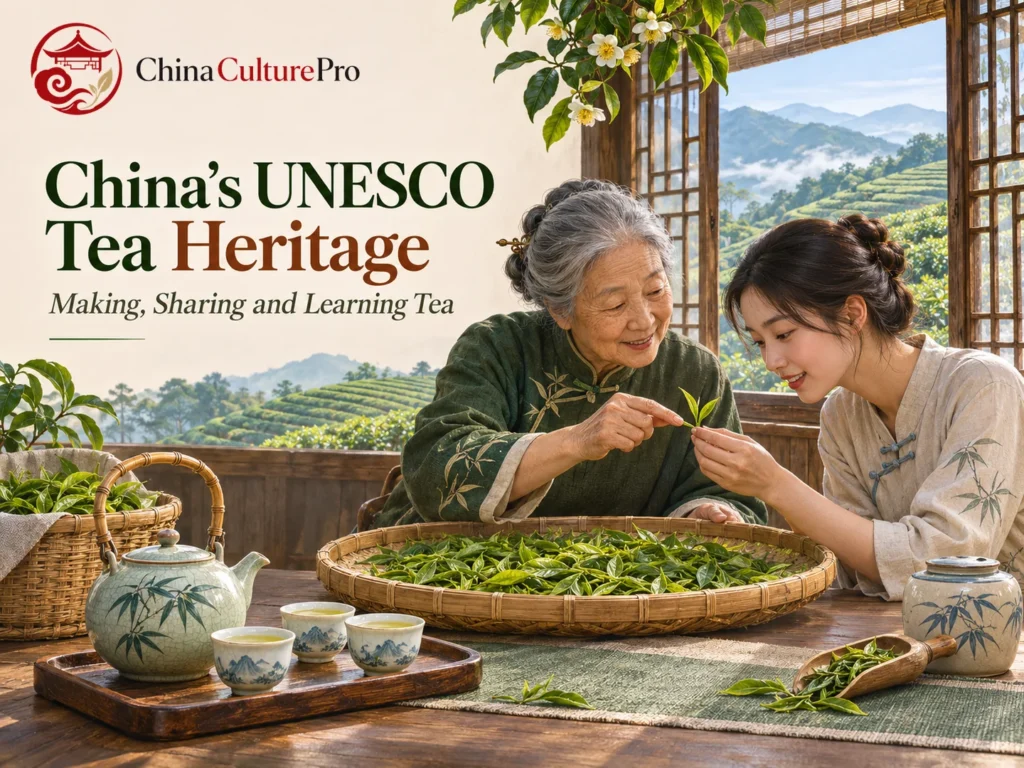
In 2022, UNESCO added China’s traditional tea processing techniques and associated social practices to its Representative List of the Intangible Cultural Heritage of Humanity. The inscription covers skills and customs that people pass on, from tending plants and processing leaves to drinking tea together. Intangible cultural heritage (非物质文化遗产, fēi wùzhì wénhuà yíchǎn) lives through the people who practice it. [1][2]
- Making: Local producers manage gardens, select leaves and process them into different teas.
- Sharing: Tea can welcome a guest, bring people together in a teahouse or mark a family occasion.
- Learning: Family members and apprentices acquire skills through repeated practice and observation.
The national inscription and the World Heritage listing for Jingmai Mountain belong to different UNESCO programs. [1][3]
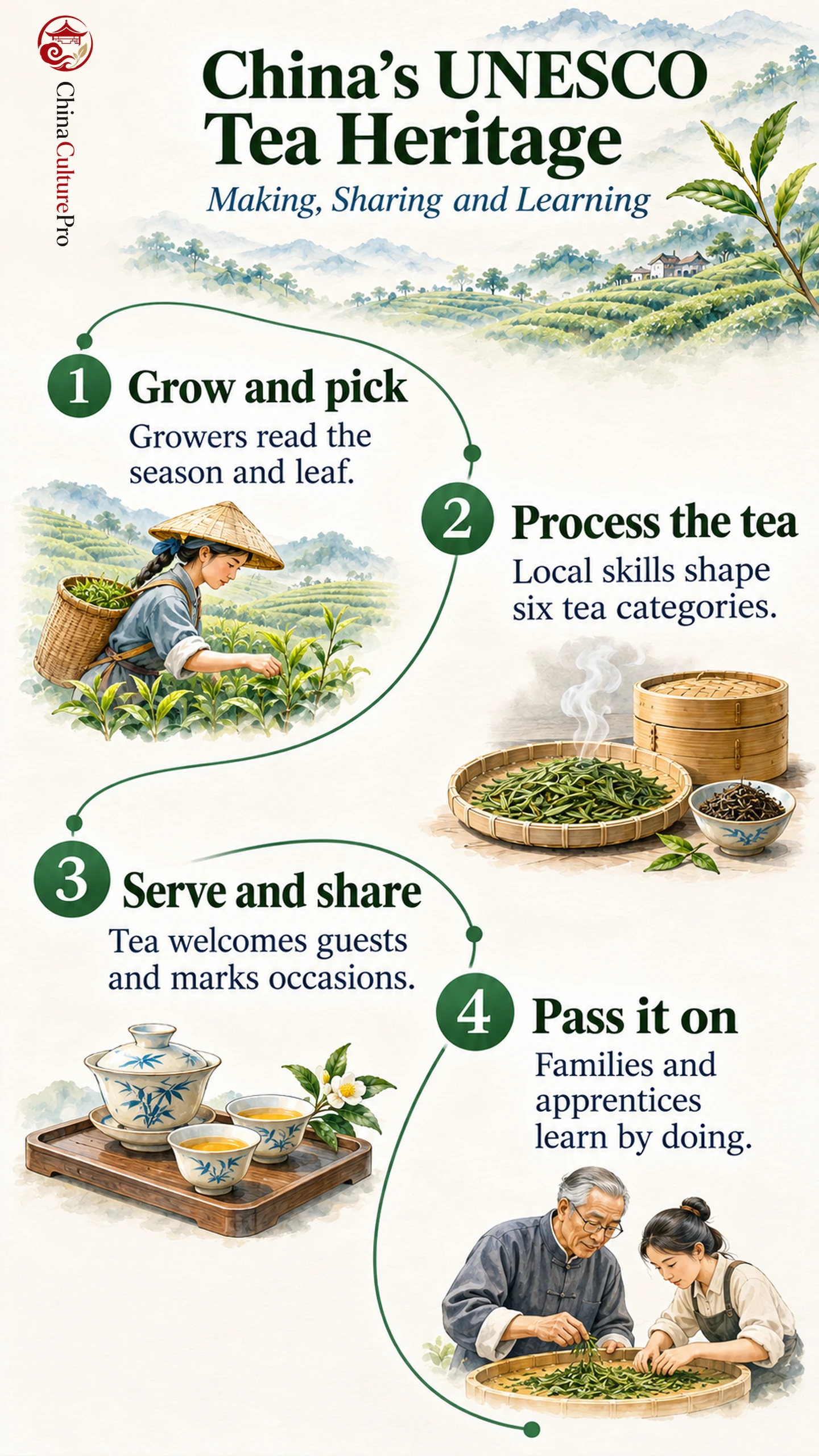
Tea reaches the cup after a series of decisions about the plant, the leaf and how it will be served. The UNESCO entry follows those decisions through the work of growers, makers and hosts.
How Local Knowledge Shapes the Tea
The inscription begins with the work in the garden. Pickers learn which leaves suit a particular tea and when to harvest them. In the workshop, handling, heat, moisture and time create differences that matter in the cup. For example, makers can heat leaves early to curb oxidation in green tea or allow partial oxidation as part of making oolong. [1][2]
The UNESCO entry names six categories, covered in the guide to China’s six major types of tea, and also recognizes teas processed again after the base tea is made. Fuzhou jasmine tea is one example. Fresh flowers lend their fragrance to the prepared leaf during scenting. [1][5]
What Sharing Tea Adds to the Inscription
A cup can open a conversation between neighbors, welcome someone to a home or accompany a wedding. UNESCO also mentions tea served in workplaces, restaurants, teahouses and temples. When neighbors sit down together, tea offers time to talk. At a wedding, it can be part of how families formally greet one another. The broader guide to Chinese tea culture follows these differences in everyday and ceremonial settings. [1][2]
Families and apprenticeships help pass on knowledge. An apprentice can watch a maker check whether the leaves are ready for the next stage. At home, a younger person can learn when and how to serve guests by helping with the tea. Some bearers carry skills that support tea service, such as preparing the pastries that accompany it. [1]
Three Tea Heritage Designations Compared
| Designation | Example | What it recognizes |
|---|---|---|
| UNESCO Intangible Cultural Heritage | Traditional tea processing and associated social practices in China, 2022 | Knowledge, skills and social practices taught and carried on by communities |
| UNESCO World Heritage | Cultural Landscape of Old Tea Forests of the Jingmai Mountain in Pu’er, 2023 | A particular Yunnan landscape of old tea forests, villages and related land use |
| FAO agricultural heritage | Anxi Tieguanyin Tea Culture System, 2022 | A local agricultural system linking cultivation, ecosystems, knowledge and livelihoods |
Jingmai’s World Heritage property includes places shaped by Blang and Dai communities. By comparison, Anxi’s Tieguanyin heritage is recognized by the FAO for a system of tea cultivation and processing in Fujian. The FAO also recognizes the jasmine-and-tea landscape in Fuzhou. The 2022 UNESCO inscription brings together skills and practices shared across many places, including communities with their own distinct tea landscapes. [1][3][4][5]
FAQs About China’s UNESCO Tea Heritage
When did UNESCO inscribe China’s traditional tea practices?
The intergovernmental committee inscribed the element in 2022. Its official decision is 17.COM 7.b.2, and its nomination number is 01884. [1][2]
Is scented tea included?
Yes. The UNESCO entry recognizes flower-scented tea as an example of tea that goes through additional processing after the base tea is made. [1]
Does the inscription include ways of drinking tea?
Yes. Preparing, drinking and sharing tea are part of the entry. UNESCO describes both everyday hospitality and social or ceremonial uses. [1]
Sources
[1] UNESCO Intangible Cultural Heritage. Traditional Tea Processing Techniques and Associated Social Practices in China
[2] UNESCO Intangible Cultural Heritage. Decision 17.COM 7.b.2
[3] UNESCO World Heritage Centre. Cultural Landscape of Old Tea Forests of the Jingmai Mountain in Pu’er
[4] Food and Agriculture Organization. Anxi Tieguanyin Tea Culture System
[5] Food and Agriculture Organization. Fuzhou Jasmine and Tea Culture System