
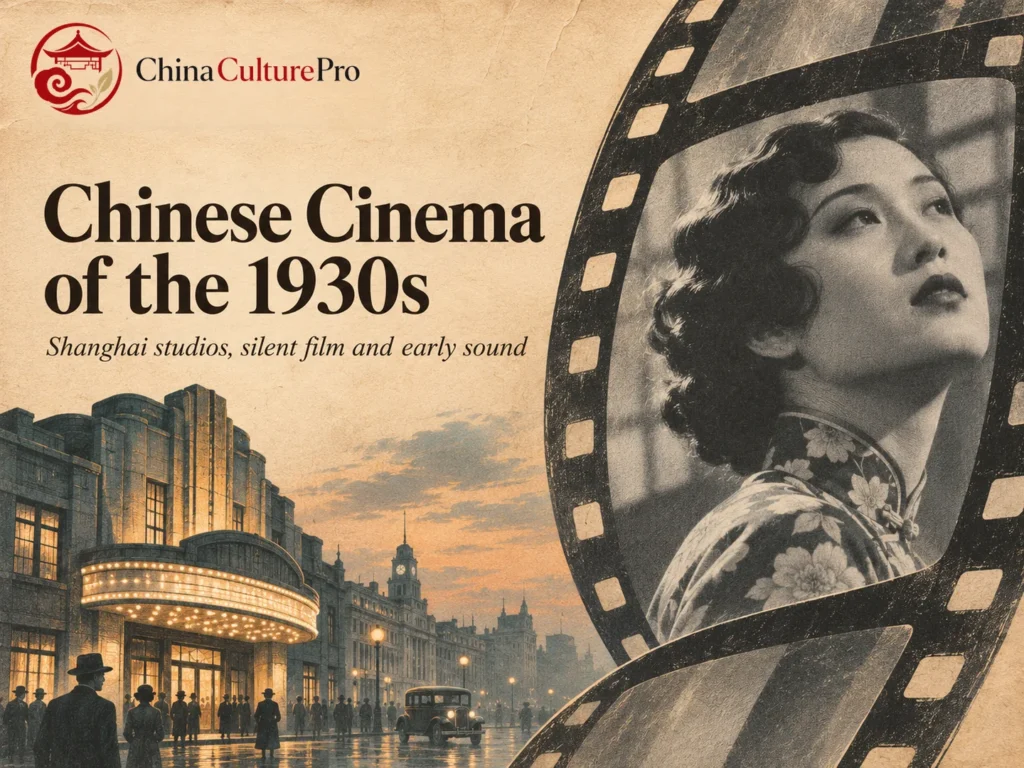

Quick Answer: What Defined Chinese Cinema of the 1930s?
Shanghai was the main center of Chinese filmmaking in the 1930s. Commercial studios released silent and sound films during the same years, and filmmakers used melodrama, comedy and songs to tell stories about work, poverty and city life. Ruan Lingyu’s (阮玲玉, Ruǎn Língyù) The Goddess (神女, Shénnǚ, 1934), Shen Xiling’s Crossroads (十字街头, Shízì Jiētóu, 1937) and Yuan Muzhi’s Street Angel (马路天使, Mǎlù Tiānshǐ, 1937) offer three ways into the period. The fighting in Shanghai in 1937 changed the conditions under which studios and filmmakers could work. [1][2][3][4][5]
- Studios: Lianhua and Mingxing supported distinct productions and stars. [2][3][4]
- Sound: Sound experimentation began early in the decade while major silent films continued to appear. [3][6][7]
- Viewing: Watch how rooms, windows and streets organize the relationships between characters. [3][4][5]
Start with a silent film and an early sound film to hear and see how the storytelling changes.
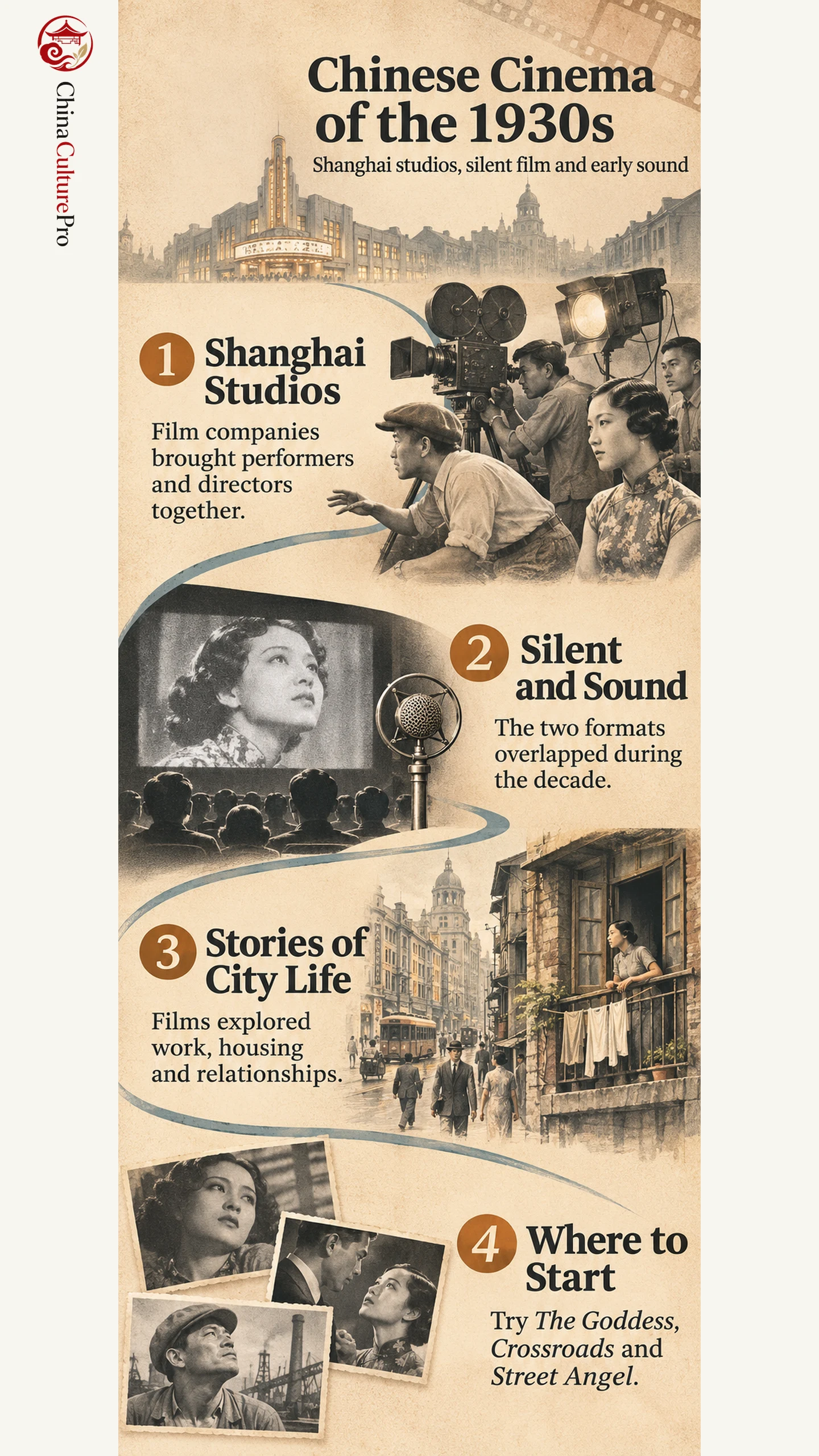
A camera in a cramped Shanghai room could show what a character had to hide. A teahouse song could tell an audience about a life outside the frame. Filmmakers in the 1930s used both kinds of detail to show who had space, money and a chance to make a living in the city. [1][3][4][5]
Why Shanghai Became the Center
Shanghai had established studios, actors and theaters, alongside audiences familiar with films from abroad. Studios such as Lianhua, also called United Photoplay Service, and Mingxing, or Star Film Company, brought together writers, directors and performers. Lianhua made The Goddess. Mingxing made Street Angel. The studio credits help you trace the people and production companies behind the films. [1][2][3][4]
The city’s theaters also brought international films into the local market. Film historian Jason McGrath compares the premise of Crossroads with an earlier Hollywood film about graduates facing unemployment. The comparison shows how similar screen conventions could travel through different cities and serve different stories. It leaves open the question of direct borrowing. [5]
How Silent and Sound Films Overlapped
In 1931 Mingxing released The Songstress Red Peony (歌女红牡丹, Gēnǚ Hóng Mǔdān), an early Chinese sound production. Its recorded singing and dialogue were played from discs. Other filmmakers experimented with a soundtrack on the film itself. A film with recorded sound played from discs and a film with sound recorded on the film strip can mark different historical firsts. [6][7]
The Goddess came out in 1934 as a silent film, while Yuan Muzhi used dialogue and musical numbers in Street Angel three years later. A new score can accompany a restored silent print. The film’s original format and the music in a particular screening are separate details. The guide to Chinese film music gives the broader context for the use of songs and scores. [3][4][6][7]
What Left-Wing Filmmakers Put on Screen
Historians often date Shanghai’s left-wing cinema movement to 1932–1937. Films in and around the movement gave attention to people whose lives were shaped by joblessness, exploitation and unequal access to the city. Writers and directors worked within commercial studios, where they still had to reach paying audiences. [1][2][5]
Street Angel mixes music, comedy and melodrama around working-class characters. Crossroads uses romance and humor as several graduates face joblessness. In these films, a love story or a joke can turn on who can afford a room or find a job. [4][5]
Three Films That Show the Range
| Film | Director | What to Watch For |
|---|---|---|
| The Goddess (1934) | Wu Yonggang | Ruan Lingyu’s controlled silent performance and the way rooms confine her character. [3] |
| Crossroads (1937) | Shen Xiling | How humor and romance sit beside graduates’ uncertainty about work. [5] |
| Street Angel (1937) | Yuan Muzhi | How music and the close quarters of the neighborhood shape relationships. [4] |
Ruan Lingyu was a major star of the silent period. In The Goddess she plays a mother trying to support her son through sex work while facing exploitation. In Street Angel, Zhou Xuan plays a teahouse singer. Set the films side by side to compare what an understated gesture can communicate with what a song can bring into a scene. [1][3][4]
What Changed in 1937
The war disrupted the studios and drew some filmmakers away from Shanghai. Production continued in parts of the city under changing conditions. The Wan brothers’ Princess Iron Fan (1941) belongs to that later wartime chapter, when feature filmmaking was still possible but the industry had been reshaped. For a wider view of the people who worked across periods, see the guide to Chinese film directors. [1][8]
FAQs About Chinese Cinema of the 1930s
Which film should I watch first?
The Goddess is a good entry for silent performance. Street Angel is a good choice if you want to hear how songs work inside a Shanghai neighborhood story. [3][4]
Was Chinese cinema entirely silent in the early 1930s?
Early sound releases appeared in 1931, and silent films continued alongside them. The Goddess is a prominent silent film from 1934. [3][6][7]
Were all Shanghai films part of the left-wing movement?
The movement shaped a prominent body of films from 1932 to 1937. Shanghai had commercial studios and a wider range of films and audiences. [1][2]
Sources
[1] British Film Institute. A Century of Chinese Cinema: An Introduction
[2] Shaoyi Sun, MCLC Resource Center. Building a New China in Cinema: The Chinese Left-Wing Cinema Movement
[3] Hong Kong Film Archive. The Goddess: 4K Digitally Restored Version
[4] UCLA Film & Television Archive. Street Angel and Song at Midnight
[5] Jason McGrath, University of Minnesota Press. Chinese Film: Realism and Convention from the Silent Era to the Digital Age
[6] Zhu Lin, Doshisha University. When Opera Meets Film: Early Chinese Sound Filmmaking in a Transnational Perspective
[7] Chinese Cinema course reader. Chinese Cinema: Early Sound Production
[8] Daisy Yan Du, Journal of Chinese Cinemas. Suspended Animation: The Wan Brothers and Their Animated Encounters with Hong Kong