


Quick Answer: What Is ACG Culture in China?
ACG stands for anime or animation, comics and games. In China it also describes the communities that form around those media. The abbreviation appeared on a Taiwanese bulletin board in 1995 and spread through Chinese-language fan circles. In mainland China, it can encompass both imported works and Chinese productions, as well as activities such as fan art, cosplay and online video commentary. [1][2][3][4]
- Related term: Erciyuan (二次元, èrcìyuán) can refer to fictional worlds, the fans around them or a recognizable style. [2]
- Online example: On Bilibili, timed viewer comments appear over a video at specific moments. [3][4]
- In-person example: An event can bring together screenings, performances, games and people dressed as characters. [5]
The meaning depends on whether the speaker is labeling media, describing a community or talking about a style.
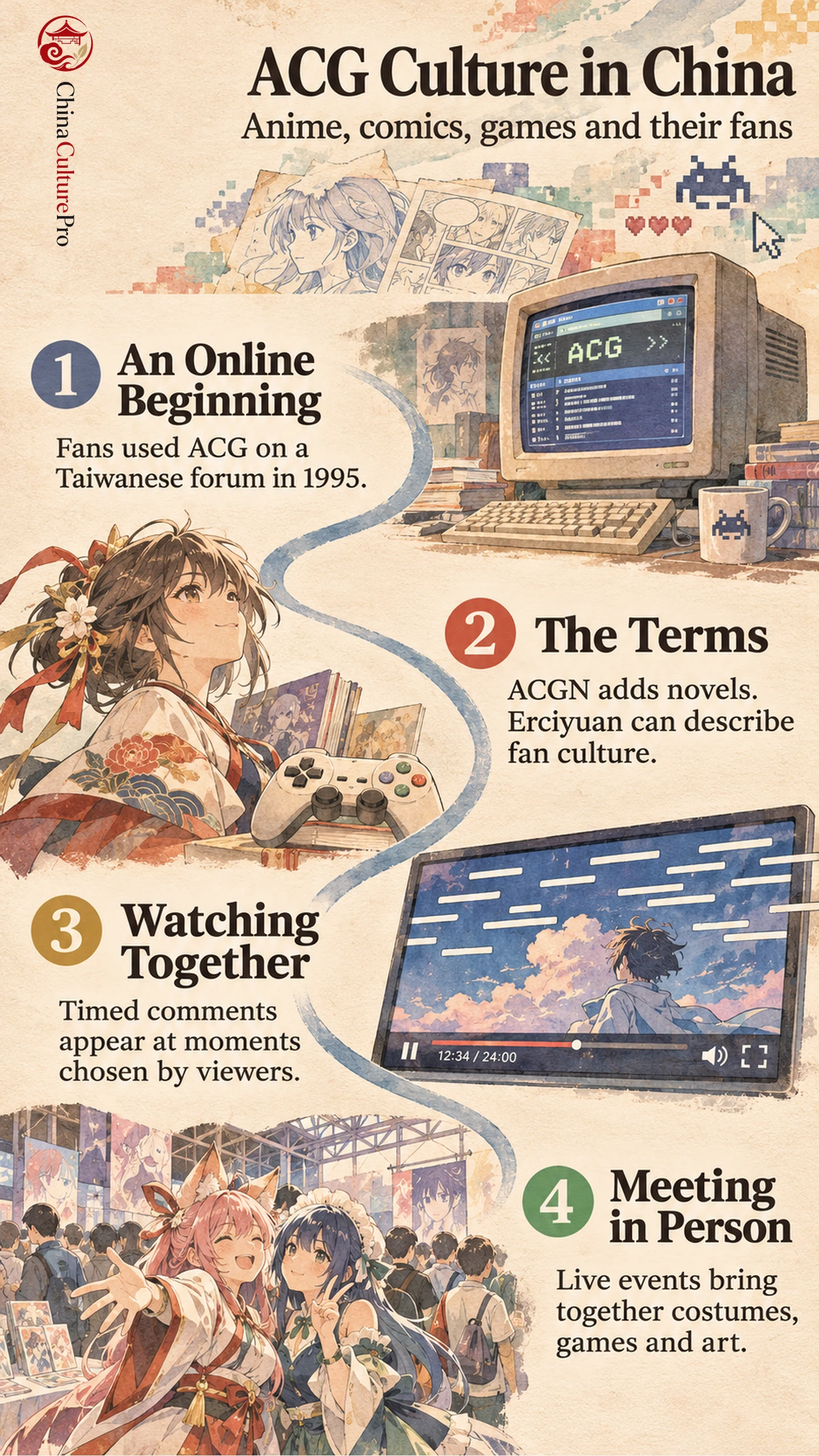
A fan may read a comic, watch its adaptation, make a character costume and share a video of it online. ACG gives that cluster of interests a name. In Chinese usage it can describe what people watch and play, as well as the places they go to meet others who share the interest. [1][2][4][5]
Where the Term ACG Came From
In 1995 a fan created an ACG discussion board on a bulletin-board system at National Sun Yat-sen University in Taiwan. Animation researcher Chen Yan traces how the abbreviation spread from Taiwan to mainland Chinese fan circles. The board gave fans a shared place to discuss Japanese animation, comics and games. [1][2]
Today the label can include locally produced works in the same settings. A game made in China, a Japanese anime series and a Chinese comic can all appear under the same event or community label. ACGN adds novels, often light novels, as an explicit fourth category. Fans may still discuss a novel adaptation under ACG. [1][2][3][5]
ACG, Erciyuan and Dongman in Everyday Use
Dongman (动漫, dòngmàn) combines the terms for animation and comics. Erciyuan can cover the virtual worlds built by these works and the social spaces fans create around them. The table shows what each label tends to emphasize. [1][2]
| Label | Typical Focus | Example in Use |
|---|---|---|
| ACG | A group of media and the fandom around them. [1][2] | A convention advertises animation, comics and games. |
| ACGN | The same group with novels explicitly included. [1][2] | A fan group adds light-novel discussion alongside adaptations. |
| Erciyuan | Fictional worlds and their fan culture or visual style. [2] | A fan describes their interests as part of a shared culture. |
| Dongman | Animation and comics as related forms. [1] | A category brings together animated series and comics. |
The guide to Chinese donghua and Japanese anime explains how the labels for animation shift with language and audience. The guide to Chinese comics covers the publishing and reading side. [1]
What Fans Do Together Online
Bilibili began as an ACG-themed website in 2009 and adopted its current name in 2010. One practice associated with it is danmu (弹幕, dànmù), a stream of comments over the video image. The comment stays attached to a moment in the video, so someone who watches later sees it at the same point. [3][4][6]
If a character unexpectedly returns, viewers can post a repeated phrase at the moment of the reveal. Later viewers see the phrase just as they reach the same scene. Researchers have documented how timing, repetition and shared references make these comments feel like a conversation among people watching together. Video edits, artwork and discussion also give Chinese fan communities ways to share what they notice or make. [4][6]
How Fan Events Bring the Media Together
Bilibili’s company history identifies BilibiliWorld as a live event bringing exhibitions, performances and games together. A visitor might see a game demonstration, a performance and a costume based on a character from the same series. Cosplay in China is one way people bring a character into that shared space through costumes, photography and performance. [4][5]
The label on an event can tell you more about the mix of activities than the origin of a series. Look at whether the event centers on publishers, games, performances or fan-made work. Fans may share character art or perform in costume. A studio may use the same gathering to introduce a new work. [4][5]
FAQs About ACG Culture in China
Does ACG mean anime only?
Anime or animation is one part of ACG. The abbreviation also includes comics and games, and the term is used for communities around all three. [1][2]
Does erciyuan have to be two-dimensional?
The term literally refers to two dimensions, but fans also use it for related styles, fictional settings and community practices that can include physical costumes or objects. [2][4]
Is ACG a Japanese abbreviation?
The abbreviation is documented on a Taiwanese bulletin board in 1995. It was used to discuss forms strongly associated with Japanese popular culture and spread through Chinese-language fan circles. [1][2]
Sources
[1] Chen Yan, Association for Chinese Animation Studies. An Etymological Study of the Terms Dongman, Donghua, and Manhua
[2] China Writers Association. The Origins and Development of Erciyuan Culture in China
[3] Bilibili. Company Overview
[4] Zhen Troy Chen, Global Media and China. Slice of Life in a Live and Wired Masquerade
[5] Bilibili investor relations. 2020 Environmental, Social and Governance Report
[6] Leticia-Tian Zhang and Daniel Cassany, New Media & Society. Making Sense of Danmu: Coherence in Massive Anonymous Chats on Bilibili.com