


Quick Answer: What Is Zhongyong, the Mean?
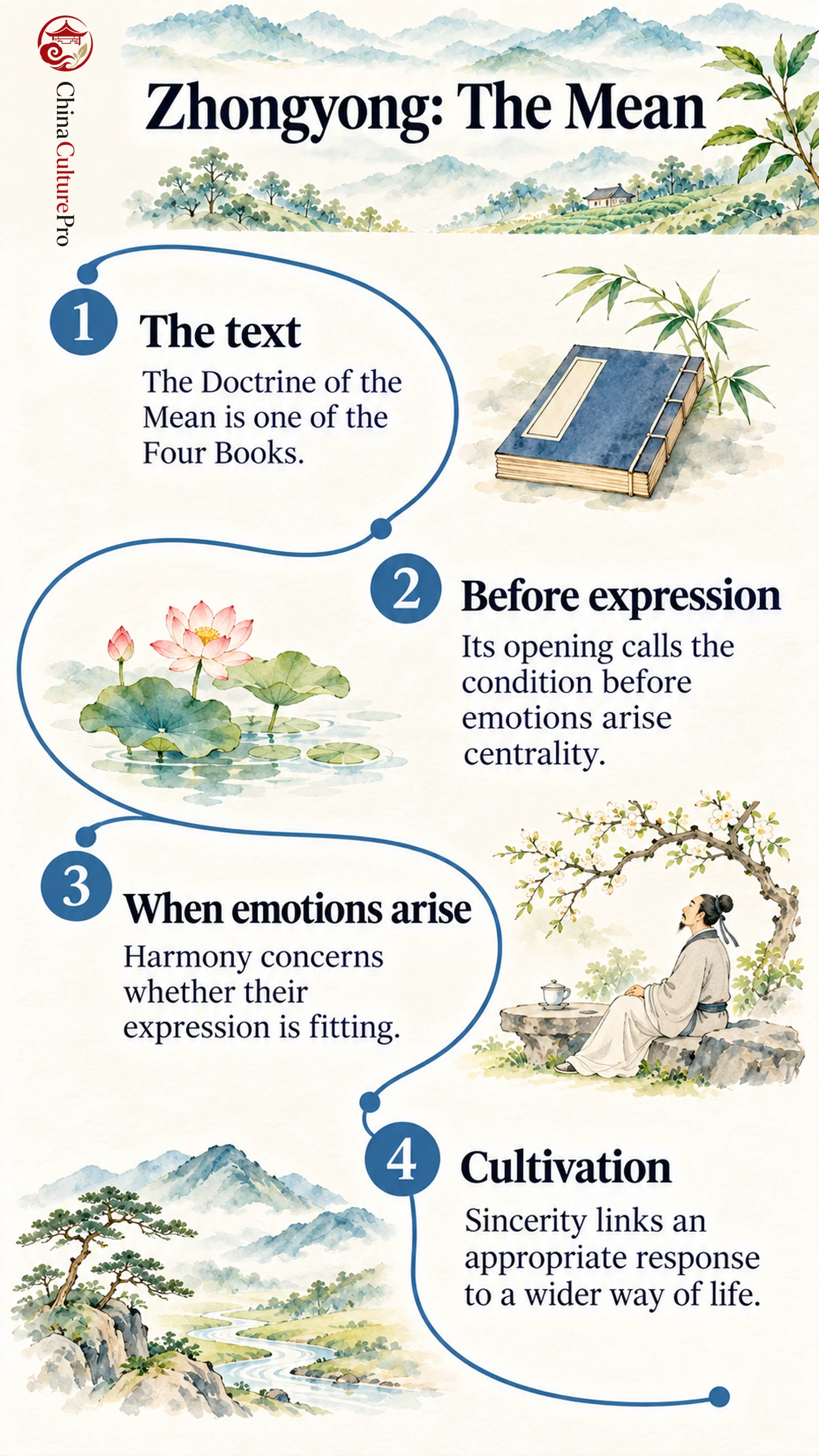
Zhongyong (中庸, Zhōngyōng), commonly called the Doctrine of the Mean, is a Confucian text on fitting conduct and cultivation. Its opening connects what Heaven endows with human nature. It then distinguishes the condition before feelings arise from the appropriate expression of feelings when they do arise.[1][2]
- Text: It became one of the Four Books used to organize Confucian learning.
- Feeling: Joy, anger and other emotions can be expressed in a way that fits a situation.
- Cultivation: Later sections give sustained attention to the work of becoming genuine in one’s conduct.[1][2][3]
The title asks a reader to consider what an occasion calls for. That question is more demanding than choosing a position at equal distance from two extremes.
An appropriate response can be quiet in one setting and strong in another. The opening of the Mean gives readers language for asking how a feeling can emerge and yet have its expression fit what is happening.
Where the Text Sits in the Confucian Classics
The Doctrine of the Mean was transmitted as part of the Book of Rites and later received sustained attention as one of the Four Books. Zhu Xi (朱熹, Zhū Xī) arranged and commented on it within that collection. The Great Learning offers a related example of how earlier material came to be read through his program of study.[1][3]
The opening connects the nature a person receives with following the Way and with education. The sequence provides a setting for the passages on feeling. It raises a question about how nature and endowment can matter to the habits a person develops.[1][2]
Centrality and Harmony in the Opening Chapter
The opening calls the condition before pleasure, anger, sorrow and joy arise centrality (中, zhōng). When feelings arise and their expression fits the situation, the text calls this harmony (和, hé). The distinction is between a condition before expression and the quality of expression when it occurs. The text gives both states a place in cultivation.[1][2]
A person may feel grief in response to a loss, for example. Whether their response is fitting depends partly on the event and relationship. It does not follow that a less intense response is always preferable. The example helps explain why the title’s “mean” need not name a numerical middle between an intense feeling and an absence of feeling.[1][2]
Why Sincerity Matters to a Fitting Response
Sincerity (诚, chéng) becomes important in later sections of the text. The discussion concerns a person’s genuine relation to what they are doing. A gesture can have the outward form people expect, while the broader question is whether it expresses a commitment the person actually sustains. The text connects this work with a wider way of living.[1]
The relation between fitting expression and sincerity helps explain why the Mean is a work about cultivation. A single case can give a reader an example of a response that fits. The wider project concerns how someone becomes capable of acting with that quality across circumstances.[1][3]
FAQs About Zhongyong
Is the Mean a compromise between extremes?
The opening gives more weight to an expression fitting the occasion. A response may take a different form or intensity when the circumstances change, as the relationship or occasion makes different demands.[1][2]
Does the opening recommend suppressing emotions?
It describes a condition before feelings arise and a way for their expression to be harmonious once they do. Appropriate expression is part of the account.[1][2]
Did Zhu Xi write the Doctrine of the Mean?
Zhu Xi edited and commented on an earlier text. His work shaped its place in the Four Books and the way later students read it.[1][3]
Sources
[1] Robert Eno, University of Texas course archive. The Great Learning and Doctrine of the Mean
[2] Four Books Sourcebook. The Doctrine of the Mean, Chapters 1–11
[3] Stanford Encyclopedia of Philosophy. Zhu Xi