


Quick Answer: Who Was Li Tang?
Li Tang (李唐, Lǐ Táng) was a Song court painter whose career connected the Northern and Southern Song painting academies.[1]
- Landscape: His axe-cut texture strokes (斧劈皴, fǔpī cūn) make rocks appear sharply faceted.[2]
- Key work: Whispering Pines in Myriad Valleys bears his signature and the date 1124.[2]
- Range: His reputation also includes historical figure painting, such as Gathering Wild Herbs.[3]
A signed work, an attributed work and a painting formerly assigned to him offer different kinds of evidence.
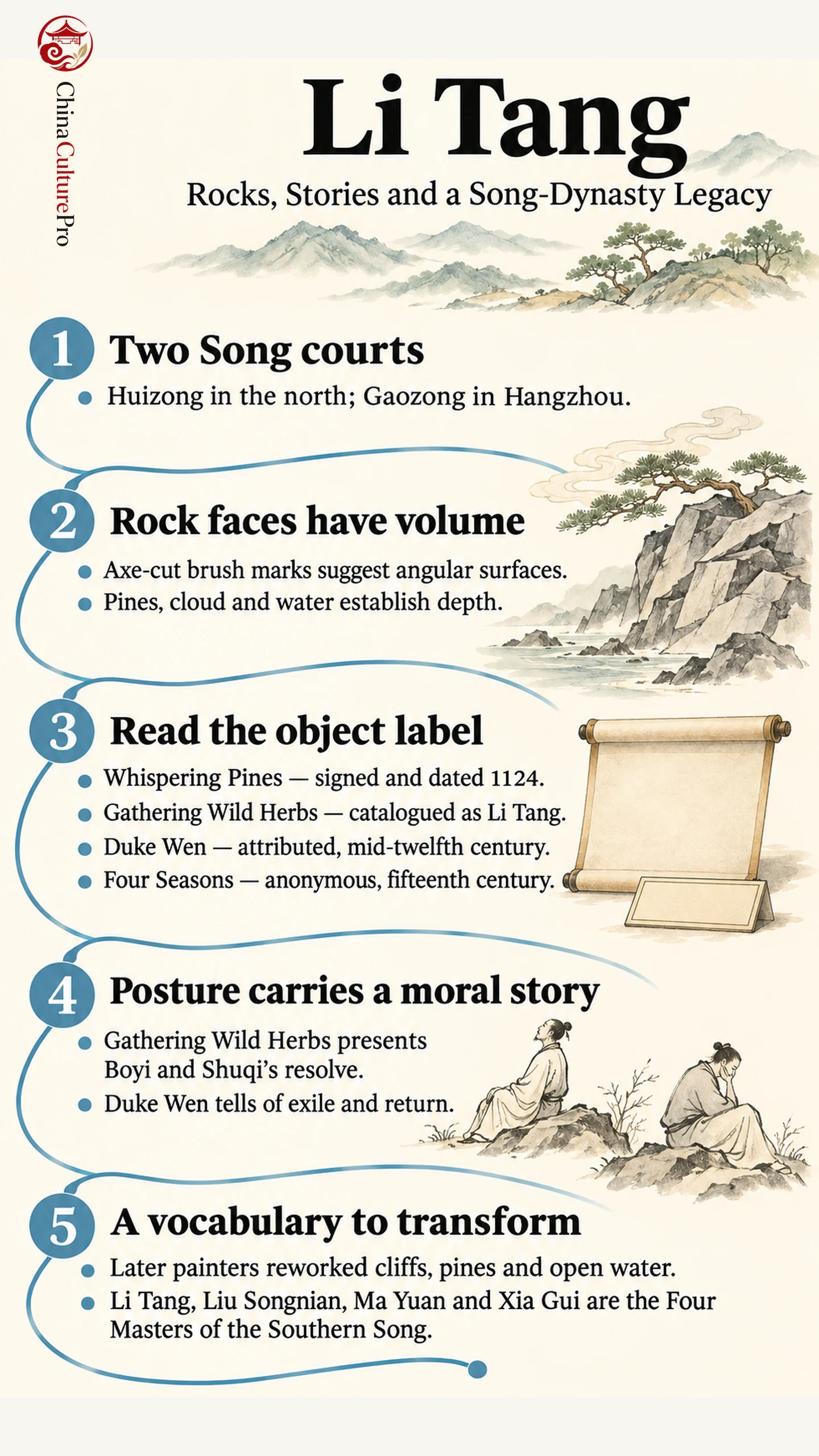
Li Tang’s mountains reward a close look at the edge of a rock. A stroke can establish a face, a shadow or a break in the surface. His figures ask a different question: how can posture make an old story’s moral stakes visible?
A Career across the Northern and Southern Song
Originally from Heyang in Henan, Li Tang served Huizong’s northern Song court before joining Gaozong’s re-established painting academy in Hangzhou.[1][2]
Reading the Rocks and Pines in the 1124 Landscape
Whispering Pines retains a commanding mountain while bringing the foreground woods and streams closer to the viewer. White clouds separate dark forms and give the rocks a softer counterpoint.[1]
The rock mass breaks into angular faces. Light, dark and axe-cut marks give it volume; this does not require a single consistent direction of illumination. Compared with Fan Kuan’s monumental landscape, the mountain presses nearer.[6]
Look from a jagged rock face toward the pine needles, then into the gaps opened by cloud and water. Texture and interval work together: the painting offers depth through overlapping forms, not through ink marks alone.[2]
Four Works and Their Attribution Labels
Use the wording of each object record when comparing these paintings.
| Work | Date and format | Collection and attribution |
|---|---|---|
| Whispering Pines in Myriad Valleys | 1124; hanging scroll, ink and colors on silk; 188.7 × 139.8 cm | National Palace Museum, Taipei; signed and dated.[1][2] |
| Gathering Wild Herbs | Song dynasty; handscroll, ink and light color on silk; 27.2 × 90.5 cm | Palace Museum, Beijing; catalogued as Li Tang.[3] |
| Duke Wen of Jin Recovering His State | Mid-twelfth century; handscroll, ink and color on silk | Metropolitan Museum of Art; attributed to Li Tang, unsigned.[4] |
| Landscape of the Four Seasons | Fifteenth century; handscroll, ink and color on silk | Metropolitan Museum of Art; unidentified artist, formerly attributed to Li Tang.[5] |
The last scroll is evidence for later revival of Song styles. Its former attribution shows why an artist’s name and an object’s present classification must be read separately.[5]
Historical Figures and the Meaning of Loyalty
Gathering Wild Herbs depicts the brothers Boyi and Shuqi, remembered for refusing Zhou grain after the Shang fell. One holds his knees while the other leans toward him. Their thin bodies and attentive poses give moral resolve a physical form. The story has been interpreted as praising steadfastness amid the Southern Song’s confrontation with the Jin.[3]
Duke Wen follows another ancient exile and restoration story. Its writing follows Gaozong’s calligraphic manner, probably through a scribe working for him.[4] These examples make Chinese figure painting essential to understanding Li Tang’s wider reputation.
A Landscape Language Later Painters Transformed
Angular cliffs, distinctive pines and concentrated land masses recur in works by followers, including the Yan brothers. Later masters Ma Yuan and Xia Gui redirected this visual language rather than simply repeating it.[6]
Li Tang is grouped with Liu Songnian, Ma Yuan and Xia Gui as the Four Masters of the Southern Song (南宋四家, Nán Sòng Sì Jiā).[3] Read the grouping as an art-historical comparison, then ask how each painter organizes the viewer’s attention.
For a first comparison of Chinese landscape painting, follow one feature: a cliff edge, a pine or the proportion of empty water. That keeps “influence” visible rather than abstract.
FAQs About Li Tang
Was Li Tang a painter of the Tang dynasty?
No. Tang is part of his name; his signed 1124 landscape belongs to the Song dynasty.[2]
Did he use an axe to paint mountains?
No. “Axe-cut” describes the appearance of brush-made rock textures, not a carving tool.[1]
Are all paintings bearing Li Tang’s name his own work?
No. Some retain qualified attributions; others, including the fifteenth-century Four Seasons scroll, are now assigned to later artists.[4][5]
Sumber
[1] National Palace Museum. Whispering Pines in Myriad Valleys
[2] National Palace Museum. Li Tang’s Whispering Pines: Collection Record
[3] Palace Museum. Gathering Wild Herbs
[4] Metropolitan Museum of Art. Duke Wen of Jin Recovering His State
[5] Metropolitan Museum of Art. Landscape of the Four Seasons
[6] University of California, Berkeley. James Cahill: New Directions in Landscape, Li Tang and His Followers