

Quick Answer: What Changed during the Song Dynasty?
The Song (宋, Sòng) dynasty, dated 960–1279, saw major developments in urban commerce, printed knowledge, official education and the arts. Its technological importance includes new applications and wider use of existing knowledge, as well as inventions.[12][7]
- Cities: Shops, services and busy streets supported expanding urban life.
- Knowledge: Printed books and competitive examinations increased the value of education.
- Commerce: Paper currency and maritime exchange helped move goods and payments.
- Culture: Painting, poetry, calligraphy and ceramics served varied audiences and patrons.
The dynasty shared its wider world with other states. Economic and cultural achievement did not mean uniform prosperity or permanent military security.

Song history becomes especially vivid through the connection between a street scene and a printed page. Both point to a world in which people bought services, sought information and cultivated forms of knowledge with social value.
That world changed substantially after the court lost its northern capital. Begin with the period split, then follow commerce, technology and culture. The Chinese dynasty timeline and broader Chinese history guide provide the surrounding sequence.
Northern and Southern Song: Dates and Capitals
Zhao Kuangyin (赵匡胤, Zhào Kuāngyìn) established the dynasty in 960 after a military coup.[13] Its consolidation followed the fragmented Five Dynasties and Ten Kingdoms period. The new ruling house gradually strengthened its position; founding a dynasty was not the same as instantly controlling every neighboring territory.
| Periode | Conventional dates | Main capital |
|---|---|---|
| Northern Song (北宋, Běi Sòng) | 960–1127 | Kaifeng (开封, Kāifēng) |
| Southern Song (南宋, Nán Sòng) | 1127–1279 | Hangzhou (杭州, Hángzhōu) |
In 1127, conquest of the northern capital forced the court south. The ruling house continued, but with changed territory, resources and strategic problems. The two period names identify that political relocation rather than two unrelated dynasties.[12]
Scholar-Officials and New Arguments about Learning
The examination system gained enormous prestige as a path toward public office. Procedures such as concealing names and recopying scripts sought to reduce favoritism. Examinations assessed literary education and knowledge of classical texts, rather than functioning as modern specialist job tests.[3]
Education remained unequal. Most people were not literate, and families with land, resources and scholarly connections had advantages. The expansion of examination culture should not be confused with equal chances for every resident.[3]
The revival often called Neo-Confucianism (理学, lǐxué) also changed debates about learning, moral cultivation and social order. Zhu Xi (朱熹, Zhū Xī) developed influential interpretations of classical texts and educational practice. Their later authority should not be projected backward as one uncontested doctrine followed throughout the Song.[11]
Scholar-officials could disagree about policy and the responsibilities of government. Shared education provided a language for argument; it did not make political debate disappear.
Cities, Markets and the Work behind Prosperity
Song cities included shops, restaurants, workshops and services alongside residences. Street commerce was more integrated into urban space than in the tightly separated ward-and-market arrangement associated with earlier capitals. Crowded cities also faced poverty and the practical demands of public assistance and fire prevention.[4]
A famous visual source is Qingming shanghe tu (清明上河图, Qīngmíng Shànghé Tú), the early twelfth-century handscroll associated with Zhang Zeduan (张择端, Zhāng Zéduān). Its traffic, buildings and occupations invite close study of urban activity.[5]
The version matters. Later artists copied and changed the composition, sometimes adding features from their own times. A brightly colored later court version should not be labeled as though it were the original Song painting.[5]
Even the earlier scroll is a composed image, not a photograph or a complete record of everyone’s circumstances. Its busy economy depended on farming, transport and labor beyond the most attractive commercial scenes. The useful question is both what the artist shows and what the format leaves outside the frame.
Paper Money and Maritime Connections
Paper currency developed within specific monetary problems. In Sichuan, cumbersome iron coins encouraged merchants to issue paper bills known as jiaozi (交子, jiāozǐ). Problems with private issuers helped lead to government takeover in the 1020s.[6]
The bills became important for regional payments, including public finance and commerce. This history is more precise than imagining that all coins across the empire were replaced at once. Issuers, redemption arrangements and the area of circulation mattered to how paper money worked.[6]
The wider history of Chinese currency follows these changing relationships between metal money, paper instruments and state authority.
Overseas commerce also formed part of the Song economy. Improved ships and navigation supported sea travel, connecting coastal markets with wider exchanges.[8] The Maritime Silk Road history places those ports and routes in their longer development. Trade by sea complemented inland production and transport; it was not a separate economy detached from the countryside.
Printing, Navigation and Military Technology
Woodblock printing predated the Song. Its expansion made it possible to reproduce books and images for wider audiences. Bi Sheng (毕昇, Bì Shēng) developed movable characters made from baked clay during the eleventh century, but movable type did not immediately displace whole-page blocks.[7]
The important comparison is practical. Reusable characters offered one method; carved blocks could remain useful and economical for particular editions. The history of Chinese printing explains why a new technique need not make an older one obsolete.
Navigation combined several tools and skills. Magnetic direction finding, steering systems, hull construction and knowledge of waters contributed to maritime travel. The Song importance of the compass concerns its documented navigational use and development, rather than the first recognition that a magnet aligns north–south.[8]
Gunpowder weapons also developed through military experimentation. A manual of 1044 recorded formulas and applications, while incendiaries, explosive devices and fire-producing weapons changed over time.[9] Grouping such technologies among the Four Great Inventions does not give them all the same origin date.
Painting, Tea and Literati Life
Painting served several purposes. Court artists could present closely observed nature and images of ordered rule; scholar-artists also valued personal expression through brushwork. The monumental landscapes associated with Fan Kuan and Guo Xi (范宽, Fàn Kuān; 郭熙, Guō Xī) belong within this varied artistic world, rather than one timeless national style.[1]
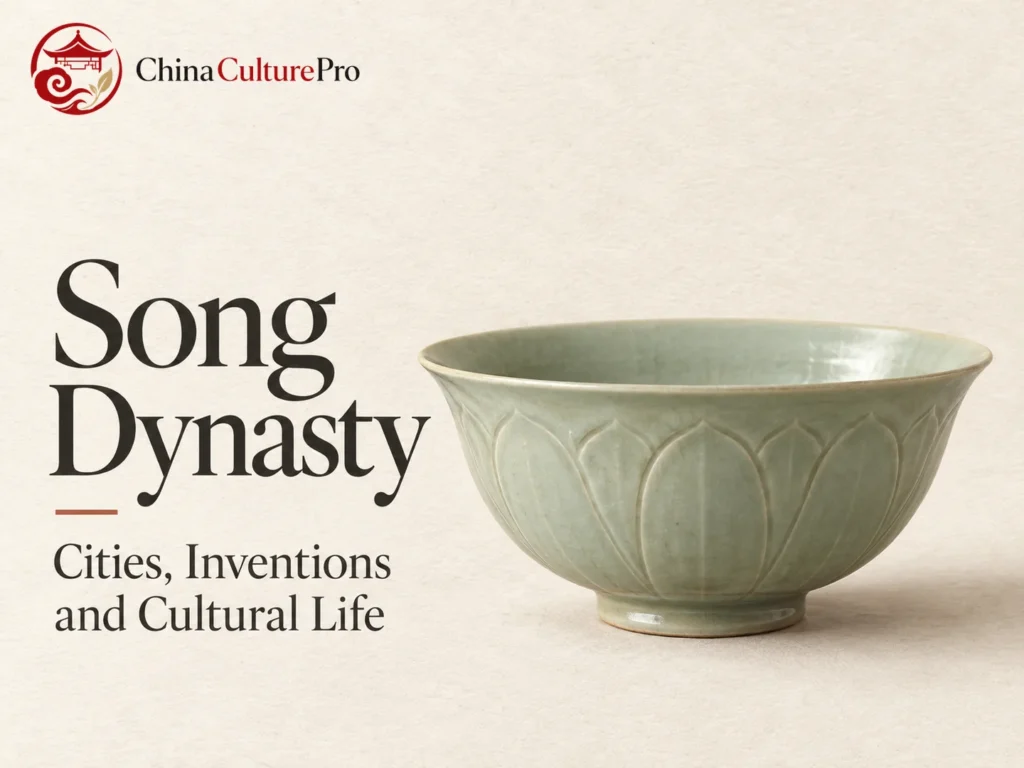
Ceramics likewise connected technical production with changing taste. Refined glazes, carved surfaces and tea bowls show how makers worked with shape, texture and use.[1] Celadon provides a useful path into the relationship between glaze, kiln conditions and aesthetic preference.
Su Shi (苏轼, Sū Shì) offers another point of entry. He combined public office and political controversy with poetry, prose, painting and calligraphy. Educated social life included composing, viewing works, collecting and discussing the arts.[10]
Tea bowls place tea culture within this material setting. An elegant vessel can reveal specialized taste and craft without proving that every household consumed or understood tea in the same way.
Frontier States, Conquest and Song Legacies
The Song operated in a world of neighboring powers, including the Liao (辽, Liáo) and Jurchen Jin (金, Jīn). Warfare and negotiated payments were parts of that relationship. Song prosperity should not be mistaken for uncontested command over the whole region.[2]
Military adaptation also mattered. Defensive systems and developing weapons helped sustain resistance, but rivals could adopt technologies too. Possessing an innovation did not guarantee victory.[9]
The Mongol conquest ended the remaining Song regime in 1279. The Yuan dynasty (元, Yuán) name had already been proclaimed in 1271; those dates mark different events.[12]
Political defeat did not erase printed learning, commercial practices, ceramic skills or artistic models. The dynasty’s legacy is best understood through those interacting developments, alongside the social costs and strategic limits that shaped them.
FAQs About the Song Dynasty
Did the Song invent paper and printing?
Both existed earlier. Song importance lies in expanding printed culture and developing technologies such as baked-clay movable type. The history of invention includes earlier experiments, improvements and later adoption, not one dynasty creating everything at once.[7]
Did movable type immediately replace woodblock printing?
No. Whole-page woodblocks remained useful and competitive. A printer’s choice depended on the work and production conditions, so the appearance of reusable characters did not make carved blocks disappear.[7]
Was the entire Song dynasty ruled from Hangzhou?
No. Kaifeng was the principal northern capital before the court’s retreat in 1127. Hangzhou became the center of the continuing southern regime, which lasted until 1279.[12]
Does commercial prosperity mean the Song had no military power?
No. The dynasty supported armies, defenses and military technology, and resisted powerful opponents for long periods. Economic strength and technical skill shaped its capabilities without removing strategic constraints or ensuring victory.[2][9]
Sumber
[1] Metropolitan Museum of Art. Northern Song Dynasty, 960–1127
[2] Columbia University, Asia for Educators. Northern Rivals: Liao, Jin, Xi Xia and the Mongols
[3] Columbia University, Asia for Educators. Scholar-Officials and the Examination System
[4] Columbia University, Asia for Educators. A New Kind of City Emerges
[5] Columbia University, Asia for Educators. Two Versions of the Qingming Scroll
[6] Cambridge University Press. Northern Song Monetary Policy and the Invention of Paper Currency in Sichuan
[7] Columbia University, Asia for Educators. Printing and Movable Type
[8] Columbia University, Asia for Educators. Shipbuilding and the Compass
[9] Columbia University, Asia for Educators. Gunpowder
[10] Columbia University, Asia for Educators. The Three Perfections and Su Shi
[11] Columbia University, Asia for Educators. Neo-Confucianism and Family
[12] Metropolitan Museum of Art. China, 1000–1400 AD
[13] Palace Museum. Zhao Kuangyin