

Quick Answer: What Was the Jin Dynasty?
The Jin dynasty (晋朝, Jìn Cháo) was the ruling house of the Sima family from 265 or 266 to 420 CE. Historians divide it into the Western Jin (西晋, Xī Jìn) and the Eastern Jin (东晋, Dōng Jìn). The former briefly reunited the kingdoms that had followed the Han, and the latter governed from the lower Yangtze region after the northern court fell.[1][2][3][4]
- Western Jin: The dynasty was founded in 265 or 266 and conquered its last rival in 280. Its northern court fell in 316.[1][2][4]
- Eastern Jin: A member of the Sima family established a new court in the south in 317. It lasted until 420.[2][3][14]
- Cultural life: Calligraphy, poetry and Buddhist travel left records that survive through different forms of transmission.[7][9][11]
The dynasty continued in the south, while political control in the north changed hands.
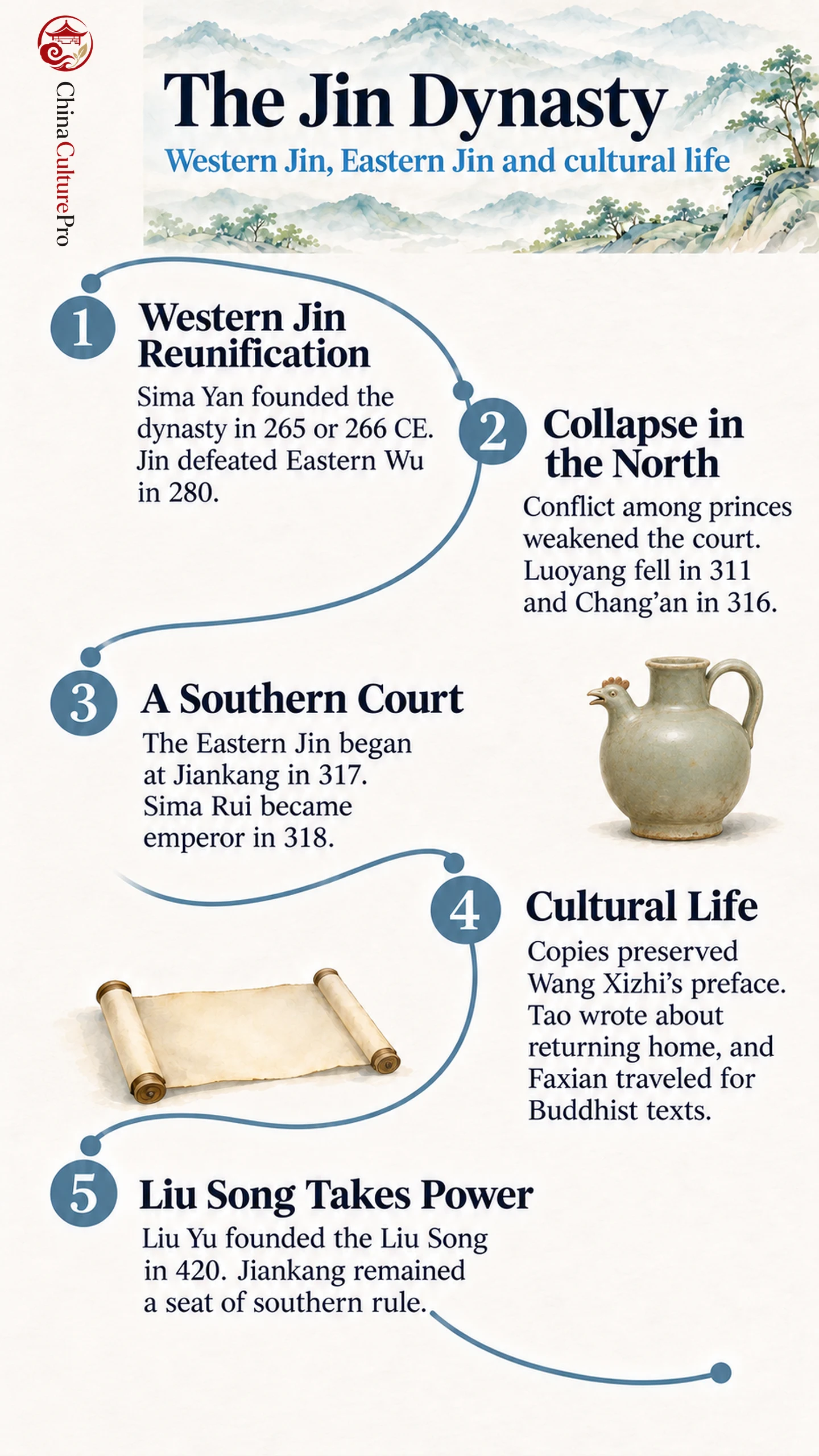
The Jin shift from a reunited court to a southern one can be traced through chronicles, an Eastern Jin celadon ewer and copies of a famous calligraphic preface.[1][2][7][11][13]
How the Western Jin Reunified China
Sima Yan (司马炎, Sīmǎ Yán) inherited the power his family had accumulated in the government of Cao Wei (曹魏, Cáo Wèi). He displaced its ruler and founded the Jin, taking the throne conventionally dated to 265 CE. Some historians give 266 because the traditional and converted calendars place the accession in different years. Both dates refer to the transfer of power from the last Wei ruler.[1]
The new dynasty initially controlled the territories that had come under Wei, including lands taken from Shu. Eastern Wu (东吴, Dōng Wú) remained independent in the south. Jin forces conquered it in 280. The Three Kingdoms period therefore ended after the Western Jin had already been founded.[1][4]
The conquest brought the former rival courts under the same dynasty, with Luoyang as the Western Jin capital. Keeping territories together required an arrangement among powerful officials, military commanders and members of the ruling family. Those arrangements became harder to sustain after the founder’s death.[1][2]
Why the Western Jin Collapsed
After Sima Yan died in 290, struggles over control of the court intensified. The conflict known as the War of the Eight Princes (八王之乱, Bā Wáng Zhī Luàn) involved members of the ruling house and their armies. Control of the capital and influence over the emperor changed hands. The conflict consumed resources and weakened the Western Jin’s ability to respond to political and military rivals outside the court.[1][2]
Forces of a rising northern regime, known as Han at the time and often called Han-Zhao (汉赵, Hàn–Zhào) in modern histories, took Luoyang in 311. A Western Jin court held on at Chang’an for several more years. It fell in 316 when Liu Yao took the city and the emperor was dethroned. The two losses mark different stages of the dynasty’s collapse.[1][2]
Movement south was already underway before the last northern capital fell. Northern elite families left in several waves, carrying connections and administrative experience to places where established southern families also had influence. Migration continued after the founding of the Eastern Jin as different northern regimes rose and fell. The new southern court depended on communities that had arrived at different times. Military appointments also preceded the transfer of the court. In 306 the prince who had prevailed in the fighting gave a member of the ruling house a garrison command at Xiapei, near modern Xuzhou. That posting gave the future founder of the southern court a base before the last northern capital fell.[2][5]
The Eastern Jin Court at Jiankang
Sima Rui (司马睿, Sīmǎ Ruì) established the southern center of Jin rule at Jiankang (建康, Jiànkāng), present-day Nanjing. In 317 he assumed the title of king of Jin. He became emperor in 318. This is why the Eastern Jin is dated from 317 even though the imperial accession came the following year.[2][3]
The court relied on commanders and influential households with different regional ties, including families that had already been established in the south. Their cooperation gave the dynasty ways to govern and field armies. It also meant that emperors shared practical authority with people who could control troops, land and appointments.[2][3][5]
In 383 the Eastern Jin defeated an invasion by Former Qin (前秦, Qián Qín) at the Battle of the Fei River (淝水之战, Féishuǐ Zhī Zhàn). The victory preserved the southern court and weakened its northern opponent. Northern and southern regimes continued to develop along different political lines, even as some Eastern Jin commanders launched campaigns farther north.[2][6]
Eastern Jin material culture also shows the importance of the lower Yangtze. A gray-green celadon ewer with a chicken-head spout illustrates high-fired stoneware associated with the Yue kilns (越窑, Yuè Yáo) in the region. Early examples were made as burial goods. The vessel’s glaze and form are visible, while the precise meaning of the chicken head remains uncertain. It is evidence for a material tradition that flourished in the south, alongside the better-known texts associated with the court.[5][13]
Calligraphy, Poetry and Buddhist Travel
In 353, Wang Xizhi (王羲之, Wáng Xīzhī) and other participants gathered at the Orchid Pavilion near present-day Shaoxing. Wang composed the Orchid Pavilion Preface (兰亭集序, Lántíng Jí Xù) for the poems of the gathering. The original manuscript is lost. Handwritten copies and rubbings taken from engravings kept its composition and calligraphic forms in circulation. The gathering can be dated to 353. A surviving rubbing may have been produced centuries later from an engraving based on an earlier copy. Catalogues distinguish the date of the original work from the date of the surviving object. The Dingwu edition (定武本, Dìngwǔ Běn) circulated through rubbings from a stone engraving. Unlike a hand-traced copy, an engraving could supply many impressions. That process allowed later calligraphers to study the preface even though they had no access to the original brushwork.[7][8]
Tao Yuanming (陶渊明, Táo Yuānmíng) wrote The Return (归去来兮辞, Guīqùláixī Cí) in 405 after leaving an official post. Its preface describes the circumstances that led him to take and then leave the position. The preface connects his decision to take office with practical needs and his departure with the difficulty of remaining in a post that did not suit him. His account presents going home as a choice about livelihood and personal commitments. It is also a crafted representation of himself.[9][10]
The monk Faxian (法显, Fǎxiǎn) left for Buddhist centers in Asia in 399 to seek texts on monastic discipline. He traveled overland to South Asia, spent time in Sri Lanka and returned by sea. His account, known as the Record of Buddhist Kingdoms (佛国记, Fóguó Jì), describes monasteries and practices he encountered as well as the texts he sought. The journey was only one stage in circulating those works. Copies had to be obtained and carried home. Translation projects then made some of that material available to readers and religious communities in Chinese, helping shape the texts used in Chinese Buddhism.[11][12]
How the Jin Gave Way to the Liu Song
The general Liu Yu (刘裕, Liú Yù) had already become the effective ruler of the Jiankang regime before he took the throne. His supporters initially included men associated with northern troops. Over time he built wider ties among the soldiers and wealthy families of the Jiankang regime. Campaigns against Southern Yan in 409–410 and into the Guanzhong region in 417–418 strengthened his standing. In 420, the last Eastern Jin emperor abdicated in his favor. Liu founded the Liu Song (刘宋, Liú Sòng), which continued to govern from Jiankang.[3][14]
The change replaced the Sima ruling house in the south. The Liu Song was the first of the four dynasties usually called the Southern Dynasties. The court continued to draw on officials, families and military forces that had served the preceding government. The year 420 marks a change of dynasty within a continuing southern political center. The Northern and Southern Dynasties guide follows those parallel developments. The Liu Song belongs to this fifth-century succession and predates the Song dynasty that began in 960.[3][14][15]
FAQs About the Jin Dynasty
Why do some timelines start the Jin in 266 instead of 265?
The difference comes from how Sima Yan’s accession is assigned to a year in converted calendars. Both dates refer to the creation of the same dynasty. The conquest that completed its reunification came later, in 280.[1][4]
Did the Eastern Jin rule northern China?
Its political center and main territories lay in the south. It defended itself against northern regimes and mounted campaigns northward, but it did not restore enduring control over the north.[2][3][6]
Is the Jin dynasty the same as the later Jurchen Jin?
The dynasty of the Sima family was written 晋. The Jurchen Jin (金朝, Jīn Cháo) was a different ruling house in northern China from 1115 to 1234. The two names look alike when written without tone marks in English.[1][15]
Sumber
[1] Cambridge University Press. The Cambridge History of China: Western Jin
[2] Cambridge University Press. The Cambridge History of China: Eastern Jin
[3] Cambridge University Press. The Cambridge History of Chinese Literature: From the Eastern Jin Through the Early Tang
[4] Seshat Global History Databank. Western Jin: Political and Chronological Overview
[5] Cambridge University Press. The Cambridge History of China: Southern Material Culture
[6] Academy of Chinese Studies. Famous Battles in Ancient China: Battle of Fei River
[7] National Palace Museum. The Preface to the Orchid Pavilion: Copies and Rubbings
[8] Smithsonian National Museum of Asian Art. Gathering at the Orchid Pavilion
[9] Chinese Text Project. Tao Yuanming’s Collection: The Return
[10] Library of Congress Digital Collections. Tao Yuanming and His Return to Rural Life
[11] Wellcome Collection. Faxian: A Record of Buddhistic Kingdoms
[12] FROGBEAR Research Project. Faxian and Liu Yu’s Inner Circle
[13] The Metropolitan Museum of Art. Chicken-Headed Ewer
[14] Cambridge University Press. The Cambridge History of China: The Southern Dynasties
[15] The Metropolitan Museum of Art. China, 1000–1400 CE: The Jurchen Jin and the Song