


Quick Answer: What Was the Three Kingdoms Period?
The Three Kingdoms (三国, Sānguó) period is conventionally dated 220–280 CE. The Eastern Han (东汉, Dōng Hàn) court lost its throne in 220. Three rival states emerged from the preceding wars, and the Western Jin (西晋, Xī Jìn) conquered the last of them in 280.[1][2][5]
- Cao Wei: Cao Wei (曹魏, Cáo Wèi) ruled much of northern China from 220 to 265 by the usual chronology.
- Shu Han: Shu Han (蜀汉, Shǔ Hàn) governed from the southwest from 221 to 263.
- Eastern Wu: Eastern Wu (东吴, Dōng Wú) asserted independence in 222 and survived until 280.[5][7]
All three states coexisted from 222 until Shu fell in 263.
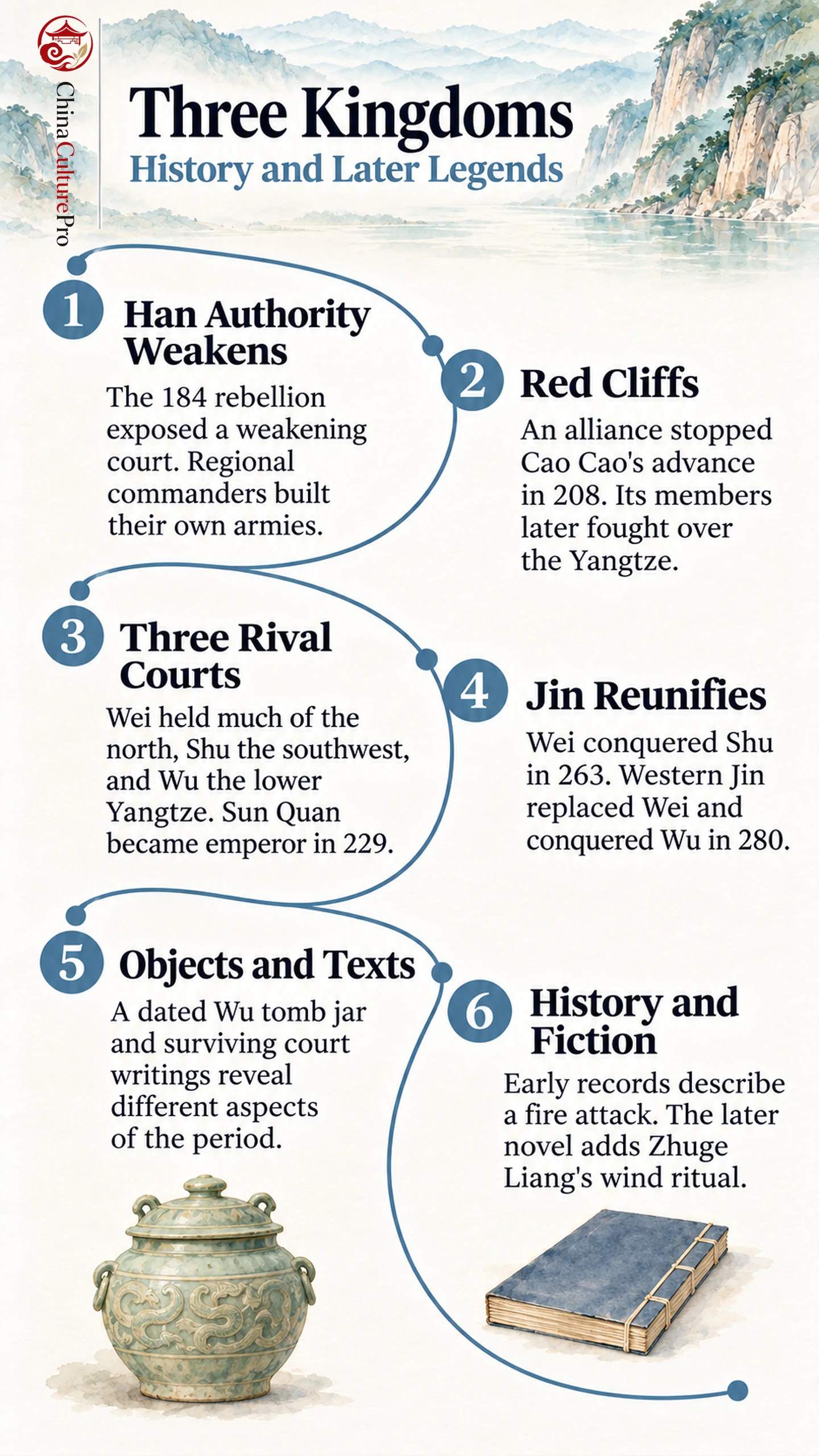
A historical chronology answers a different question from a story about loyalty or strategy. Start with the loss of Han authority, follow the three courts that took shape, and then ask when a familiar episode first appears in the sources. The Chinese dynasties timeline shows where the period sits between the Han and Jin.
How the Eastern Han Lost Control
The Yellow Turban Rebellion (黄巾起义, Huángjīn Qǐyì) broke out in 184. Its suppression did not restore effective central rule. As the court became less able to control the provinces, military commanders acquired troops and resources of their own. The emperor remained on the throne for decades while real power shifted toward competing regional commanders. This gap between formal authority and military power is essential to understanding the end of the Han dynasty.[2]
Cao Cao (曹操, Cáo Cāo) built the strongest northern coalition. In 200 he defeated Yuan Shao (袁绍, Yuán Shào) at Guandu (官渡, Guāndù), where an attack on his rival’s supplies helped turn the campaign. Cao Cao secured much of the northern plain through further campaigns. Control of the north gave him the resources to move south toward the Yangtze.[3]
Red Cliffs and the Shifting Southern Alliance
At Red Cliffs (赤壁, Chìbì) in 208, Liu Bei (刘备, Liú Bèi) and Sun Quan (孙权, Sūn Quán) joined forces against Cao Cao. Liu Bei sent Zhuge Liang (诸葛亮, Zhūgě Liàng) to Sun Quan. Sun’s commander Zhou Yu (周瑜, Zhōu Yú) led forces against Cao Cao alongside Liu Bei’s troops. The early biography of Zhou Yu records illness in the northern army and describes Huang Gai (黄盖, Huáng Gài) using a feigned surrender to send burning ships against the opposing fleet.[3][4]
The defeat prevented Cao Cao from imposing immediate control over the south. In the years that followed, his opponents also fought each other. Sun Quan’s forces seized positions in Jing Province (荆州, Jīngzhōu) in 219, when Guan Yu (关羽, Guān Yǔ), a general serving Liu Bei, was captured and killed. Liu Bei’s counterattack ended in defeat at Yiling (夷陵, Yílíng) in 222. Shu and Wu later renewed their alliance against Wei. They had fought over the same river corridor that had once made them allies.[3]
Wei, Shu and Wu Compared
The states held different parts of the former Han realm and made different claims to authority. Their conventional dates are a useful starting point for reading the period, provided the dates of territorial control and imperial proclamations are kept separate.[5][7]
| Keadaan | Conventional dates | Main territory and founding claim |
|---|---|---|
| Cao Wei | 220–265 | Northern China and the Yellow River heartland. Cao Pi (曹丕, Cáo Pī) took the throne after the last Han emperor abdicated in 220.[2][5][7] |
| Shu Han | 221–263 | The southwest, centered on Chengdu. Liu Bei took the imperial title in 221 and claimed to continue the Han.[5][7][8] |
| Eastern Wu | 222–280 | The middle and lower Yangtze and areas farther south. Sun Quan asserted independence in 222 and took the imperial title in 229.[3][5][7] |
The northern state inherited the advantages of Cao Cao’s land and supply policies. His administration put abandoned fields back into use through state-organized farming settlements called tuntian (屯田, túntián). Farmers received support and returned a share of the harvest. The system helped provision the regime, although ordinary land and household taxation continued in other areas.[3]
Shu’s armies reached the northern front through mountain passes, while Wu relied on naval defense along the Yangtze. Those routes help explain why the northern court’s larger territorial base yielded no immediate victory.[3][7]
How Western Jin Ended the Division
The decisive change began inside Wei. In 249, Sima Yi (司马懿, Sīmǎ Yì) seized control at court, establishing the basis for his family’s rise. In 263 a Wei invasion reached the Chengdu area and the last Shu ruler, Liu Shan (刘禅, Liú Shàn), surrendered.[3][6]
Sima Yi’s grandson Sima Yan (司马炎, Sīmǎ Yán) then displaced Wei and founded Western Jin, conventionally dated 265. Some chronologies use 266 because of the conversion between calendars. Wu still ruled in the southeast, so the dynastic change at Wei’s court did not end the division.[6]
In 280, Jin conquered Wu and its last ruler, Sun Hao (孙皓, Sūn Hào), surrendered. Jin thereby brought the three states’ principal territories under one court. That settlement was brief. The Jin dynasty guide follows the later collapse in the north and the continuation of a Jin court in the south.[1][6][7]
What Tombs and Surviving Texts Reveal
A funerary jar dated 272, excavated near present-day Nanjing, offers evidence from Wu’s last decade. A jar from the tomb identified as Cao Cao’s in Anyang gives a northern counterpart from the early third century. Their archaeological contexts place objects in particular settings and times. These finds cannot establish how a general felt about a rival, or confirm dialogue remembered centuries later.[7]
Surviving texts are uneven, too. Wei’s writers are prominent in later literary collections, but Wu supported its own historians and developed court ritual music. Looking at the distribution of surviving texts alongside excavated objects changes the picture of what the rival courts did. The court with the richest surviving anthology is not necessarily the only one that produced literature or invested in ceremony.[8]
How History Became Romance
The Records of the Three Kingdoms (三国志, Sānguó Zhì), compiled by Chen Shou (陈寿, Chén Shòu) under Western Jin, is an early history organized around the three states. Pei Songzhi (裴松之, Péi Sōngzhī) completed an extensive commentary in 429. His notes preserve excerpts from some works that are now lost and present accounts that sometimes disagree with one another. An annotation may therefore represent a different source from the main narrative on the same page.[9]
The much later Romance of the Three Kingdoms (三国演义, Sānguó Yǎnyì), traditionally attributed to Luo Guanzhong (罗贯中, Luó Guànzhōng), turns the rivalry into a novel about rulership, strategy and loyalty. Its earliest known printed edition is associated with 1522, long after the third-century events and after earlier stages of textual development. The novel gives Liu Bei’s cause a sympathetic moral focus, which is a literary interpretation of the contest over legitimacy.[10]
Red Cliffs shows how to read the difference. The early biography attributes the fire-ship plan to Huang Gai and places Zhou Yu at the center of Sun Quan’s military response. In chapter 49 of the novel, Zhuge Liang performs a ritual to summon a favorable wind. The biography describes wind spreading the fire and gives Huang Gai the tactical initiative. The two accounts show how a later writer could retain the battle while shifting attention to a different character. The era’s cultural afterlife also includes temple murals portraying Guan Yu as an object of devotion, a role that developed after his lifetime.[4][7][11]
FAQs About the Three Kingdoms Period
Why does the Three Kingdoms period start after Red Cliffs?
Red Cliffs took place in 208 while the Eastern Han still formally existed. The conventional start of 220 marks the last Han emperor’s abdication and the founding of Wei. The battle belongs to the history of how the three rival states formed.[2][3][5]
Who won the Three Kingdoms period?
Western Jin reunited the principal territories of the three states. Wei conquered Shu in 263, the Sima family replaced Wei with Jin, and Jin defeated Wu in 280.[1][3][6]
Is Romance of the Three Kingdoms historically accurate?
The novel uses historical people and events but recasts them through invented or elaborated scenes and literary judgments. Use it to understand how later readers imagined the period, and compare a particular claim against the early historical record and its annotations.[9][10]
Sumber
[1] Smithsonian National Museum of Asian Art. Period of Division
[2] Cambridge University Press. The Cambridge History of China: Introduction to the Ch’in and Han Empires
[3] Australian National University. The Three Kingdoms and Western Jin: A History of China in the Third Century AD, Part I
[4] Chinese Text Project. Records of the Three Kingdoms: Biography of Zhou Yu
[5] Cambridge University Press. Three Faces of Sun Tzu: Chronology of Chinese History
[6] Cambridge University Press. The Cambridge History of China: Western Jin
[7] Tokyo National Museum. Three Kingdoms: Unveiling the Story
[8] Harvard University. Remaking History: The Shu and Wu Perspectives in the Three Kingdoms Period
[9] Presses de l’Inalco. Records of the Three Kingdoms
[10] University of Washington Press. Romance of the Three Kingdoms: The Mencian View of Political Sovereignty
[11] Chinese Text Project. Romance of the Three Kingdoms: Chapter 49