

Quick Answer: What Is the Tang Dynasty Known For?
The Tang (唐, Táng) dynasty ruled from 618 to 907 and is especially associated with imperial expansion, influential poetry and cultural exchange. Its cities, court and workshops brought together people, objects and ideas from different regions.[1][2]
- Empire: Strong rulers built on earlier institutions, while power changed considerably across the period.
- Poetry: Poems served artistic, social and political purposes, including reflection on war.
- Exchange: Envoys, merchants, migrants and pilgrims helped connect East and Central Asia and maritime networks.
- Art: Ceramics, metalwork, painting and religious images show both local skill and adapted influences.
The familiar “golden age” label describes notable achievements, not equal prosperity or uninterrupted tolerance for everyone.

A glazed horse, a poem about separation and a printed Buddhist scroll can all belong to Tang history. Each reveals a different part of an empire whose cultural influence extended well beyond its political lifespan.
Institutions, patronage, movement and conflict all shaped this culture. The Chinese history overview gives the broader setting, while the dynasty timeline places its interrupted rule and later fragmentation in sequence.
From Sui Foundations to Tang Imperial Rule
The preceding Sui dynasty (隋, Suí) had restored political unity and developed institutions that the Tang inherited. Li Yuan (李渊, Lǐ Yuān) founded the new dynasty in 618, during the breakdown of that earlier regime.[9]
Emperor Taizong (唐太宗, Táng Tàizōng), who ruled from 626 to 649, strengthened the early empire through government and military campaigns. The imperial court’s reach, however, was never simply the same as direct control over every place connected to it.[1]
Wu Zetian (武则天, Wǔ Zétiān) later ruled as emperor of her own dynasty, commonly distinguished as Wu Zhou (武周, Wǔ Zhōu), from 690 to 705. Tang rule was restored afterward. Her reign belongs within the era’s cultural history, while the change of dynastic name should remain visible in its political chronology.[8]
The long reign of Emperor Xuanzong (唐玄宗, Táng Xuánzōng), from 712 to 756, encompassed celebrated cultural patronage and the onset of a devastating rebellion.[1] That combination helps explain why “early,” “high” and “late” Tang are useful distinctions rather than interchangeable labels for one stable age.
Governing the Empire and Its Capitals
Chang’an (长安, Cháng’ān), near modern Xi’an, was a major imperial center. Luoyang (洛阳, Luòyáng) also held an important place in court and urban life. Palaces, officials, markets and religious institutions brought different forms of authority into these cities.[2][6]
The imperial examinations provided an important route into government and helped give literary ability political value. Family standing and patronage still mattered; a successful examination was not the only way to gain office.[1]
Governing an empire required revenue, communication and military resources as well as accomplished writing. Campaigns drew men and supplies away from communities, connecting court ambitions with household pressures.[5]
The cities’ cultural richness should therefore be read alongside the systems that supported them. A grand capital was both a place of opportunity and a concentration of imperial demand.
Chang’an and the Meaning of Cosmopolitan Culture
“Cosmopolitan” is useful when it identifies actual exchanges. Textiles, vessels, musical practices, clothing and religious images crossed regional boundaries and were adapted by people who encountered them. Diplomacy, conquest, commerce and pilgrimage all contributed.[2]
The Silk Road network connected the empire with Central Asian communities and routes farther west. Maritime trade linked southern ports with other Indian Ocean regions. The movement of silk belonged to these larger networks of goods and knowledge.[2]
Such connections did not amount to modern freedom of travel or universal equality. Legal restrictions shaped contact, and the opportunities available to court elites differed from those of ordinary subjects. “Cosmopolitan culture” should specify whose experience and which setting it describes.[3]
Objects can make exchange visible without answering every demographic question. A tomb figure representing a foreign musician shows that such a subject mattered to its makers and patrons. It is not a census of the capital’s population or proof that all migrants had similar lives.
Poetry as Art, Social Practice and Witness
Tang poetry mattered beyond private self-expression. Literary ability helped people participate in educated social circles, communicate with patrons and make claims about public responsibility. Verse also gave form to friendship, travel, landscape, longing and loss.[1][4]
Three useful starting points for comparing poetic voices are Li Bai (李白, Lǐ Bái), Du Fu (杜甫, Dù Fǔ) and Wang Wei (王维, Wáng Wéi). Wang Wei’s writing of retreat, Du Fu’s attention to public suffering and the varied imagery of Li Bai offer different paths into the period’s literature.[4][5]
Du Fu’s “A Song of War Chariots” offers a concrete example. Its depiction of conscription, family separation and neglected fields exposes the costs beneath imperial military ambition. Reading it changes what a triumphal account of expansion can leave out.[5]
A poem is still a crafted work, with selected images, speakers and conventions. It can illuminate moral concerns and lived pressures without functioning as a statistical report. The wider guide to Chinese poetry explains how forms and historical contexts shape that reading.
Religious Patronage and Its Limits
Buddhism (佛教, fójiào), Daoism (道教, dàojiào) and classical ethical learning all shaped Tang institutions and culture. Their relationships, often discussed through the Three Teachings, included accommodation and rivalry rather than permanent agreement.[4]
The monk Xuanzang (玄奘, Xuánzàng) traveled to India and returned with texts that contributed to Buddhist translation and scholarship. The historical translator should be distinguished from the later fictional adventures associated with him.[9]
Chinese Buddhism received powerful patronage, while religious Daoism also competed for imperial support. Patronage could change sharply: persecution of Buddhist institutions in the 840s, especially 845, damaged monasteries and clergy. It did not erase Buddhist practice or prove that every subject had rejected foreign ideas.[3][9]
Religious diversity and religious security are different questions. An empire could host multiple traditions while rulers restricted particular communities or redirected their resources.
Ceramics, Painting and the Printed Page
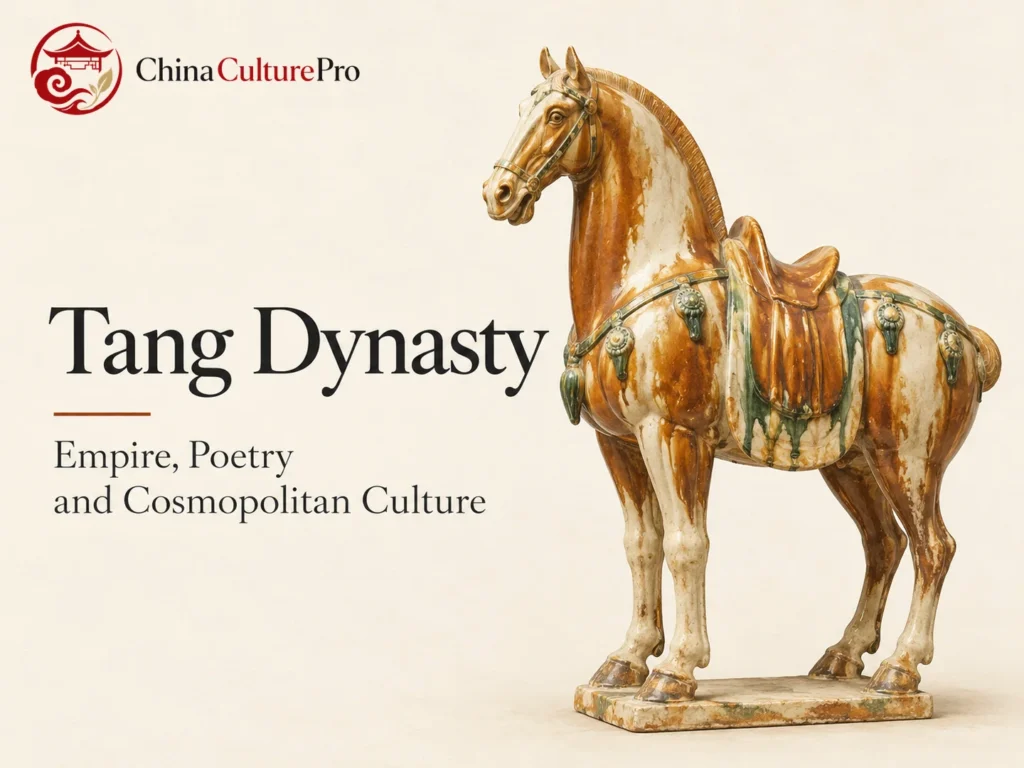
Tang sancai (三彩, sāncǎi) refers to a family of multicolored glazed wares, famously including tomb figures of horses, camels and attendants. The name means “three colors,” but it should not be used to classify every Tang ceramic. White wares and celadons also developed during the period.[6]
Painting flourished through court and other patronage. Studying Chinese painting requires attention to what survives: an original object, an attributed work and a later copy preserve different kinds of evidence. A copy may transmit an earlier composition while also reflecting the materials and choices of a later maker.[6]
Printing adds a securely dated landmark. The surviving Diamond Sutra (金刚经, Jīngāng Jīng) scroll dated 868 is a complete, explicitly dated printed book. Those qualifiers matter: earlier printing exists, so the scroll does not date the invention of printing itself.[7]
Woodblock printing made repeat impressions from carved blocks. It should be distinguished from the later technologies covered in the broader history of Chinese printing.
Rebellion, Late Tang Change and Cultural Legacy
The An Lushan Rebellion (安史之乱, Ān Shǐ zhī Luàn), from 755 to 763, devastated central regions and weakened the court. It did not end the dynasty: Tang rulers continued for roughly another century and a half.[1][5]
Later conflict altered political authority and damaged cultural institutions, but exchange did not simply stop after the rebellion. Religious connections and interest in outside music continued in changing forms. Describing the whole later period as a retreat into uniform isolation conceals that history.[3]
The dynasty ended in 907, followed by the Five Dynasties and Ten Kingdoms.[9] Poetry, artistic models and religious traditions crossed those political boundaries. Tang’s lasting importance lies in the cultural resources later generations continued to read, adapt and contest.
FAQs About the Tang Dynasty
Was Tang China a golden age for everyone?
No. The label highlights cultural and political achievements, particularly those visible in elite records and art. Warfare, compulsory service, unequal resources and restrictions on particular communities also formed part of Tang life.[3][5]
Were all Tang ceramics three-colored?
No. Multicolored sancai wares are famous examples, especially in burial contexts, but Tang potters also made white and green-glazed ceramics. A dynasty label is broader than one glaze tradition.[6]
Did the An Lushan Rebellion end the dynasty?
No. The rebellion lasted from 755 to 763, while the dynasty’s conventional endpoint is 907. It changed the balance of power profoundly without immediately replacing the ruling house.[1][5]
Why do some Tang paintings survive as later copies?
Paintings on fragile supports can be lost while copied compositions continue to circulate. A later copy may preserve evidence of an earlier design, but it should be labeled with its own date and attribution rather than presented as an unquestioned Tang original.
Sumber
[1] Metropolitan Museum of Art. Tang Dynasty, 618–907
[2] Metropolitan Museum of Art. Internationalism in the Tang Dynasty
[3] Cambridge University Press, Modern Asian Studies. Tang Cosmopolitanism: Towards a Critical and Holistic Approach
[4] Columbia University, Asia for Educators. The Three Teachings and Three Prominent Poets of the Tang Era
[5] Columbia University, Asia for Educators. Du Fu: A Song of War Chariots
[6] Smithsonian National Museum of Asian Art. Tang Dynasty, 618–907
[7] British Library, International Dunhuang Programme. Buddhist Texts: The Diamond Sutra
[8] Cambridge University Press. When the Emperor Is a Woman: The Case of Wu Zetian
[9] Metropolitan Museum of Art. China, 500–1000 AD