
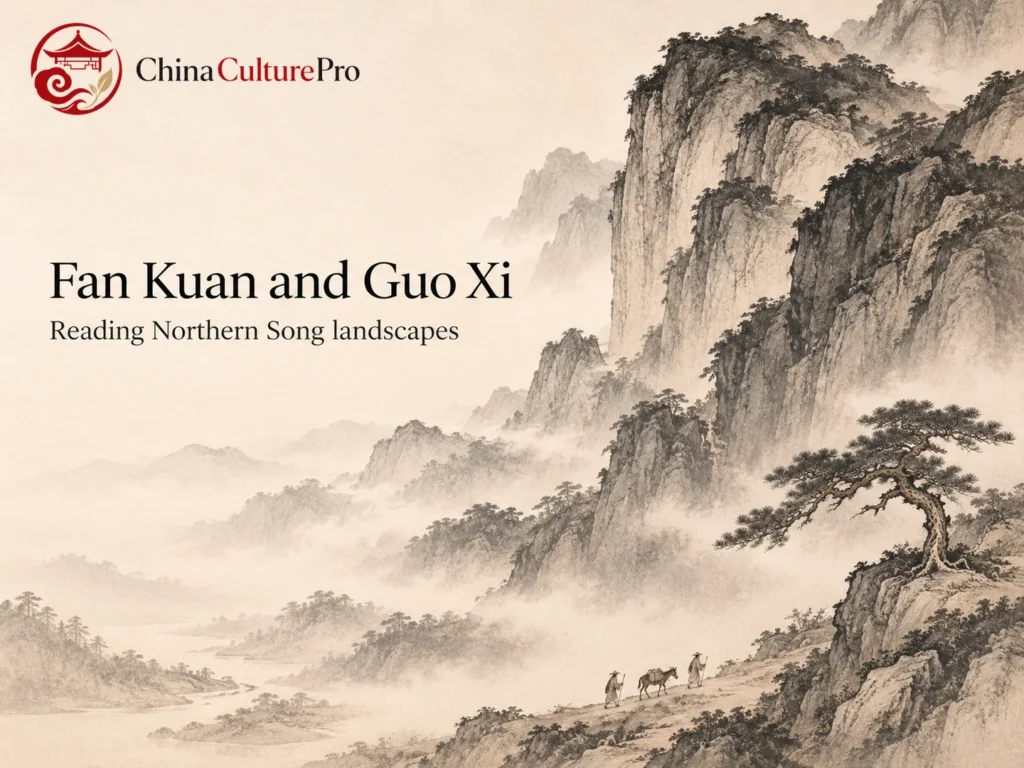

Quick Answer: How Do Fan Kuan and Guo Xi Differ?
Fan Kuan (范宽, Fàn Kuān) and Guo Xi (郭熙, Guō Xī) were Northern Song landscape painters. Fan’s Travelers Among Mountains and Streams (谿山行旅图, Xīshān Xínglǚ Tú), made around 1000, sets tiny travelers below a massive peak. Guo’s Early Spring (早春图, Zǎochūn Tú), dated 1072, draws the eye through a shifting arrangement of valleys, trees and mist. [1][2][3]
- Fan Kuan: Find the travelers first. Their small scale makes the mountain’s height palpable. [1][2]
- Guo Xi: Follow a passage where ink fades, then see where rock forms become clear again. [3]
- Viewing directions: Guo Xi’s Three Distances (三远, sānyuǎn) distinguish looking up, looking into depth and looking across space. [4][5]
Both painters use a tall format and a large mountain. The difference lies in how each asks the viewer to move through it. [1][2][3]
At first glance, the mountains dominate both paintings. Look again at the lower edge. A path, a traveler or the bend of a tree can set your eye on a different route through each scroll. That is a useful way to compare these two Chinese artists.
Fan Kuan: A Mountain Measured by Travelers
The painted silk of Travelers Among Mountains and Streams measures 206.3 by 103.3 centimeters. Large foreground rocks establish a near edge. Beyond them are wooded slopes, buildings and the line of a path. The central mountain occupies much of the upper field, with a slender waterfall descending on its right. The waterfall gives you a vertical line to follow against the dark mass of rock. The light gap and the darker rock surfaces let the eye distinguish the foreground, middle ground and far peak. [1][2]
Find the pack animals and people in the lower right. Their size gives the mountain a human measure. Dense touches of ink on the cliff face make its mass visible, while the thin pale waterfall describes a much longer vertical fall. The comparison depends as much on texture and line as on the relative sizes of forms. Those are distinct Chinese painting techniques. [1][2]
Guo Xi: A Landscape Seen Through Mist
Guo Xi painted for the Northern Song court. A small inscription above the valley on the left dates Early Spring to 1072. The silk painting measures 158.3 by 108.1 centimeters. Its proportions are broader than those of Fan’s scroll, even though its painted field is shorter. Instead of reading straight from the base to one looming cliff, follow the pines and curved rock forms through the center. Patches of mist make parts of the route disappear and reappear. In the lower areas, look for people, a boat or buildings that place human activity within the changing terrain. [3]
Guo uses curled texture strokes on rock and sharply bent branches. The darker foreground details and paler passages farther in make the landscape seem to change as the eye moves. The subject is a season as well as a mountain. Mist helps suggest the unsettled atmosphere of early spring. A later imperial poem dated 1759 reads the landscape through thawing streams and rising vapor. The poem is evidence of a later viewer’s reading, while Guo’s own small inscription establishes the painting’s date. Such painting inscriptions and seals can refer to different moments in an object’s history. [3]
What Guo Xi’s Three Distances Describe
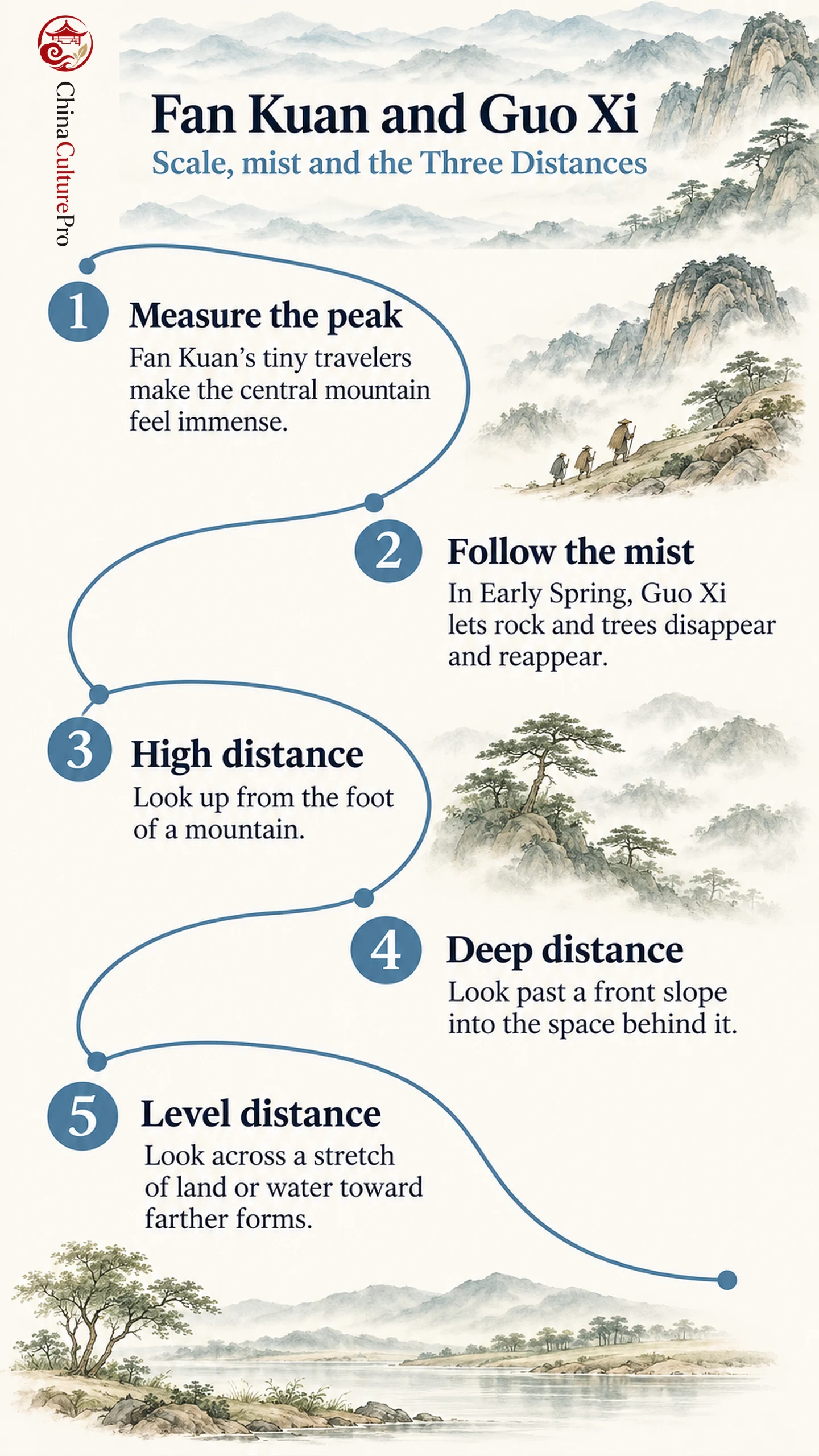
- High distance (高远, gāoyuǎn): Look up from the foot of a mountain toward its summit. This direction emphasizes ascent and height. [4]
- Deep distance (深远, shēnyuǎn): Look from the front of a mountain into the space behind it. Overlapping forms and valleys can invite the eye inward. [4]
- Level distance (平远, píngyuǎn): Look across from nearer ground toward a farther landscape. In a low landscape, a wide reach of water can lead the eye from nearer forms to a distant bank. [4][5]
Old Trees, Level Distance, a handscroll attributed to Guo Xi, gives a different test of these ideas. Trees, water and distant forms lead the eye sideways. The low, long arrangement also takes advantage of the different way a handscroll is viewed. Compare these scroll painting formats before assuming Guo always worked at monumental scale. [5]
Two Hanging Scrolls at a Glance
| Lukisan | Date and format | First detail to find |
|---|---|---|
| Travelers Among Mountains and Streams | Around 1000, hanging scroll on silk, painted area 206.3 × 103.3 cm | Locate the travelers below the cliff and compare their size with the waterfall. [1][2] |
| Awal Musim Semi | Inscribed 1072, hanging scroll on silk, painted area 158.3 × 108.1 cm | Follow the curved rocks and pines, then trace where mist opens a passage behind them. [1][3] |
FAQs About Fan Kuan and Guo Xi
Were Fan Kuan and Guo Xi Contemporaries?
Both belong to the Northern Song, but their two best-known landscapes are usually placed several decades apart. Fan’s scroll dates to around 1000, while Guo dated Early Spring to 1072. [1][3]
Where Is Fan Kuan’s Signature?
The tiny signature sits among trees in the lower right of Travelers Among Mountains and Streams. A museum staff member identified it on 5 August 1958. The name is easy to miss in a small reproduction. [1][2]
Are the Three Distances the Same as One-Point Perspective?
They describe different directions in which a viewer can look through a landscape. A painting can suggest looking up, inward and across within one image without organizing those directions around a single fixed vanishing point. [4][5]
Sumber
[1] National Palace Museum. Fan Kuan and Guo Xi: Northern Song Masterworks
[2] National Palace Museum. Travelers Among Mountains and Streams
[3] National Palace Museum. Awal Musim Semi
[4] University of California eScholarship. Three Distances in Landscape Painting
[5] Ping Foong. Guo Xi’s Intimate Landscapes and the Case of Old Trees, Level Distance