


Quick Answer: Who Was Gu Kaizhi?
Gu Kaizhi (顾恺之, Gù Kǎizhī) was an Eastern Jin painter from present-day Wuxi, active around the late fourth and early fifth centuries. He is remembered for portraits and narrative figure painting. The scrolls associated with his name survive through later versions. [1][7]
- The Admonitions Scroll (女史箴图, Nǚshǐ Zhēn Tú): Scenes on court conduct interpret a text by Zhang Hua. [2][4]
- The Luo River Goddess (洛神赋图, Luòshén Fù Tú): A meeting and parting unfold through repeated figures in a landscape. [5]
- Wise and Benevolent Women (列女仁智图, Liènǚ Rénzhì Tú): Episodes draw on biographies compiled in the Han dynasty. [6]
A label can preserve the traditional attribution of a composition while identifying the object in front of you as a later copy. [4][5][6][7]
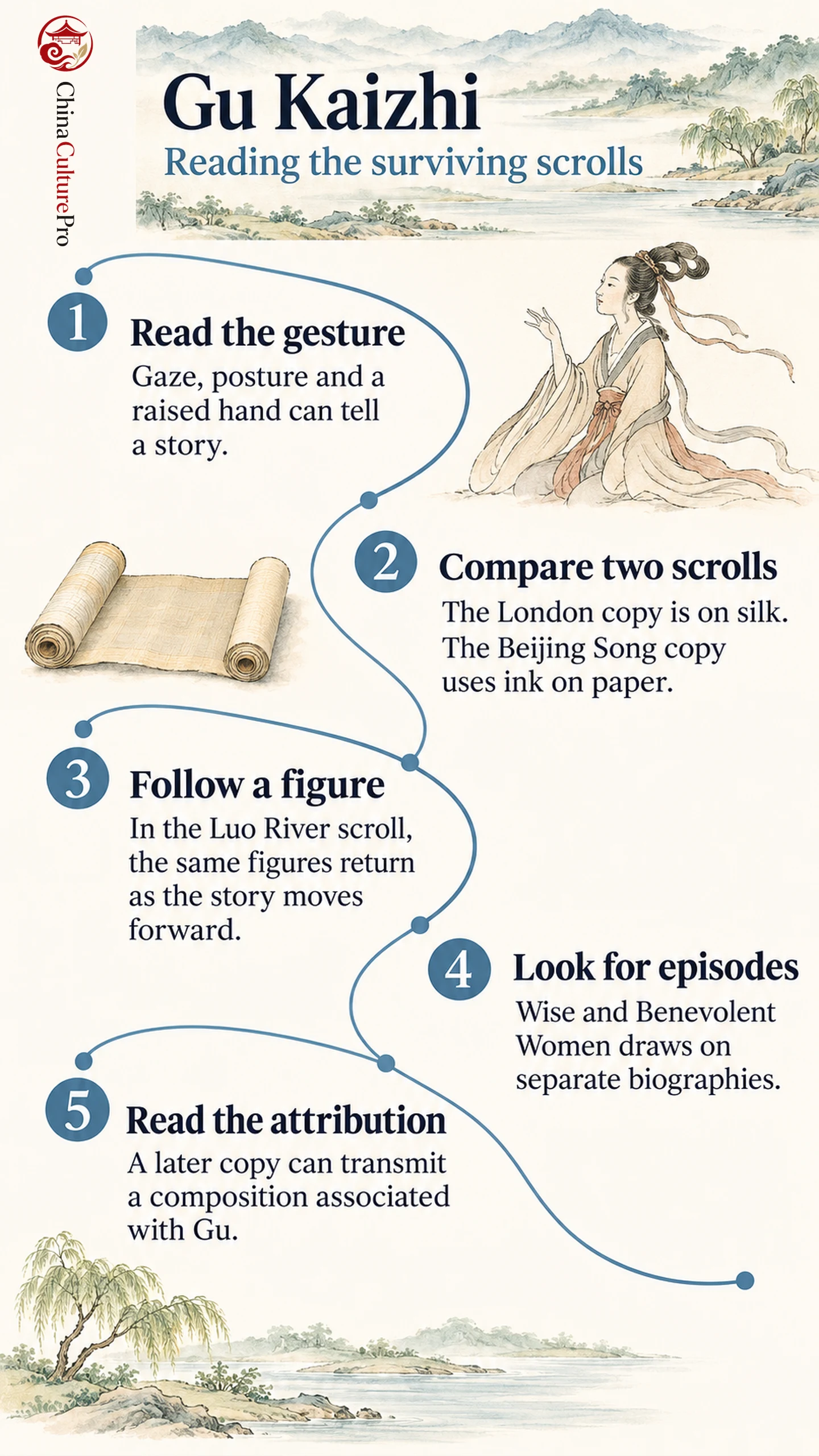
A raised hand, a turned head or a figure placed at some distance from a companion can tell a story across a narrow band of silk. These details help explain Gu Kaizhi’s place among Chinese artists and show how later painters transmitted the compositions linked to him.
The Eastern Jin Painter and His Reputation
Biographical traditions remember Gu as a painter of portraits and literary and religious subjects. Precise birth and death dates vary in modern accounts, so the Eastern Jin setting is a firmer guide to his career. The account of his painting of the Buddhist figure Vimalakirti at a monastery in Jiankang belongs to the received biography. It gives a sense of the range later writers associated with him. [1]
Gu’s reputation for conveying character is often explained through anecdotes about the eyes. The stories connect a detail of the face with the impression of a living person. The surviving copies offer a broader visual lesson. A person’s gaze, the angle of the body and the position of the hands can work together, giving the figures in a scene different intentions. That relationship is central to Chinese figure painting. [1][2]
The Admonitions Scroll and Its Versions
Zhang Hua’s text offered models of conduct to women at court. The London silk scroll intersperses passages from the text with illustrations, often using little background. In one scene, a woman advances and the emperor raises his hand to turn her away. The space between them makes the gesture easy to read. Nine illustrated scenes survive in this version, which is treated as an early copy of a design traditionally linked to Gu. [2][3][7]
The Beijing Song copy uses ink outlines on paper and contains eleven scenes, including two that precede the bear encounter. The different opening changes the sequence through which a viewer encounters examples of court conduct. A sequence spread across a handscroll makes each episode available in turn. The London object also preserves a woven silk fragment from an older mount. Its later inscriptions and seals help tell the story of collecting and remounting, separately from the original design’s attribution. [2][4]
The Luo River Goddess and Wise and Benevolent Women
The Luo River Goddess takes its subject from a rhapsody by Cao Zhi. In the Beijing painted silk copy, the narrator encounters the goddess by the Luo River, and she later departs in a carriage drawn by six dragons. The two characters appear more than once as the action progresses. Repetition lets separate moments coexist across a continuous landscape. The silk bears no artist’s signature. Its fabric, pigments and brushwork support its identification as a Song copy, even though the relative scale of figures and hills recalls earlier painting. [5]
Wise and Benevolent Women uses a different source. The Southern Song copy draws on stories of women collected by Liu Xiang during the Han. The scroll has pale color and ink outlines on silk. It survives as an incomplete selection from a group of fifteen biographies in the source chapter. It offers a comparison with the Luo River scroll because it groups distinct exemplary episodes rather than following one meeting and parting across a landscape. [5][6]
Four Surviving Scrolls to Compare
| Versi | Medium and period | Ciri yang perlu diperhatikan |
|---|---|---|
| London Admonitions Scroll | Ink and color on silk, early copy | Look at how a hand gesture conveys a response against a spare background. [2][3][7] |
| Beijing Admonitions Scroll | Ink on paper, Song copy | Compare the scene sequence and continuous outlines with the silk version. [4] |
| Beijing Luo River Goddess | Color on silk, Song copy | Trace the recurring figures through changes in water, trees and rocks. [5] |
| Beijing Wise and Benevolent Women | Ink and light color on silk, Southern Song copy | Identify where the surviving sequence changes from one exemplary figure to another. [6] |
FAQs About Gu Kaizhi
Do Any Original Gu Kaizhi Paintings Survive?
The famous scrolls associated with him are known through copies and traditional attributions. No surviving painting is securely identified as Gu’s own work. A traditional name on a label can refer to the composition transmitted through a later object. [4][5][6][7]
Why Are the Eyes Associated with Gu Kaizhi?
Accounts of his portrait practice give the eyes a special role in conveying a sitter’s spirit. Gaze remains one way to read the relationships between figures in the scrolls linked to his name. [1][2]
Are All Versions of the Admonitions Scroll on Silk?
The early London example uses silk, while the Beijing Song copy is an ink drawing on paper. Their different materials and numbers of surviving scenes matter when comparing reproductions. [2][4]
Sumber
[1] Encyclopedia of China and Berkshire Publishing. Gu Kaizhi
[2] British Museum. Admonitions Scroll: Image and Description
[3] University of Chicago. Admonitions of the Court Instructress to the Palace Ladies
[4] The Palace Museum. Admonitions Scroll, Song Copy
[5] The Palace Museum. The Luo River Goddess, Song Copy
[6] The Palace Museum. Wise and Benevolent Women, Southern Song Copy
[7] British Museum. Annual Report 2016–2017