

Quick Answer: What Is Chinese Figure Painting?
Chinese figure painting (人物画, rénwùhuà) uses people and human activity as the main subject. It includes stories, portraits, court scenes and images of sacred figures. The painter can give a figure an identity, a role in an event or a place within a larger group. [1]
- Story: Pose and spacing help you tell who is acting, who is watching and how one scene leads to the next. [2][3]
- Portrait: Facial features and an inscription can help identify a particular sitter. Costume and pose can show how the person was presented. [4]
- Setting: Court and religious works can use groups of figures to express work, rank or devotion. [5][6]
Figure painting names a subject area. Painters can render figures with fine outlines, freer brushwork or layered colors. [1][7]
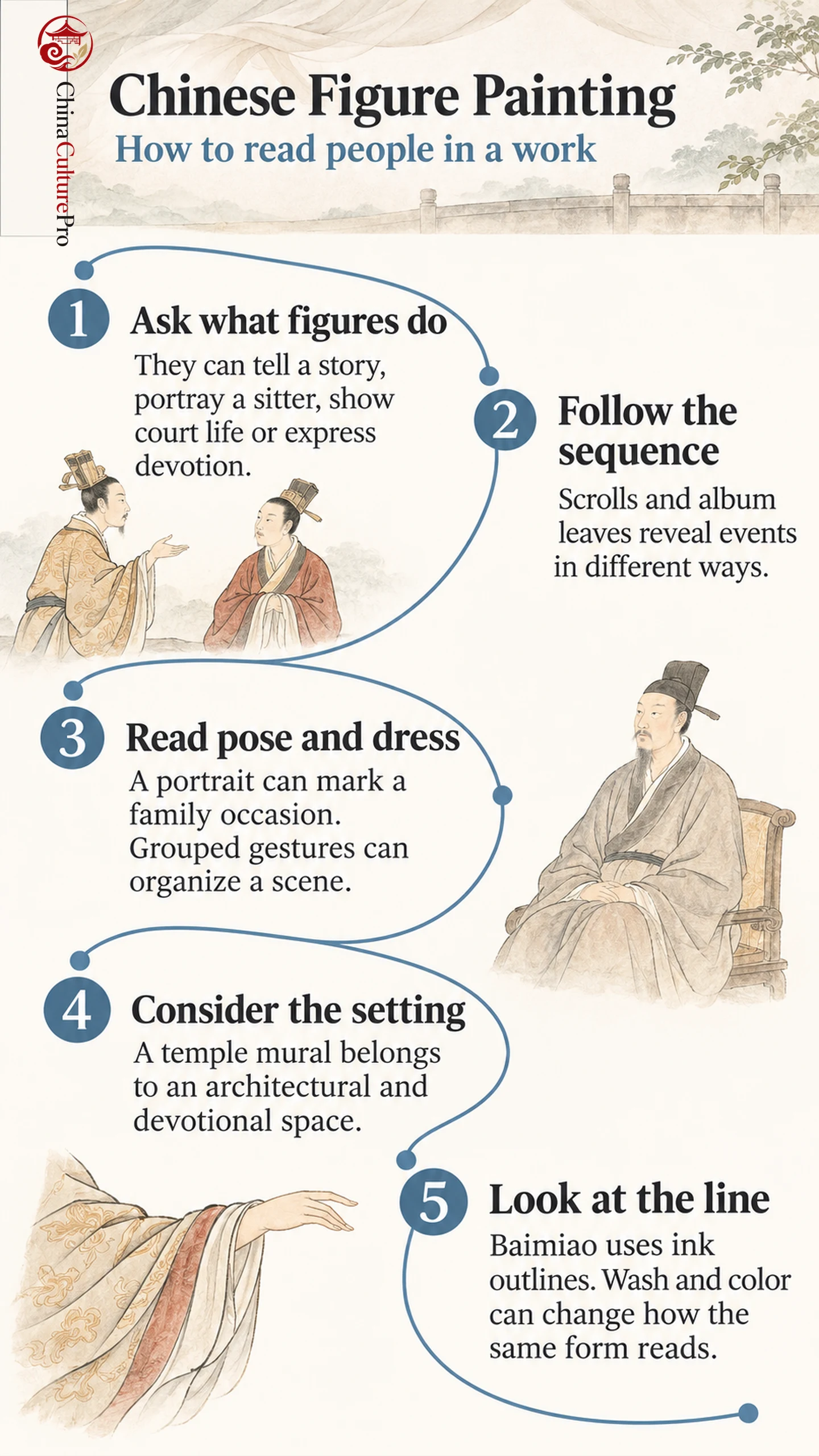
A face can carry the character of one sitter. A row of figures can carry the rhythm of a story. To understand a Chinese figure painting, first ask what the people are doing in the picture. That question helps you decide which details to examine. [1][3][4]
Four Ways Figures Work in Chinese Paintings
| Fungsi | What the figures do | Contoh |
|---|---|---|
| Narrative | Connect moments in a story through pose, grouping and repeated characters. | Admonitions Scroll (女史箴图, Nǚshǐ Zhēn Tú), a surviving early version of a moral narrative. [2] |
| Portrait | Present a particular person through likeness, clothing and pose. | The birthday portrait of Yizhai. [4] |
| Court life | Show an activity or a role through costume, setting and repeated actions. | Court Ladies Preparing Newly Woven Silk, attributed to Emperor Huizong. [5] |
| Religious image | Identify sacred figures and their attendants within a devotional setting. | A Yuan mural of a Buddhist paradise. [6] |
These functions can overlap. An identified portrait can later take on a ritual role, and a religious work can tell a story. [4][6]
How Scrolls and Albums Tell Stories
The Admonitions Scroll pictures episodes from a text by Zhang Hua that offered advice on conduct at court. Its early composition is traditionally associated with Gu Kaizhi (顾恺之, Gù Kǎizhī). The surviving British Museum painting is usually dated between 400 and 700. Read the spacing and gestures within one group, then see how the next scene changes the people, place or action. That date range refers to the surviving painting. The earlier composition is known through its association with Gu. [2]
Album leaves create a different rhythm. In a Southern Song album telling the story of Cai Wenji (蔡文姬, Cài Wénjī), eighteen leaves pair a scene with verses associated with her story. The episodes cover captivity, family life and return. The album has been attributed to Li Tang, though the attribution is uncertain. Its structure shows how painting formats can set the pace of a narrative. The story is set in an earlier period than the painting. [3]
Portraits, Court Figures and Social Roles
Ruan Zude (阮自德, Ruǎn Zìdé) painted his relative Yizhai for the sitter’s eighty-fifth birthday. An inscription gives the relationship and the occasion. The date is catalogued as 1561 or 1621. The face receives close attention, while the broad robe organizes the lower part of the composition. The painting could be read as an image of a person, a celebration of age and a record of family ties. Similar family portraits sometimes took on a ritual role after the sitter died. [4]
In Court Ladies Preparing Newly Woven Silk, an early twelfth-century scroll attributed to Emperor Huizong, groups of women share a task. The artist describes their clothes and movements as part of a scene. Follow who bends, reaches or waits as the fabric moves between groups. Their actions give the scene its structure. [4][5]
Religious Figures and Their Settings
The Yuan mural of the paradise of the Medicine Buddha (药师佛, Yàoshī Fó) once occupied a wall in the main hall of a monastery in Shanxi. Its figures belonged to an architectural and devotional setting. The placement of a central sacred figure among attendants helps organize attention at a much larger scale than a handscroll. The mural’s earlier identification as a different Buddhist assembly also shows why a central pose alone is an incomplete clue to identity. [6]
The Dunhuang murals belong to another architectural setting, with images painted inside cave sanctuaries. Read the surrounding figures and original location alongside any identification of the central figure. [6][9]
Line, Color and the Shape of a Figure
Baimiao (白描, báimiáo) is an ink-outline approach. The line can thicken at a fold or curve as a sleeve turns, making the form readable through changes in the stroke. Li Gonglin (李公麟, Lǐ Gōnglín) is associated with the method. His Five Horses handscroll offers a model for how outline can define a horse and its handler. [7][8]
In a dated work from 1347, Zhao Yong (赵雍, Zhào Yōng) took a horse-and-groom composition from the first image of that scroll. He shaded the horse with ink wash and gave the groom a red robe. The relationship between the two pictures makes it possible to see what the new tones and color contribute to the same basic arrangement. For other ways to read such marks, compare the techniques used in Chinese painting. [7]
FAQs About Chinese Figure Painting
Is Chinese Figure Painting the Same as Portraiture?
Portraits form one part of figure painting. The broader genre also includes narrative, court, everyday and religious scenes, where the figures may serve a story or represent a role. [1][2][6]
What Is Baimiao in Chinese Painting?
Baimiao is drawing with ink lines, usually with little or no color filling. The lines give the figure its edges, clothing folds and sense of movement. [7][8]
Who Is Associated With Early Chinese Figure Painting?
Gu Kaizhi is a prominent early name. The Admonitions Scroll preserves a composition traditionally associated with him in a surviving version generally dated later than his lifetime. [1][2]
Sumber
[1] Palace Museum, Beijing. Paragons of the Nation: Figure Paintings from Across the Ages
[2] British Museum. British Museum Confirms Two Major Exhibitions for Spring 2025
[3] National Palace Museum, Taipei. Lady Wenji’s Return to China
[4] The Metropolitan Museum of Art. Ruan Zude: Portrait of the Artist’s Great-Granduncle Yizhai at the Age of Eighty-Five
[5] Museum of Fine Arts, Boston. Art of Asia
[6] Anning Jing. The Yuan Buddhist Mural of the Paradise of Bhaisajyaguru
[7] National Museum of Asian Art. Horse and Groom, after Li Gonglin
[8] Freer Gallery of Art. Horse and Groom, after Li Gonglin: Collection Documentation
[9] UNESCO World Heritage Centre. Mogao Caves