

Quick Answer: Who Was Gu Hongzhong?
Gu Hongzhong (顾闳中, Gù Hóngzhōng), active in the tenth century, was a Southern Tang (南唐, Nán Táng) court painter associated with figure painting. His reputation centers on The Night Revels of Han Xizai (韩熙载夜宴图, Hán Xīzài Yèyàn Tú), also called The Night Banquet of Han Xizai.[3]
- Subject: An official’s gathering unfolds through music, dancing and conversation.
- Survival: The famous Palace Museum scroll is a later copy.
- Reading: Repeated appearances of the host connect separate moments of the evening.[1][2]
The artist, the composition attributed to him and the surviving painted object belong to different layers of evidence.
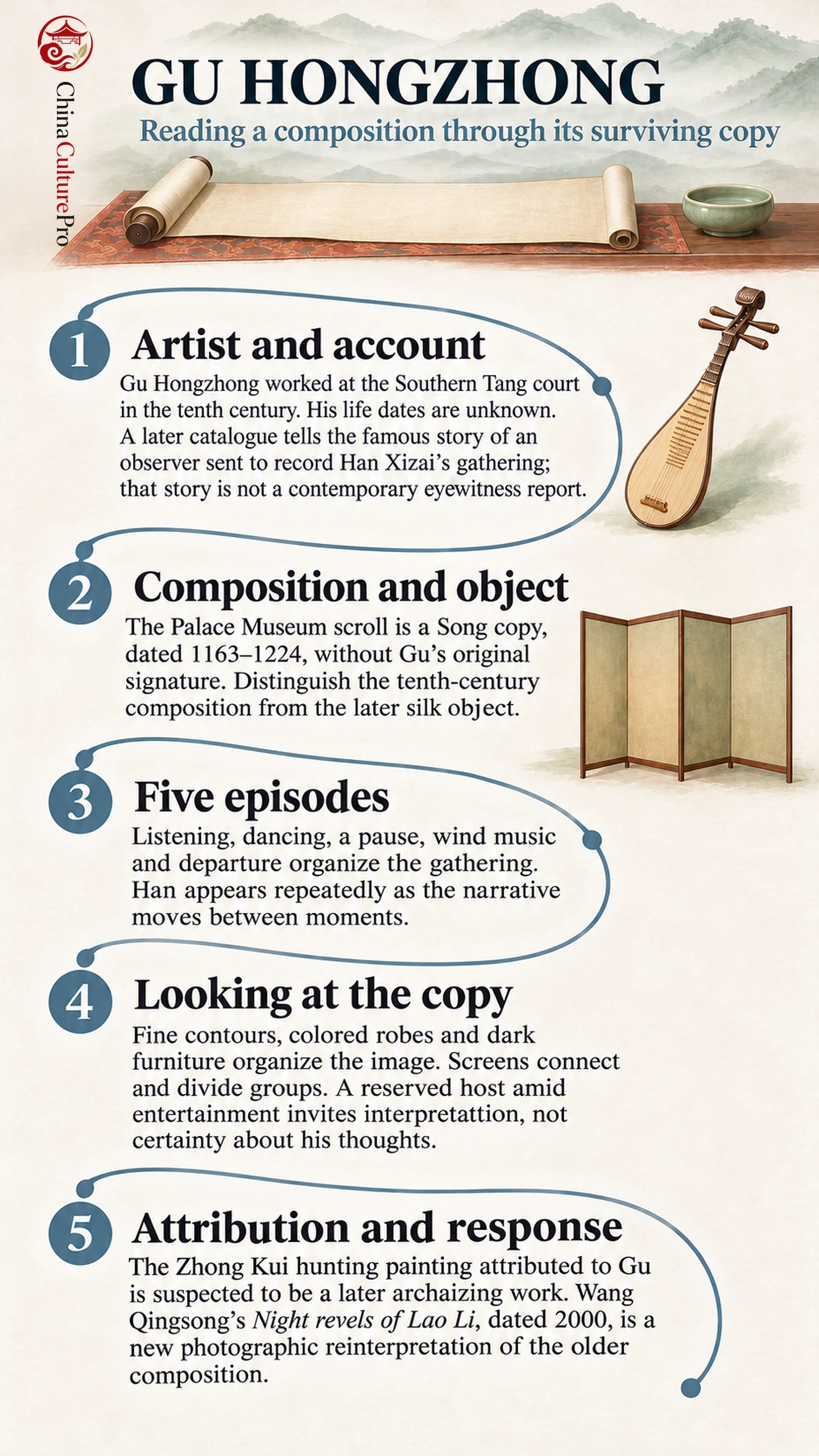
A long painting can show one person several times without depicting several different people. Gu Hongzhong’s best-known composition uses that possibility to turn an evening’s entertainment into a sustained visual narrative, preserved today through a later copy rather than an undisputed autograph.
A Southern Tang Painter and a Later Court Account
Gu came from Jiangnan (江南, Jiāngnán) and served the Southern Tang court during the Five Dynasties and Ten Kingdoms period. His life dates are unknown. Southern Tang was a successor state after the Tang empire’s fall.[3]
The early-twelfth-century catalogue Xuanhe Huapu (宣和画谱, Xuānhé Huàpǔ) describes the official Han Xizai (韩熙载, Hán Xīzài) and his entertainments. In its account, the ruler Li Yu (李煜, Lǐ Yù) sent Gu to observe a gathering and paint it from memory.[3]
That is a later literary account, not a surviving eyewitness report from Gu. Other accounts give the picture an admonitory purpose. The familiar “artist as spy” story should therefore be presented as a reported explanation, rather than verified circumstances of a commission.[1][3]
The Surviving Scroll Is a Song Copy
The Palace Museum dates its unsigned ink-and-color-on-silk copy to 1163–1224, during the Song dynasty. It is a later witness to the composition associated with Gu.[1]
Its format is a handscroll (手卷, shǒujuàn), a horizontal work opened a section at a time. Later inscriptions and collectors’ seals document its reception and attribution; their presence does not make it an autograph.[1][2]
Reading the Five Episodes
Reading generally proceeds from right to left. The five broad episodes provide landmarks rather than five unrelated pictures.[2]
| Episode | Tindakan |
|---|---|
| Listening | A musician plays the pipa (琵琶, pípá). |
| Dancing | Han accompanies a dancer on a drum. |
| A pause | The host washes his hands. |
| Wind music | A female ensemble performs. |
| Departure | Guests begin to leave. |
The repeated Han connects different moments; he is one protagonist, not several hosts in a single scene.[2]
Line, Color and the Reserved Host
In the surviving copy, fine, flowing contours define robes and faces. Stronger dark furniture contrasts with colored clothing. Screens and couches organize groups, separating activities while allowing the eye to continue across the scroll.[1]
Han’s tall hat identifies him. His reserved bearing amid entertainment can suggest conflicting pleasures and responsibilities, but it cannot establish his private thoughts.[2]
These are qualities of the surviving copy, not verified brushstrokes by Gu.[1]
Attribution and Later Reinterpretation
Another painting traditionally attributed to Gu, Depiction of Zhong Kui (钟馗, Zhōng Kuí) Going out Hunting, belongs to the National Palace Museum. Its curatorial discussion suspects a Ming-period archaizing work. A catalogue attribution is consequently different from a securely surviving original.[4]
The Night Revels composition also has a modern afterlife. Wang Qingsong (王庆松, Wáng Qìngsōng) reworked it in the staged photograph Night revels of Lao Li, dated 2000. The historical arrangement becomes a framework for contemporary people and social commentary. This is a new artwork responding to the older image, not another medieval copy.[5]
FAQs About Gu Hongzhong
Is the surviving Night Revels Gu Hongzhong’s original?
No. The Palace Museum identifies it as a Song copy, dated 1163–1224.[1]
Why does Han Xizai appear repeatedly?
The repeated figure links different moments in a continuous narrative.[2]
Was Gu Hongzhong sent to spy on Han Xizai?
An early-twelfth-century catalogue tells that story; it is not a contemporary eyewitness report.[3]
Was Han Xizai the painter?
No. Han is the official who hosts the gathering; Gu is the painter associated with its composition.[3]
Sumber
[1] The Palace Museum. The Night Revels of Han Xizai
[2] Smarthistory, Kristen Loring Brennan. Gu Hongzhong, The Night Revels of Han Xizai
[3] Xuanhe Huapu, volume 7. Gu Hongzhong: catalogue entry
[4] National Palace Museum, via National Cultural Memory Bank. Depiction of Zhong Kui Going out Hunting
[5] Queensland Art Gallery / Gallery of Modern Art. Wang Qingsong: Night revels of Lao Li