


Quick Answer: Who Was Liu Songnian?
Liu Songnian (刘松年, Liú Sōngnián) was a Southern Song court painter from Qiantang, present-day Hangzhou.[3]
- Range: His reputation embraces carefully observed figures, landscapes and architectural settings.[1]
- Seasonal painting: The Four Seasons landscapes connect changing nature with garden life.[1]
- Dated works: Three luohan (罗汉, luóhàn) paintings, depicting Buddhist guardians of the teachings, bear the date 1207.[3][4]
A later picture made in his style and a work bearing his signature require different kinds of attribution evidence.
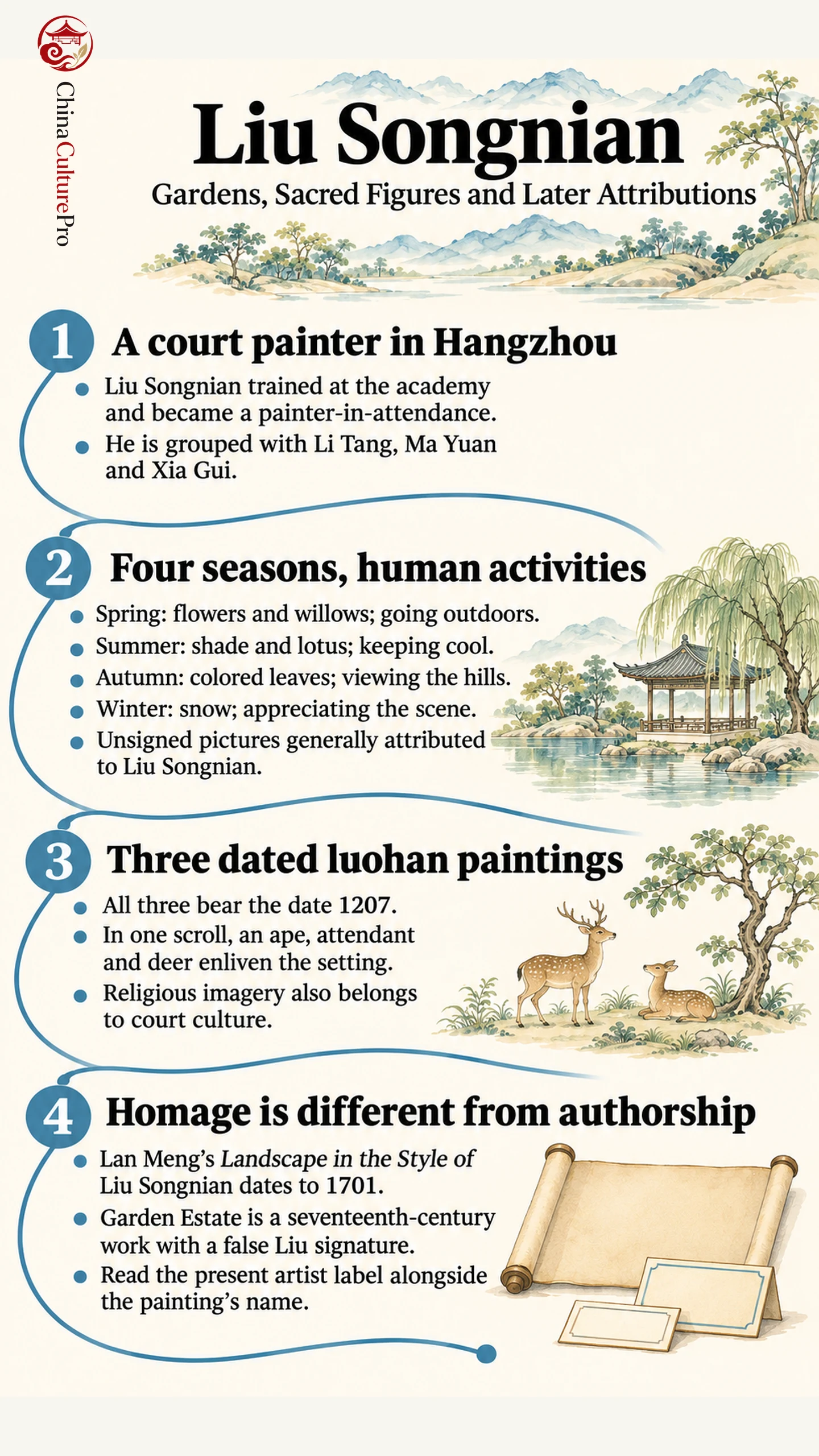
In Liu Songnian’s art, a building or a small figure can organize an entire landscape. A garden becomes a place to walk, rest or watch the weather. In the religious paintings, faces, robes, trees and animals bring a sacred presence close to ordinary experience.
A Painter of the Southern Song Court
Liu trained within the painting academy, became a painter-in-attendance and learned from Zhang Dunli.[3] His career belongs to the institutional world of the Southern Song.
He is grouped with Li Tang, Ma Yuan and Xia Gui as the Four Masters of the Southern Song (南宋四家, Nán Sòng Sì Jiā).[1][3] Use the grouping to compare different ways of joining landscape and human attention.
Reading People and Seasons in the Garden Landscapes
The Four Seasons pictures are unsigned but usually assigned to Liu. Their main forms gather toward one side, leaving room for lake and distant mountains.[2]
Ruled-line painting (界画, jièhuà) uses guided straight lines for buildings, while axe-cut texture strokes (斧劈皴, fǔpī cūn) articulate rocks.[1] Compare the measured rooflines with the irregular edges of trees and slopes.
| Musim | Natural cues | Human activity |
|---|---|---|
| Musim semi | Flowers and leafy willows | Going outdoors.[1] |
| Musim panas | Dense shade and lotus | Keeping cool.[1] |
| Musim gugur | Clear air and colored foliage | Looking toward the hills.[1] |
| Musim dingin | Snow-covered scenery | Appreciating the snow.[1] |
The seasonal change is also a change in how people inhabit their surroundings. Follow a path toward a terrace, then look back toward open water. Garden design and landscape painting meet in this relationship between shelter, movement and views.
The Dated Luohan Paintings of 1207
One of the three dated scrolls, measuring 117 × 55.8 cm, shows a luohan beside a tree. An attendant catches fruit from a long-armed ape, while two deer look upward. The branches remain visible through the halo, and patterned clothing adds another layer of fine detail.[3] Follow the exchanges of looking and movement before examining individual brush marks.
These are also works of court culture. Scholarship has examined the triptych through the imperial painting academy and its visual and material environment, extending interpretation beyond a purely local Buddhist tradition.[4] This connection helps place Buddhist imagery within the broader practice of figure painting.
Artistic Legacy: Homage, Attribution and Signatures
Lan Meng’s Landscape in the Style of Liu Songnian, dated 1701, is a later painting in ink and color on silk. Its rich blue-green manner reflects the study of older models. The title identifies an artistic reference, not Liu’s authorship.[5]
Garden Estate presents a different case. The seventeenth-century handscroll carries a false Liu Songnian signature and is assigned to an unidentified artist. Its expansive garden imagery belongs to the later market for paintings presented as old works.[6]
Compare these labels before using either picture as evidence of Liu’s own brushwork. His name may indicate a model to emulate, an old attribution or a claim that later research has rejected.
FAQs About Liu Songnian
Was Liu Songnian primarily a landscape painter?
Both landscape and figure painting are central to his reputation. The 1207 luohan scrolls are key religious figure paintings.[3]
Are the Four Seasons paintings signed?
No. They lack the painter’s signature and seal but are generally attributed to him.[2]
Does a painting with his name prove his authorship?
No. Garden Estate illustrates why a signature must be assessed alongside the object’s date and present classification.[6]
Sumber
[1] Palace Museum. Liu Songnian’s Landscapes of the Four Seasons
[2] Palace Museum. Four Seasons Landscapes: Attribution and Composition
[3] National Palace Museum. Lohan, Dated 1207
[4] Stanford University, Ho Center for Buddhist Studies. Yunru Chen: Liu Songnian’s Luohan Triptych
[5] Nelson-Atkins Museum of Art. Lan Meng: Landscape in the Style of Liu Songnian
[6] Metropolitan Museum of Art. Garden Estate