

Quick Answer: What Is Sichuan Opera?
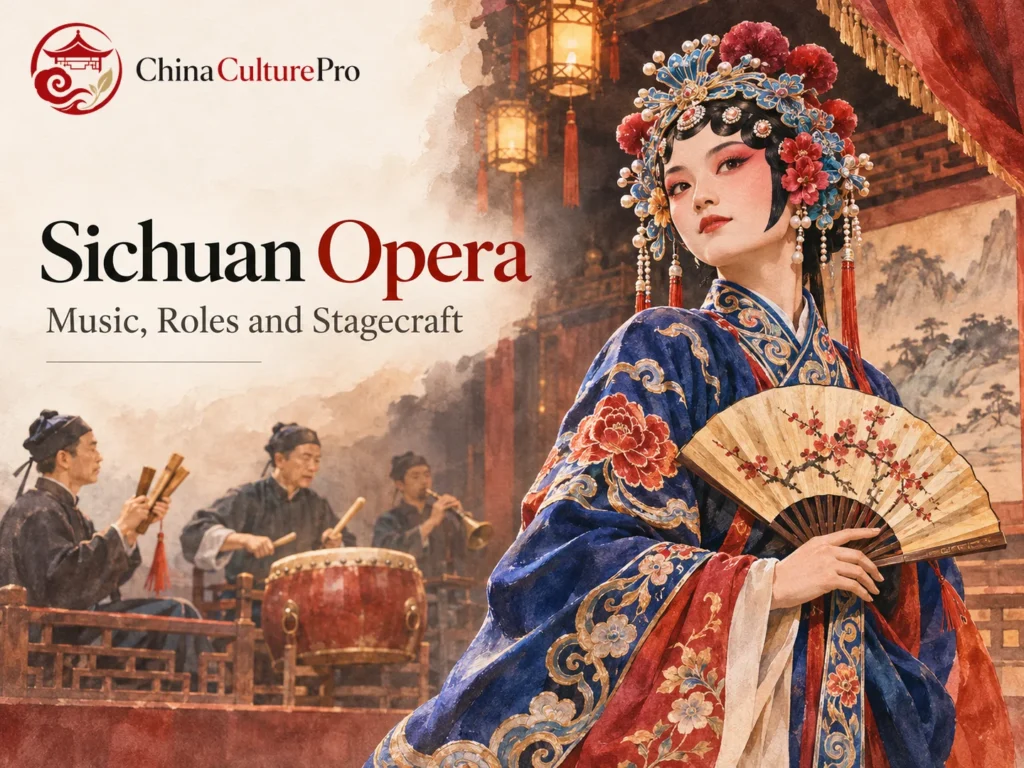
Sichuan opera, or chuanju (川剧, chuānjù), is a regional theater tradition performed in Sichuan, Chongqing and parts of neighboring provinces. It brings together five vocal traditions, character roles, instrumental accompaniment and stage movement. Face changing is one of its best-known techniques.[1][2][3]
- Listen for the music: Gaoqiang (高腔, gāoqiāng) pairs singing with a supporting chorus and percussion. Other scenes can draw on different tune families.[1][2]
- Watch the roles: Young male, female, other male, painted-face and clown roles each have their own training and ways of moving.[1][3]
- Read the effect in context: A sudden change of face can express a shift in mood or reveal something about a character. A full performance has music, acting and dramatic development around such effects.[4]
China included Sichuan opera in its first national intangible cultural heritage list in 2006.[1]

You can learn a great deal about a scene by listening before you look at the costumes. A reply from the chorus or a sharp percussion accent can change the meaning of a performer’s next move.
The Five Vocal Traditions in Sichuan Opera
| Vocal tradition | What the name points to |
|---|---|
| Gaoqiang | A family of high tunes in which solo singing, chorus and percussion can answer one another.[1][2] |
| Kunqiang (昆腔, kūnqiāng) | A local vocal tradition related to Kunqu.[1][2] |
| Huqin (胡琴, húqín) | A system related to pihuang singing and associated with bowed-string accompaniment.[2][3] |
| Tanxi (弹戏, tánxì) | A tradition related to clapper opera.[2][5] |
| Dengdiao (灯调, dēngdiào) | A vocal tradition related to local lantern theater, also described as dengxi.[1][2] |
The styles have distinct histories. Over time, troupes used them within the same repertory. This explains why an evening of excerpts can offer several sounds under one opera name. The influence of Kunqu is part of that history, alongside styles shaped by performers in Sichuan.[1][2][5]
How Gaoqiang Gives a Scene Its Rhythm
Gaoqiang uses named tunes and can bring together three parts. The performer sings, a chorus gives vocal support and percussion marks beats or changes in the action. The supporting singing is called bangqiang (帮腔, bāngqiāng). It may pick up a line or add emphasis. The division of sound lets a listener hear a relationship between the singer and the rest of the group.[1][2]
The style has a dramatic function too. A strong collective entry can build tension, while a beat can draw attention to a gesture or a pause. It is one way in which Chinese opera singing and speech work alongside instrumental and physical performance.[1][2]
How Roles and Stage Effects Work Together
The Sichuan opera heritage record describes five main types, including young male roles, female roles, other male roles, painted-face roles and clowns. Each type gives a performer conventions for voice, posture and gesture. In a comic scene, the timing of a response can matter as much as an elaborate costume. The guide to Chinese opera role types sets these practices in a wider context.[1][3]
Face changing, or bianlian (变脸, biànliǎn), is an effect that can make a shift in a character’s state visible in an instant. Certain performances also use long sleeves or other physical effects. A 2023 festival program in Hong Kong presented excerpts featuring different vocal traditions and kinds of stagecraft. The range is visible in Chengdu’s wider performance culture and in troupes across the region.[4][5]
FAQs About Sichuan Opera
Is Sichuan Opera the Same Thing as Face Changing?
Face changing is a technique used in some Sichuan opera performances. The form also has singing, percussion, acting, distinct role types and a repertory of plays.[1][4]
What Is the Chorus Doing in Gaoqiang?
The chorus gives vocal support to the lead singing. Its entries help shape the phrasing of a passage alongside percussion and the performer’s lines.[1][2]
Is Sichuan Opera Performed Only in Sichuan?
The tradition has a strong presence in Sichuan and Chongqing. It also has a history in parts of Yunnan, Guizhou and Hubei.[1]
Источники
[1] China Intangible Cultural Heritage Digital Museum. Sichuan Opera
[2] Hong Kong Leisure and Cultural Services Department. Chinese Opera Festival: Sichuan Opera Program Notes
[3] Meng Jiaxin. Sichuan Opera
[4] China Intangible Cultural Heritage Digital Museum. Sichuan Opera Up Close: Interview With Xia Tingguang
[5] Hong Kong SAR Government. Sichuan Opera Troupe to Showcase Different Vocal Styles