
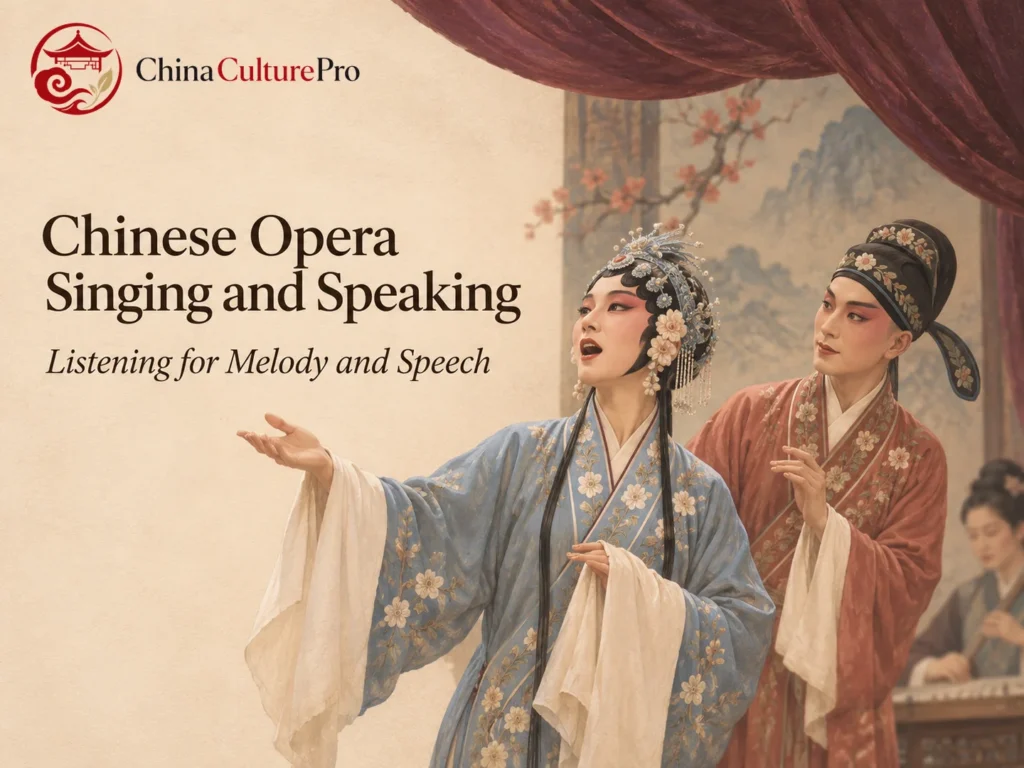

Quick Answer: How Does Singing Differ From Speaking?
Singing (唱, chàng) in Chinese opera fits words to melodic and rhythmic patterns. Spoken delivery (念白, niànbái) gives words a shaped rhythm and pitch through the actor’s delivery. Both are trained skills. In Peking opera, a spoken line can have a marked rise and fall even when it is outside a sung melody.[1][2][3]
- Song: Listen for words extended within a melodic phrase.[1][3]
- Speech: Listen to how syllables group, speed up or pause.[1][2]
- Context: A change in delivery can show a change of feeling or social distance.[1][4]
Start with how the voice shapes the words. The presence of instruments by itself gives an incomplete answer.

An argument can pass from speech to song without the characters leaving the stage. A held vowel may give one character’s reaction time to unfold before the other replies.
How Melody Shapes a Sung Line
Two major systems of Peking opera singing are xipi (西皮, xīpí) and erhuang (二黄, èrhuáng). Each provides melodic shapes and rhythmic possibilities that performers can use at different tempos. Xipi is often heard in more lively passages, and erhuang often carries a reflective mood. The pace and feeling still depend on the scene and the way the performer delivers it.[2][3]
Try following a single vowel. It can stretch across several notes before the syllable finishes, giving the singer time to develop a reaction. A sung passage can also describe the setting, move the story along or carry an argument.[1][3]
How Formal and Colloquial Speech Sound
Two familiar ways of speaking in Peking opera are yunbai (韵白, yùnbái), an elevated recitation, and jingbai (京白, jīngbái), a register closer to Beijing colloquial speech. Yunbai can draw out formal language with a pronounced pitch contour. Jingbai can let an exchange move faster and sound more conversational.[2][3][4]
A dignified figure can use elevated speech in a formal encounter, and some young women and comic figures frequently use the colloquial register. These are conventions of particular role types and situations. The same character can speak differently when the relationship or setting changes.[2][4]
What Changes When the Delivery Changes
In a study of Yu Tangchun (玉堂春, Yù Tángchūn), the character Chong Gongdao (崇公道, Chóng Gōngdào) shifts from Beijing colloquial speech to elevated speech in the courtroom. The actor is still speaking, but the changed register puts the encounter on a more formal footing.[4]
An instrumental cue may also frame a pause or introduce a new passage. Listen for whether the voice settles into a melodic line, then notice how long the syllables last and where the next line starts. The shape of the words can clarify the shift while the orchestra continues.[1][2][3]
How the Comparison Travels to Cantonese Opera
In Cantonese opera, singing draws on several sources, including the banghuang (梆黄, bānghuáng) system and regional narrative-song traditions. Related musical material can take on a different sound when it is sung with Cantonese pronunciation and tones.[5]
A study comparing Cantonese opera speaking and singing found that the lexical tones that distinguish words remained audible in both. Average pitch tended to fall in the speech samples and rise slightly in the song samples. The study describes average patterns across samples. An individual sung or spoken line can travel in either direction.[6]
FAQs About Chinese Opera Singing and Speaking
Is Chinese opera sung all the way through?
Performers move between melodic singing and stylized spoken lines. Both can advance the story and convey feeling, and the balance varies by scene and tradition.[1][2][5]
Can spoken lines sound like singing?
Yes. The strong changes in rhythm and pitch of formal recitation can sound musical. A sustained melody provides a further clue that the performer has shifted into song.[1][3][4]
Источники
[1] China National Peking Opera Company. Basic Skills of Peking Opera
[2] State Council Information Office. Peking Opera
[3] University of Victoria Libraries. Aural Characteristics and Musical Elements of Chinese Opera
[4] Yao S.. Yunbai and Jingbai as Social Markers in Peking Opera
[5] Academy of Chinese Studies. Singing and Speech in Cantonese Opera
[6] Ling Zhang. Tunes of Different Speech Styles in Cantonese