
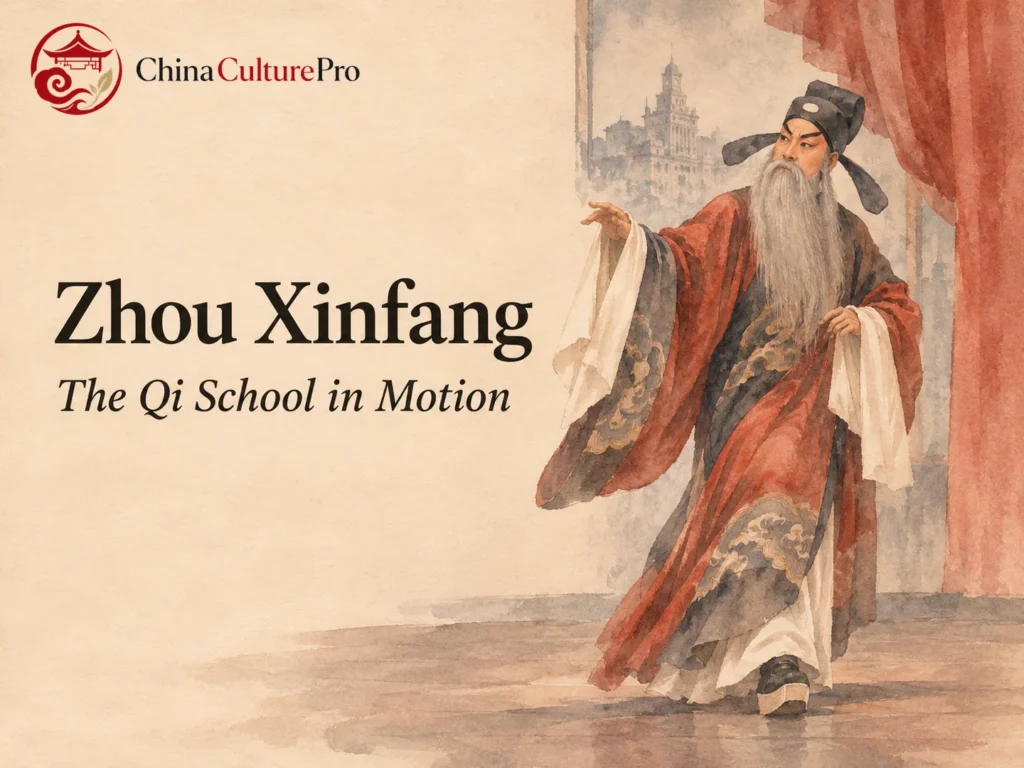

Quick Answer: Who Was Zhou Xinfang?
Zhou Xinfang (周信芳, Zhōu Xìnfāng, 1895–1975) founded the Qi school (麒派, Qípài) of Peking opera. He specialized in the laosheng (老生, lǎoshēng), or mature male role, and became the first director of the Shanghai Peking Opera Company.[1][2]
- Place: He directed Shanghai’s Peking opera company and adapted older repertory for its stage.[2][3]
- Performance: Watch how pauses and gestures prepare a spoken line.[3]
- First viewing: A 1961 color film preserves two of his stage works.[4]
Begin by following the actor’s hands and feet as closely as his voice.
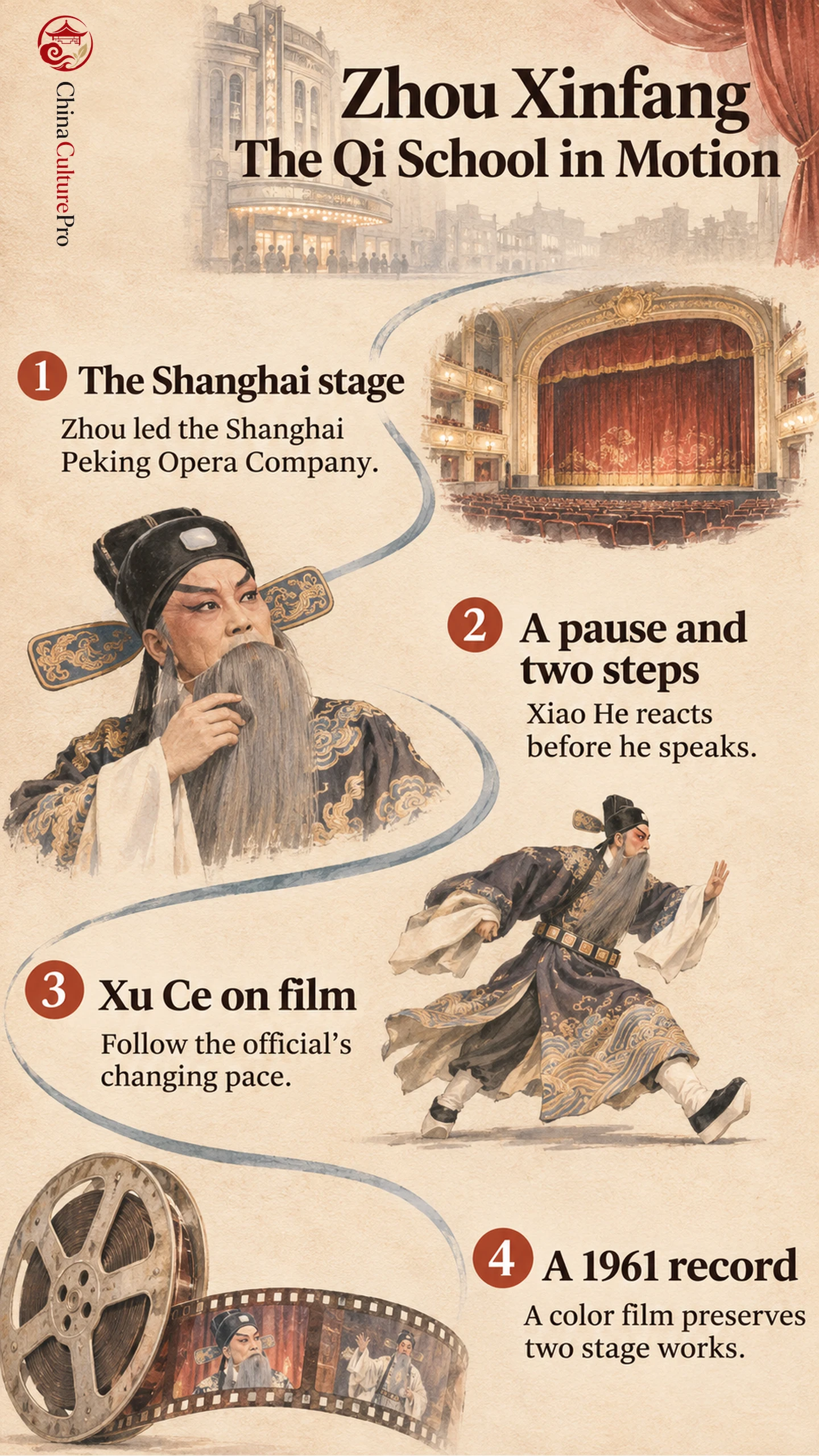
In one account of Zhou’s Xiao He, the actor retreats two steps on hearing bad news. The steps let the audience see the character absorb the news before he speaks.[3]
How the Qi School Took Shape in Shanghai
Zhou performed under the stage name Qilintong (麒麟童, Qílíntóng). The school associated with that name took shape in a career closely tied to Shanghai theater. As company director, Zhou encouraged performers to revise older plays while retaining what made each work distinctive. His performances show how much individuality an actor can give a character within established opera role types.[1][2][3]
Watch a Gesture Carry the Plot
In Xiao He Chases Han Xin by Moonlight (萧何月下追韩信, Xiāo Hé Yuèxià Zhuī Hán Xìn), Xiao He hears that Han Xin has left. An account of Zhou’s performance describes a sharp breath, two steps backward, a hand to the beard and a pause before the next command. Listen for the space between the news and the answer. His movement fills that silence.[3]
The Shanghai International Film Festival later listed a separate screen adaptation of the Xiao He play.[5]
Two Works Preserved on Film
The China Film Archive lists The Stage Art of Zhou Xinfang as a 1961 color film. It includes Xu Ce Runs to the City (徐策跑城, Xú Cè Pǎochéng) and A Command to Kill Yan Xijiao (斩阎惜姣, Zhǎn Yán Xījiāo). In the first, watch the pace of the older official’s steps as he goes to plead at the palace.[3][4]
FAQs About Zhou Xinfang
Why is Zhou’s style called the Qi school?
Qi is the first character of Zhou’s stage name Qilintong. It came to identify the performance school he founded.[1][4]
Which film preserves Zhou Xinfang’s performances?
The China Film Archive catalogs the 1961 film The Stage Art of Zhou Xinfang under his name and credits two stage works in it.[4]
Источники
[1] Музей Гугун. Zhou Xinfang
[2] Shanghai Municipal Government. Commemorating Zhou Xinfang’s 130th Birthday
[3] Shanghai Party History Research Office. The Qi School and Zhou Xinfang
[4] China Film Archive. The Stage Art of Zhou Xinfang
[5] Shanghai International Film Festival. Opera Film Exhibition