

Quick Answer: What Is Kunqu Opera?
Kunqu(昆曲,kūnqǔ) is a classical Chinese theatre tradition that developed in the Kunshan area near Suzhou. It brings together singing, recitation and precisely shaped movement. A bamboo flute can follow the singer, while percussion accents actions or changes in the scene.
Its repertoire includes *The Peony Pavilion* and *The Hall of Longevity*. Companies perform individual excerpts as well as longer productions. The difference matters when choosing a first performance. One excerpt can reveal the relationship between the voice and an actor’s gesture. A longer staging shows how those details fit into a story.
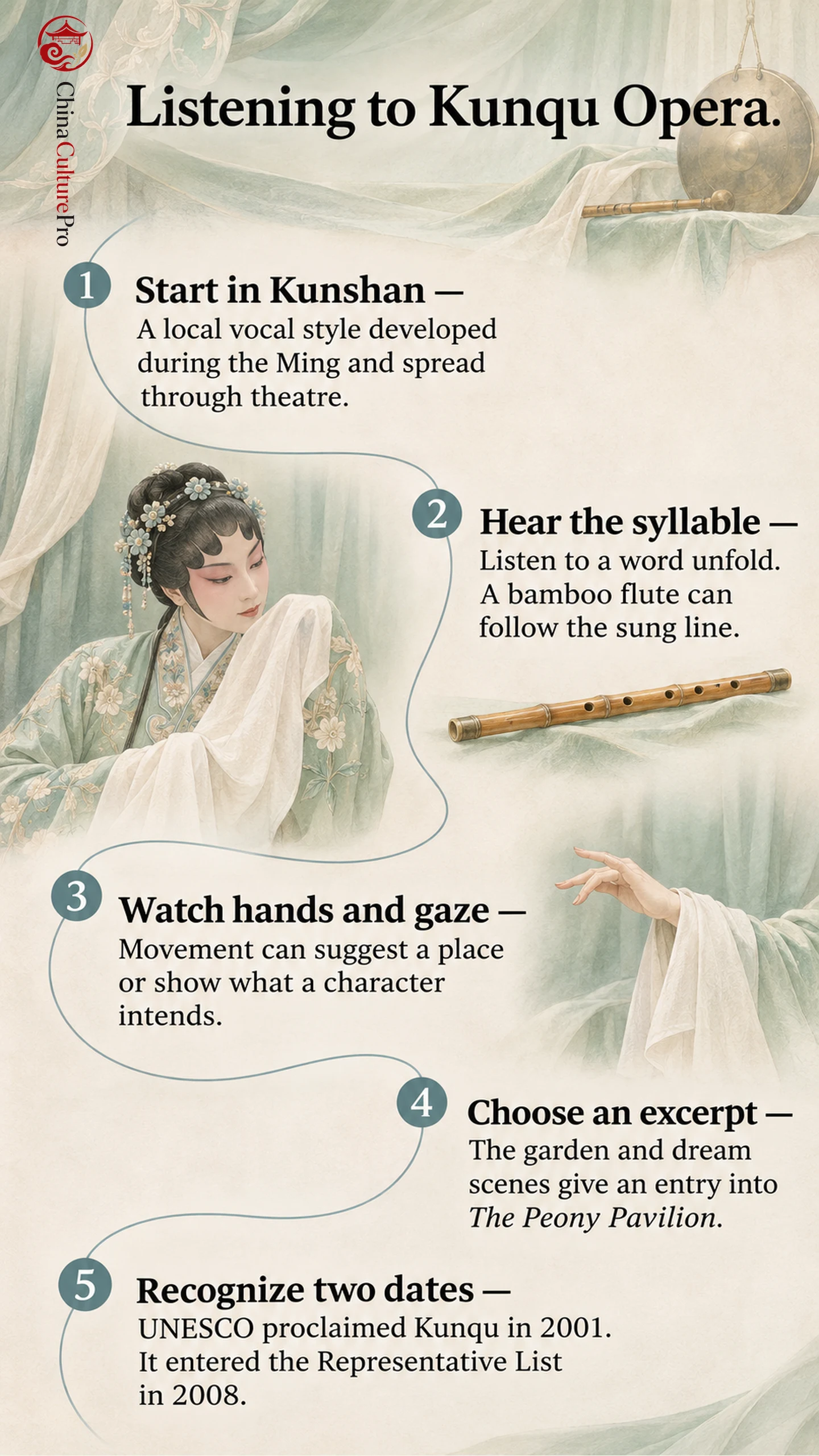
A singer can make a single word take time to arrive. Listen to the way its sound opens, then see what the performer does with their hands and gaze as it ends. That coordination of voice and movement is a way into Kunqu.
From Kunshan Singing to the Stage
A local vocal style took shape around Kunshan in the early Ming. Later in the dynasty, musicians including Wei Liangfu refined the style by drawing on other kinds of singing. Shuimodiao(水磨调,shuǐmódiào), often rendered as the water-polished style, names the result of that refinement. Liang Chenyu’s *The Washing of the Silk Gauze* helped bring the refined style to a wider theatre audience. [1]
Kunqu spread beyond the region and had a marked influence on other kinds of Китайская опера. Forms such as Peking opera drew on Kunqu’s singing and ways of performing. The forms developed different musical practices and have their own stages and audiences. [2]
The Voice, Flute and Shape of a Line
The careful shaping of a syllable is part of Kunqu’s sound. A singer can give separate attention to the beginning, body and ending of the sound. A phrase can stretch across several notes, with shifts in timing and emphasis that remain tied to the words. Hear how the singer moves from one sound to the next inside a single word. [1]
A bamboo flute can accompany the vocal line. The ensemble may also use a small drum, wooden clappers, gongs and cymbals. Listen first for where the flute follows the voice, then for the sharper sounds that mark an action. The instruments can give both continuity to a line and a distinct accent to a gesture. [2]
Gesture, Character and Classical Repertoire
An actor can set a scene with gaze, footwork and the path of a hand. These movements are part of a vocabulary learned with a particular role. A comic figure, young lead and older character may have different speech and movement even when they share the same stage. The shifts between song, speech and action help the audience follow what a character feels or intends. [1]
The repertoire often reaches audiences through zhezixi(折子戏,zhézixì), individual scenes performed as excerpts. An excerpt can focus on one episode or one singer’s technique. Familiar works such as *The Hall of Longevity* can therefore appear in a programme by the name of a scene. Check whether the programme names the entire work, an episode or an adaptation. [1]
The Peony Pavilion as a First Performance
Tang Xianzu’s *The Peony Pavilion* follows Du Liniang, whose encounter with a lover in a dream sets the plot in motion. In the garden and dream episodes, look for how the performer suggests the garden and how the dream brings the lovers together. Companies have staged the story in very different lengths and formats. [3]
| Format | What it offers | What to check before watching |
|---|---|---|
| Garden and dream excerpt | One encounter and a close view of singing and gesture | A short synopsis that places Du Liniang in the story |
| Abridged production | A selection of scenes arranged to sustain the larger story | Which scenes are included and how the adaptation is divided |
| Complete staging | The full dramatic arc with room for subplots | The number of sessions and the details of the particular production |
Start with an identified garden or dream scene if you want to learn the stage language. Then use a longer staging to follow the consequences of the dream. The *Young Lovers’ Edition* associated with Pai Hsien-yung is one documented adaptation with its own selection of scenes. [3]
Heritage Recognition and Living Productions
UNESCO first proclaimed Kunqu a Masterpiece of the Oral and Intangible Heritage of Humanity in 2001. It was incorporated into the Representative List in 2008. The dates refer to different steps in the recognition of this living heritage. [2]
Companies keep the repertoire in use through excerpts and longer stagings. A company may maintain an excerpt through teaching and rehearsal, or assemble a longer evening by selecting parts of a classical script. Those practices keep different aspects of the repertoire visible, from the training behind a small gesture to the shape of a whole play. [3]
FAQs About Kunqu Opera
Is Kunqu the same as Peking opera?
They are distinct forms. Kunqu developed earlier and influenced Peking opera, which has its own musical systems and performance history.
Do you have to watch all of The Peony Pavilion?
An excerpt is a common way to encounter the work. A synopsis can help you place the selected scene in the full story.
When did UNESCO recognize Kunqu?
UNESCO proclaimed it a Masterpiece in 2001 and incorporated it into the Representative List in 2008.
Источники
[1] China Intangible Cultural Heritage Digital Museum. Kunqu Opera, Beijing Project Entry
[2] UNESCO. Kun Qu Opera
[3] UCLA Performing Arts Research Collaborative. Peony Pavilion, Background