
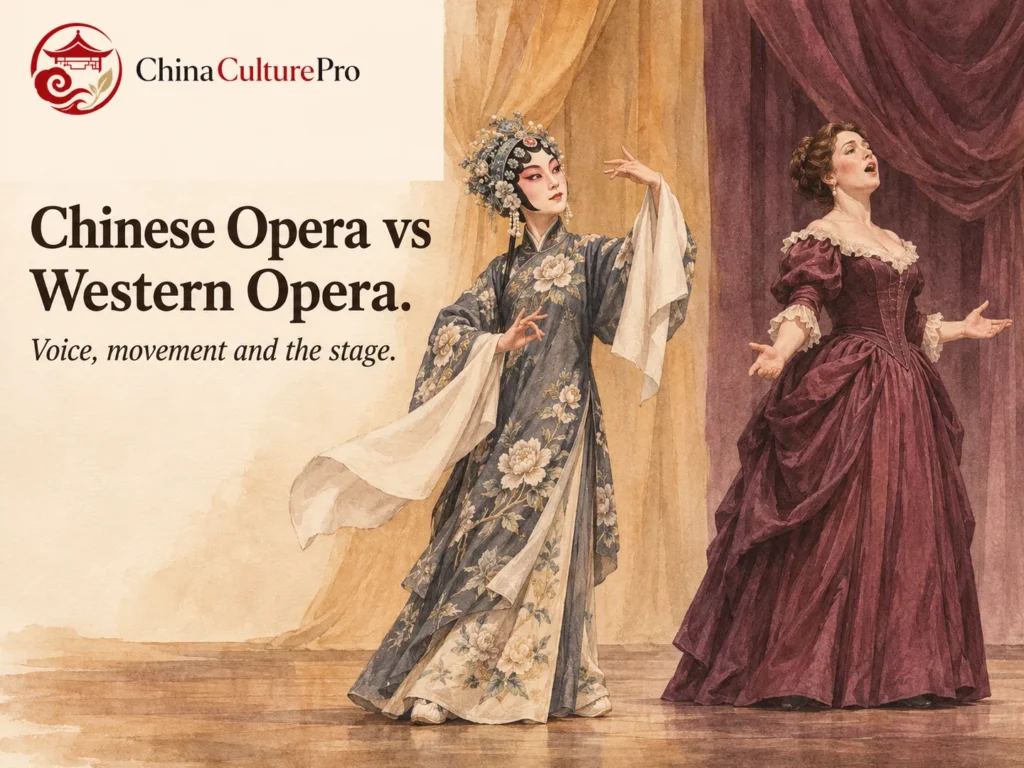

Quick Answer: How Do Chinese and Western Opera Differ?
Both Chinese opera and Western opera use music and acting to tell stories. Their forms differ in how they connect singing, speech, instruments and movement. In Peking opera, a stylized step or a percussion cue can carry information about the action. In an Italian opera, a speechlike sung passage can advance the plot before an aria dwells on a character’s feelings.
The differences depend on the works you compare. Mozart’s *The Magic Flute* uses spoken dialogue between musical numbers. Chinese opera also includes many regional forms. Compare named productions to see where their conventions meet and where they differ.
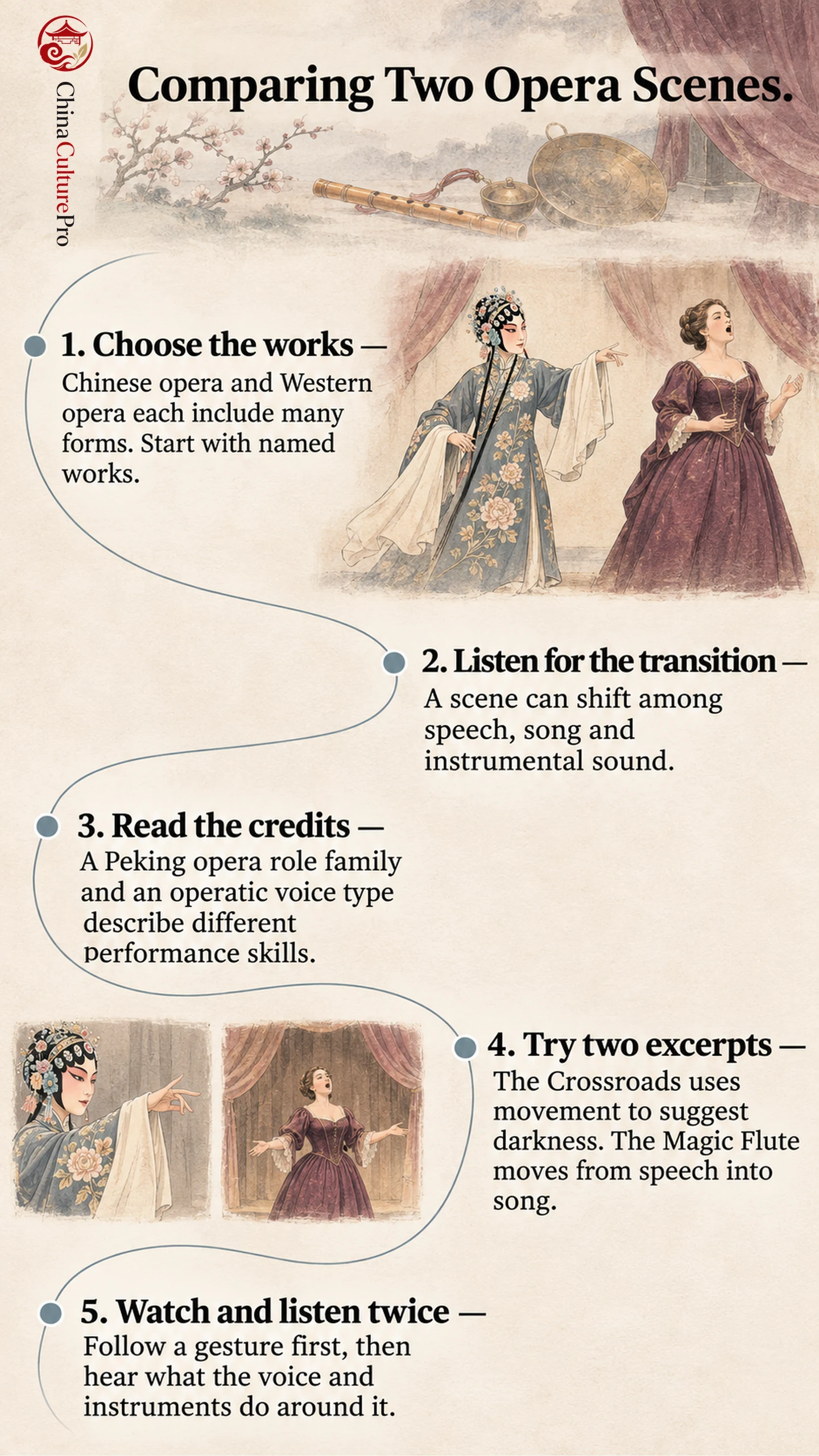
A pause in a scene can hold a character’s pose or prepare the next sung phrase. To compare two operas, ask what the pause does. The answer may be in the actor’s gaze, the accompaniment or the next words.
What the Two Labels Include
Китайская опера, often called xiqu(戏曲,xìqǔ), includes many regional theatre traditions. Peking opera is one example. Its performers use singing, stylized recitation, acting and martial movement. The ensemble supports both the sung line and the action onstage. [1]
Western opera also covers different periods, languages and genres. A familiar Italian convention distinguishes an aria, which can focus on a character’s thoughts, from recitative, a speechlike form of singing that often carries exchanges and advances the plot. [2] Mozart’s German-language *The Magic Flute* belongs to Singspiel, a form that uses spoken dialogue between musical numbers. [3]
Voice, Accompaniment and Movement Compared
The examples below compare what happens in a scene. They give a starting point for listening while leaving room for individual productions.
| Признак | Peking opera example | Western opera example |
|---|---|---|
| Voice and words | Sung passages and stylized speech use distinct performance conventions. [1] | Italian opera can alternate arias and recitative. *The Magic Flute* uses spoken dialogue alongside sung numbers. [3] |
| Accompaniment | A bright bowed fiddle called jinghu(京胡,jīnghú) can follow the voice. Percussion can articulate a gesture. [1] | The accompaniment can support a singer or take the foreground in an instrumental passage, as in the priests’ march in *The Magic Flute*. [3] |
| Where a scene puts its detail | A gesture can establish a place on a stage with few props. [1] | A musical number can make a character distinctive through rhythm, melody or vocal range, as Mozart does with Papageno and the Queen of the Night. [3] |
A vivid gesture can matter in either tradition. Look at what the actor does while the musicians play the next phrase. A familiar label such as “aria” alone cannot explain where a scene puts its dramatic emphasis.
Roles, Characters and Cast Credits
In Peking opera, a role family groups types of parts and techniques. For instance, the male-role family can include a young scholar, an older figure and a martial performer. The parts call for different ways of using the voice and body. [4]
A Western opera programme may list characters by voice type. The designation tells you about the vocal demands, such as the range expected of the singer. A Peking opera family can cover a different range of information, including how a performer moves or applies makeup. Use both the character and the part’s specific requirements when you compare performers.
Two Scenes to Compare
In the Peking opera *The Crossroads*, two people fight in an inn after misunderstanding each other. The fight takes place in darkness within the story. The Beijing company’s CCTV recording gives you an identified cast and production to follow. Notice how reaching, turning and pausing help show what each character can see. [5]
In *The Magic Flute*, listen to a passage involving Papageno and then to one of the Queen of the Night’s arias. The musical style and demands of their parts differ. A synopsis helps show why each number is there. Then listen for the transition from speaking to singing and for the effect that change has on the scene. [3]
How to Compare Productions Fairly
Start with two excerpts that give a work title, cast and company. Read just enough of the plot to know what each character wants. Watch the first scene once for movement and once for sound. Then do the same for the second, paying attention to a point where voice or accompaniment changes what you see.
Name the conventions you actually encounter. The size of the ensemble, use of scenery and amount of dialogue can depend on the work and production. Comparing specific choices gives you more information than treating either category as a single style.
FAQs About Chinese and Western Opera
Is Western opera always sung throughout?
Some works use spoken dialogue. Mozart’s *The Magic Flute* is one example.
Does Chinese opera always use a bare stage?
Some traditional stagings use few props and rely on movement. Design varies by genre and production.
Which performance should I watch first?
Choose an identified excerpt with a clear synopsis. *The Crossroads* offers a way to study movement, while *The Magic Flute* offers a way to hear the shift between speech and song.
Источники
[1] UNESCO. Peking Opera
[2] English National Opera. Beginner’s Guide to Italian Opera
[3] English National Opera. The Magic Flute, the Music
[4] Palace Museum. Peking Opera
[5] CCTV Opera Channel. The Crossroads, Beijing Company Performance