
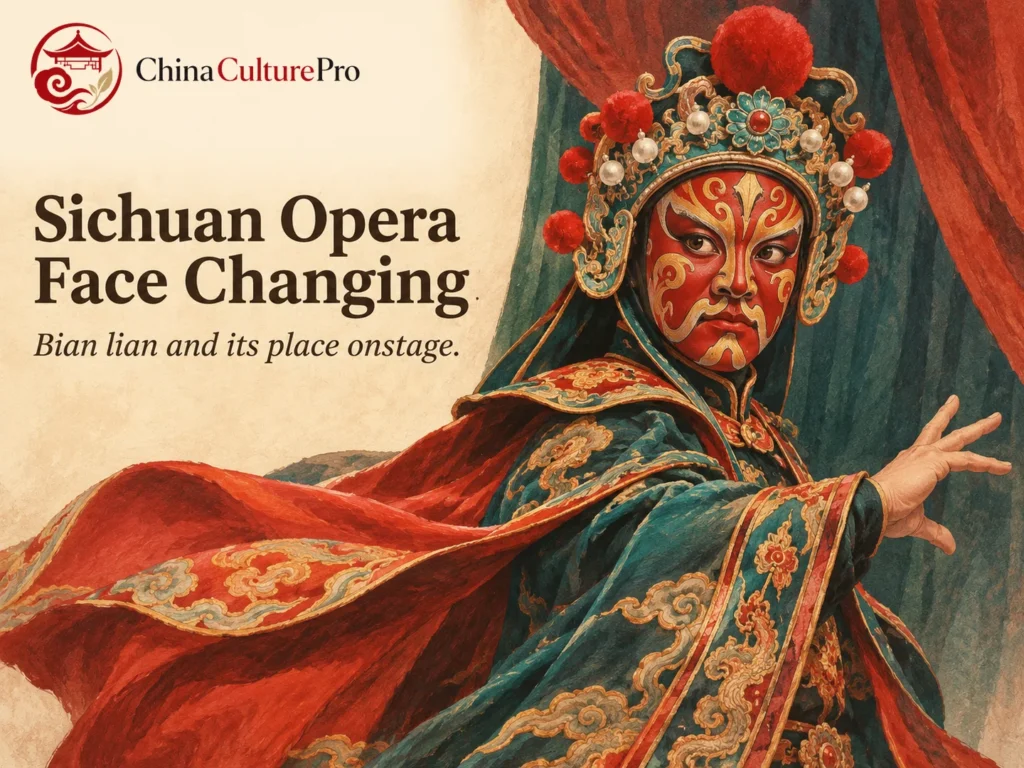

Quick Answer: What Is Sichuan Opera Face Changing?
Sichuan opera face changing, or bian lian(变脸,biànliǎn), is a stage technique in which the visible design on a performer’s face changes in an instant. A turn, a gesture or a pause can frame the change. The audience sees a different expression, pattern or identity appear within the movement.
Face changing can have a dramatic function in a play. In a shorter demonstration, the sequence of changes can be the focus. Sichuan opera also has its own singing, dialogue, percussion and repertoire.
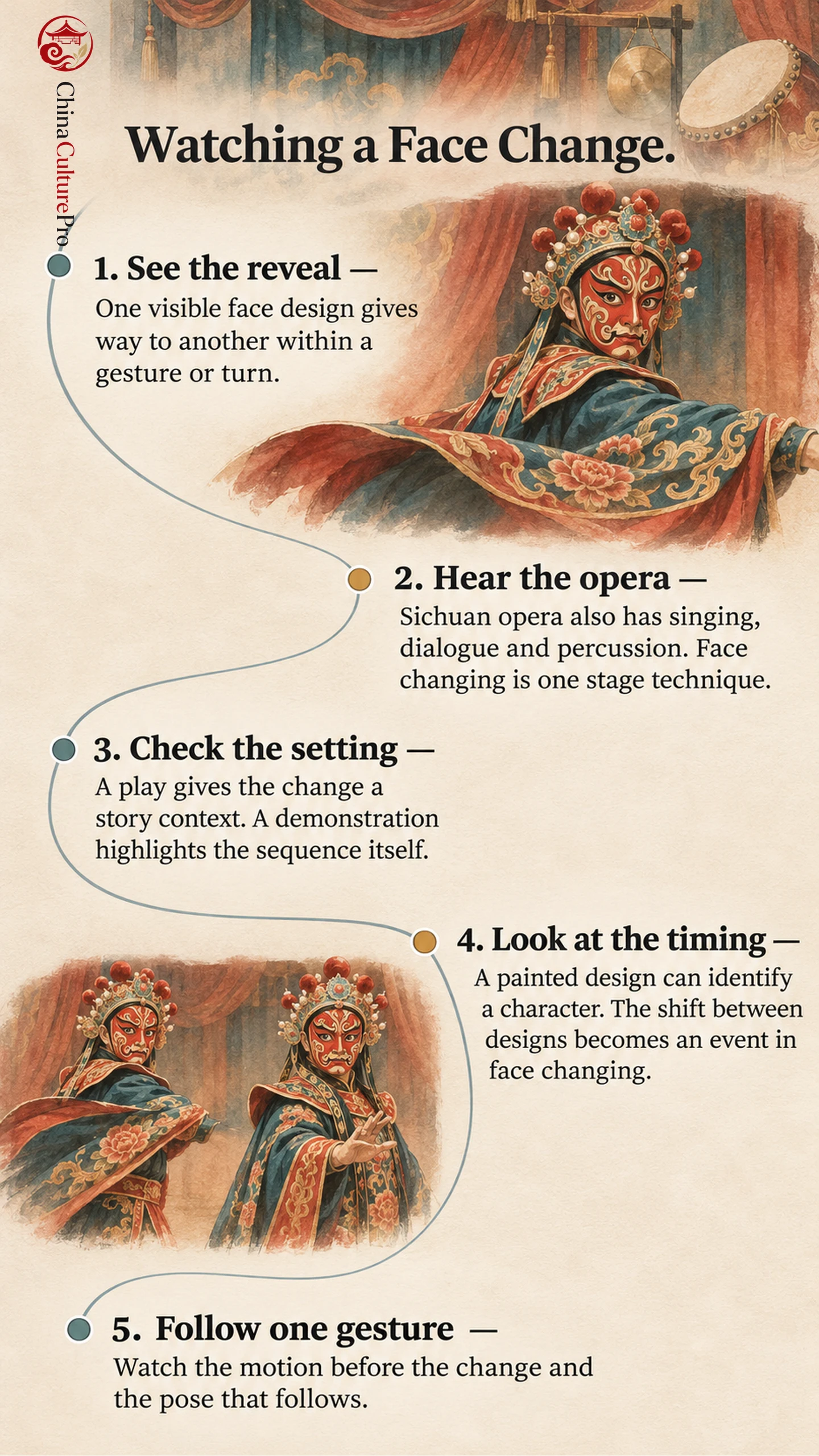
Watch a performer turn, then look again when they face the audience. The new design can change how the character reads from across the room. The speed creates surprise, while the movement around it sets up the reveal for the audience.
What the Audience Sees
One visible design gives way to another while the performer stays onstage. The audience may see a change in the main color, a sharper outline around the eyes or a different pattern across the whole face. Several changes can occur in a short sequence. The performer still has to show each design clearly across the room. [1]
A viewer can describe what happens from the audience’s side. Notice the performer’s orientation before the change, the gesture that accompanies it and how long the new design remains visible. A quick turn can make the transition hard to see. A still pose afterward gives the audience time to read the new design.
Where Face Changing Fits in Sichuan Opera
Sichuan opera, or Chuanju(川剧,Chuānjù), is a southwestern form of Китайская опера associated with Sichuan, Chongqing and nearby areas. Its repertoire draws on five vocal traditions that developed together on the Sichuan stage. One of them, gaoqiang(高腔,gāoqiāng), can combine the singing of a lead performer with supporting voices and percussion. Other styles within the genre have their own sounds and conventions. [2]
A play can make an effect visible at the moment when a character’s appearance or situation changes. Face changing is one of several specialized techniques that Sichuan opera performers developed for such scenes. The wider tradition, including its repertoire and musical practices, was included in China’s first national intangible heritage list in 2006. [2]
Face Changing in a Scene and on Its Own
A full scene gives the audience a story reason to notice the change. In CCTV’s 2018 Dragon Boat Festival programme, the Sichuan opera excerpt *Flooding Jinshan Temple* brought face changing into an episode of the White Snake legend. The published programme identifies the technique among several effects used in the scene. [3]
Short demonstrations put the sequence itself in the foreground. A 2024 video published by China’s State Council Information Office documents face changing in that format. In the play, the audience follows an episode of a story. In the demonstration, each reveal has to read clearly within the sequence. [4]
| Ситуация | What frames the face change | What to watch |
|---|---|---|
| Scene from a play | The characters and events established before the reveal | How the face change relates to what has just happened. |
| Short demonstration | The timing and ordering of the reveals | How the performer varies gestures and holds each new appearance. |
How It Differs from Peking Opera Face Painting
Peking opera face painting uses designs applied to the face to convey information about a character. Face changing in Sichuan opera uses the transition itself as an event. The position of a line or a color can help identify a painted Peking opera role. In a face-changing scene, the timing of the shift can be just as expressive as the new design. [5]
A familiar color association from one Peking opera role offers little guidance on its own in a Sichuan opera scene. Look for the character, the gesture and the context in which each design appears.
What to Watch in a Performance
Pick one reveal and follow it from the gesture before it to the moment when the performer settles. Listen for a musical accent or pause and see whether it falls before, during or after the change. Then watch where the performer directs their eyes and body. That can give the effect a sense of direction and help you see what the audience is meant to notice.
When a clip comes from a longer play, look for the title or synopsis before deciding what the change means. A stand-alone demonstration gives you a different way to appreciate the skill by watching how the performer keeps several reveals distinct.
FAQs About Sichuan Opera Face Changing
Is face changing the whole of Sichuan opera?
It is one stage technique within a genre with its own singing, acting, movement and repertoire.
Is face changing the same as Peking opera face painting?
Peking opera’s painted designs help portray particular roles. Sichuan opera face changing makes the switch between designs part of the performance.
Can you see face changing outside a full opera?
Yes. Short demonstrations can feature a sequence of face changes as the main attraction.
Источники
[1] China Culture. Sichuan Opera, Changing Faces
[2] China Intangible Cultural Heritage Digital Museum. Sichuan Opera
[3] CCTV Opera Channel. 2018 Dragon Boat Festival Opera Programme, The White Snake
[4] State Council Information Office. Video of Sichuan Opera Face Changing
[5] China National Peking Opera Company. Peking Opera Face Painting