

Quick Answer: What Are Chinese New Year Prints?
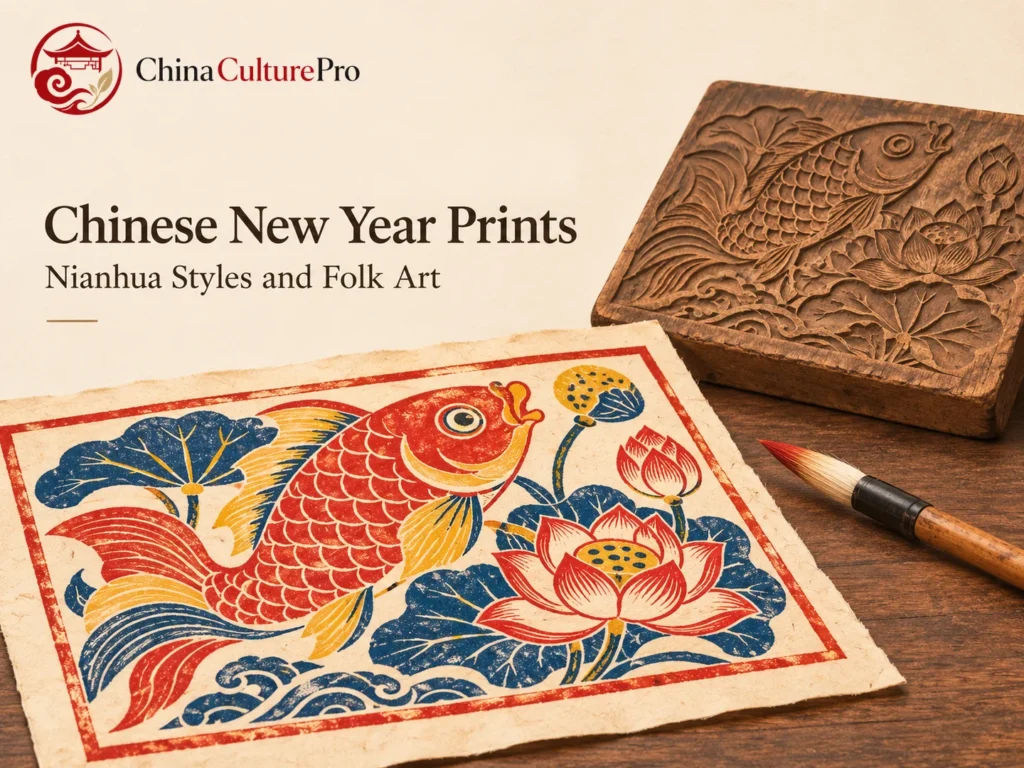
Chinese New Year pictures, or nianhua (年画, niánhuà), are images associated with decorating homes for the new year. Many traditional examples are woodblock prints. Subjects range from paired guardians and auspicious scenes to stories and scenes of work or entertainment.[1][2][6]
- Placement: The image and its shape can suit a door, wall or another place in the home.
- Technique: Color can come from separate printed blocks, a brush or both.
- Local practice: Workshop records help distinguish regional approaches.
The printed image and its intended use are two different clues.

A pair of armored figures can face each other across a doorway, while a print on a wall can show performers or a scene from a story. Where a picture was displayed helps explain its composition and its place among Chinese New Year decorations.
Door Gods, Kitchen Images and Scenes of Daily Life
Door gods (门神, ménshén) are one familiar subject. A pair can be arranged across the two leaves of an entrance. The Met also records a print that puts paired door gods together in one image. Its title connects the figures with good fortune, while the medium identifies how the image was made.[1]
The inventory for Yangjiabu (杨家埠, Yángjiābù) describes different images for doors, interior walls and places near a heated platform. It also documents the Kitchen God (灶王, Zàowáng), a figure in Chinese folk religion. The subject, format and intended placement work together, and the inventory covers more than deity images.[6]
An 1873 print from Tianjin in a British Museum exhibition shows musicians, acrobats and other performers in a garden. The exhibition notes describe a custom of pasting up such pictures at New Year and replacing them after they faded. The figures show how a scene of entertainment could also serve as a seasonal decoration.[2]
Yangliuqing, Taohuawu and Yangjiabu Styles
| Tradisi | Tempat | Documented approach |
|---|---|---|
| Yangliuqing (杨柳青, Yángliǔqīng) | Tianjin | Printed outlines and large color areas can be followed by hand-painted details. |
| Taohuawu (桃花坞, Táohuāwù) | Suzhou, Jiangsu | Workshop records describe carefully aligned color printing. |
| Yangjiabu | Weifang, Shandong | Layered color impressions appear in a varied repertoire for different household locations. |
In Taohuawu, the practitioner record of Fang Zhida (房志达, Fáng Zhìdá) describes his control of ink, pigments and alignment. His record describes the practical judgment behind making successive colors meet accurately on the paper.[3][4][5][6]
Yangjiabu records describe work that relies mainly on color printing and can include a finishing touch of rouge. The repertoire also includes stories, auspicious animals and pictures of work. Printing choices and choice of subject can vary independently within the same place.[6]
How Printing and Brushwork Share the Image
In Chinese woodblock printing, the raised surface of a carved block transfers ink to the paper. For a colored New Year print, an outline and later areas of color can come from different blocks. The printer aligns each impression so the color lands in relation to the lines already on the sheet.[5][7]
In Yangliuqing, painters can add shading and small details to printed areas. The account of carver Wang Wenda separates drawing, carving, printing and painting. The final sheet can therefore carry several people’s work. That division of labor is one way to understand traditional crafts such as printmaking.[3][7]
Look at the boundary of a colored area. A block can repeat a shape at the same place in several impressions. A brush can soften the transition within it or add a small feature that differs from sheet to sheet. Comparison across copies gives more evidence than the presence of bright colors by itself.[3][7]
What a Collection Record Can Tell You
When a picture is removed from a door or wall, its label can still give clues to use. Look for the title, medium and date in museum collection records. Read “ink and color on paper” alongside any more precise statement about carving, printing or painting. A museum title can identify a subject even when the record gives little information about the maker.[1][2]
Use a documented workshop or place of manufacture when available. A guardian, a fish or a scene from an opera can help you identify the subject. Similar subjects appear in different local repertoires, so motif is only one part of the evidence.[3][4][6]
The paired door gods print, numbered CP430, illustrates why both language fields are useful. Its English record gives an unidentified artist. The Chinese catalogue text names the Tianyi shop in Zhuxianzhen (朱仙镇, Zhūxiānzhèn), Henan. The shop information places the print in a workshop context even though the individual artist remains unidentified.[1]
FAQs About Chinese New Year Prints
Are Chinese New Year prints always door gods?
Door gods are one type. Other documented prints show entertainers, scenes from stories, household deities and wishes for good fortune.
Are New Year prints and paper cuts the same?
A New Year print transfers ink to paper. In paper cutting the image comes from the openings and remaining paper. Both can appear among seasonal decorations.
Can two prints from one block look different?
Yes. Print alignment and ink can vary, and hand-colored examples can differ in details painted after printing.
Can color alone identify a print’s workshop?
Color can suggest a process or support a comparison. Use the maker, place, printing method and catalogue history when there is enough evidence.
Sumber
[1] The Metropolitan Museum of Art. New Year Picture of Paired Door Gods Bestowing Good Fortune
[2] The British Museum. China’s Hidden Century: Large Print Exhibition Guide
[3] China Intangible Cultural Heritage Digital Museum. The Art of Yangliuqing New Year Prints
[4] China Intangible Cultural Heritage Digital Museum. Taohuawu Woodblock New Year Prints
[5] China Intangible Cultural Heritage Digital Museum. Fang Zhida
[6] China Intangible Cultural Heritage Digital Museum. Living Heritage in Weifang: Kites and New Year Prints
[7] China Intangible Cultural Heritage Digital Museum. Interview with Wang Wenda, Yangliuqing Print Carver