
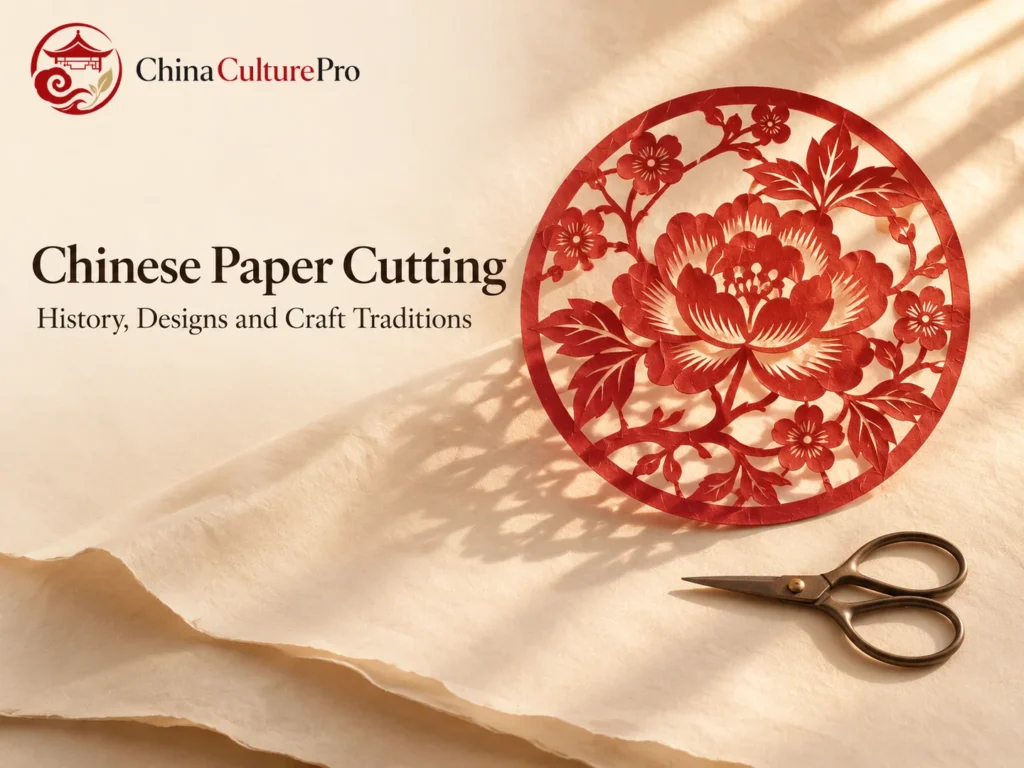

Quick Answer: What Is Chinese Paper Cutting?
Chinese paper cutting, or jianzhi (剪纸, jiǎnzhǐ), makes designs by cutting shapes into or out of paper. The remaining paper and the openings both form the image. Makers use scissors or cutting tools, and some works are colored after cutting.[1][3]
- Design: A fold can repeat a pattern, while an unfolded sheet allows a free composition.
- Local style: Tools, color and line work differ by workshop and tradition.
- Use: Cut paper can decorate a window, mark a wedding or serve as a pattern for embroidery.
The same cut shape can look different against a window, a wall or a fabric ground.
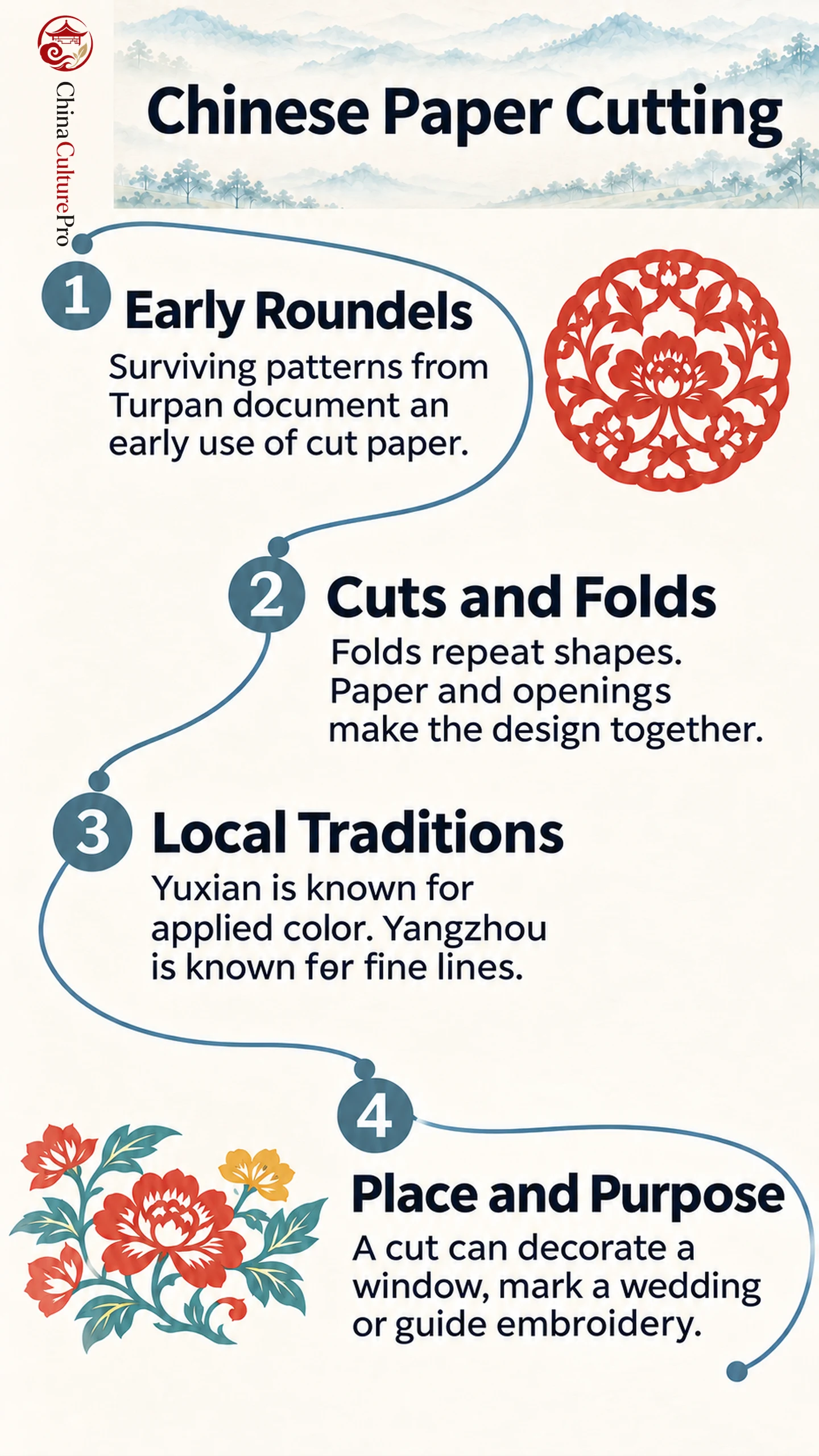
A paper flower changes when you hold it to a window. The parts cut away become as visible as the paper that remains. That relationship helps explain designs across Chinese craft traditions, from folded roundels to finely colored figures.
What Early Paper Cuts Tell Us
Some of the earliest surviving examples in China are roundels, or tuanhua (团花, tuánhuā), recovered from Northern Dynasties burials near Turpan in present-day Xinjiang. One roundel from Astana tomb 303 has a central flower, repeated diamond forms and a patterned border. The documented findspot connects this surviving pattern with a specific burial.[2][7]
These finds provide a physical record of early work. The first use of the technique could predate the surviving paper. The 2009 UNESCO inscription concerns living heritage, including the making and transmission of the craft across multiple communities.[1][2]
How Cuts, Folds and Openings Build a Design
Folding repeats a cut on each layer. When the sheet opens, the fold can become an axis of symmetry, or multiple folds can repeat motifs around a center. In an asymmetrical design, the maker places the openings individually. Which parts read as light or dark depends on the paper, the ground behind it and how the piece is lit.[3]
| Approach | How the image appears |
|---|---|
| Positive cutting | The lines of the design remain as paper. Connecting lines can hold a delicate shape together. |
| Negative cutting | Openings describe parts of the design. Light from a window or the color of a backing can show through. |
| Combined cutting | Retained lines and openings work together. One area can read as a silhouette while another shows fine details. |
When looking at a finished piece, trace one detail with your eye. A leaf vein, for example, might be a narrow strip of paper or a narrow opening. The distinction is easier to see when you change the background behind the cut.[3]
Color and cutting are separate decisions. A maker can tint selected areas on a single sheet, or use a second colored paper behind parts of the pattern. An area of color that looks solid from the front may therefore be dye on the cut paper or a piece of backing visible through an opening.[3]
Yuxian and Yangzhou Paper Cutting
In Yuxian (蔚县, Yùxiàn), Hebei, makers use knife cutting and apply several colors to the cut paper. The local inventory describes flowers, birds, opera figures and painted-face designs. The color can distinguish details within one figure, while cut openings make the outline or pattern visible. Workshops can cut multiple sheets together before adding color.[4]
The Yangzhou (扬州, Yángzhōu) tradition in Jiangsu is known for flowing fine lines and carefully arranged compositions. Its inventory records makers cutting patterns for embroidered household textiles and small accessories. Compare the role of a line in the two examples. It can define a patch of color on a Yuxian cut or give a needleworker an outline to follow in a Yangzhou pattern.[4][5]
Windows, Weddings and Embroidery Patterns
Window cuts are called chuanghua (窗花, chuānghuā). In Jingle, Shanxi, the heritage inventory records designs for the center of window panes and smaller motifs that complement them near corners. The window’s shape affects what can fit, and light makes the openings part of the composition. Window cuts are among the decorations associated with Tahun Baru Imlek and other occasions.[1][6]
At weddings, paper cuts can mark the occasion with auspicious patterns. For embroidery, a cut sheet can instead supply the shape that another maker works from. For a clue to a motif’s role, look for the intended placement. A design for a window corner has different demands from a pattern for a small embroidered pouch.[1][5][6]
Some designs also work as visual puns. A fish (鱼, yú) can stand for surplus (余, yú) in a wish for “surplus year after year” (年年有余, niánnián yǒuyú). The sound explains the connection between the image and the wish. The subject, accompanying motifs and occasion help establish whether that reading fits a particular cut.[8]
FAQs About Chinese Paper Cutting
Is Chinese paper cutting always red?
Red is a familiar choice for festive designs. Single-color work can use other papers, and makers in traditions such as Yuxian may apply several colors to a cut sheet.
Are all Chinese paper cuts made with scissors?
Scissors are one tool. Makers may also use a knife or another cutting tool, including when they work through several sheets.
Is Chinese paper cutting the same as a New Year print?
A paper cut forms its image by removing material. A New Year print forms an image by transferring ink. Both can decorate a home, and local crafts can influence one another.
What does the UNESCO inscription recognize?
UNESCO recognizes Chinese paper cutting as a living practice with varied techniques and social uses. The listing concerns the tradition and its transmission.
Sumber
[1] UNESCO. Chinese paper-cut
[2] China Intangible Cultural Heritage Digital Museum. Chinese Paper Cutting on UNESCO’s Intangible Cultural Heritage List
[3] China Intangible Cultural Heritage Digital Museum. Paper Cutting Techniques and Types
[4] China Intangible Cultural Heritage Digital Museum. Yuxian Paper Cutting
[5] China Intangible Cultural Heritage Digital Museum. Yangzhou Paper Cutting
[6] China Intangible Cultural Heritage Digital Museum. Jingle Paper Cutting
[7] China Writers Association. Early Surviving Paper Cuts
[8] Qiao Xiaoguang. Reading the Language of Paper Cutting