
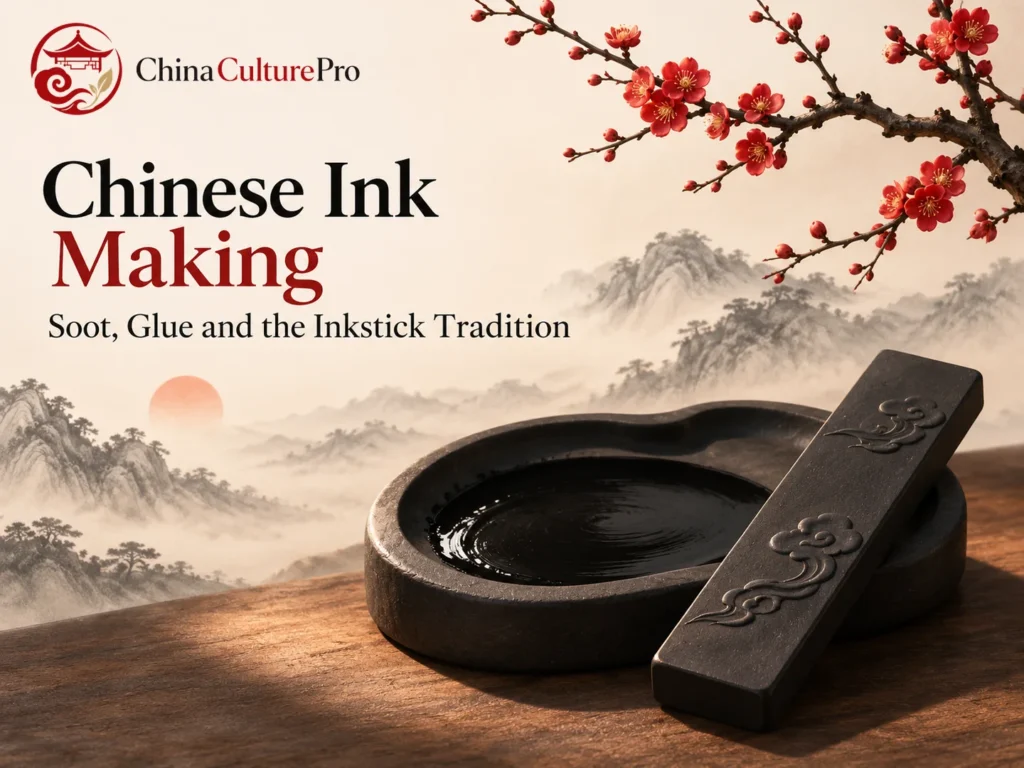

Quick Answer: How Is Chinese Ink Made?
A traditional Chinese inkstick (墨锭, mòdìng) is made by working finely collected soot into a glue binder, shaping the mixture and drying it. At the desk, an artist grinds an end of the stick with water on an inkstone to prepare liquid ink.[1][2][4]
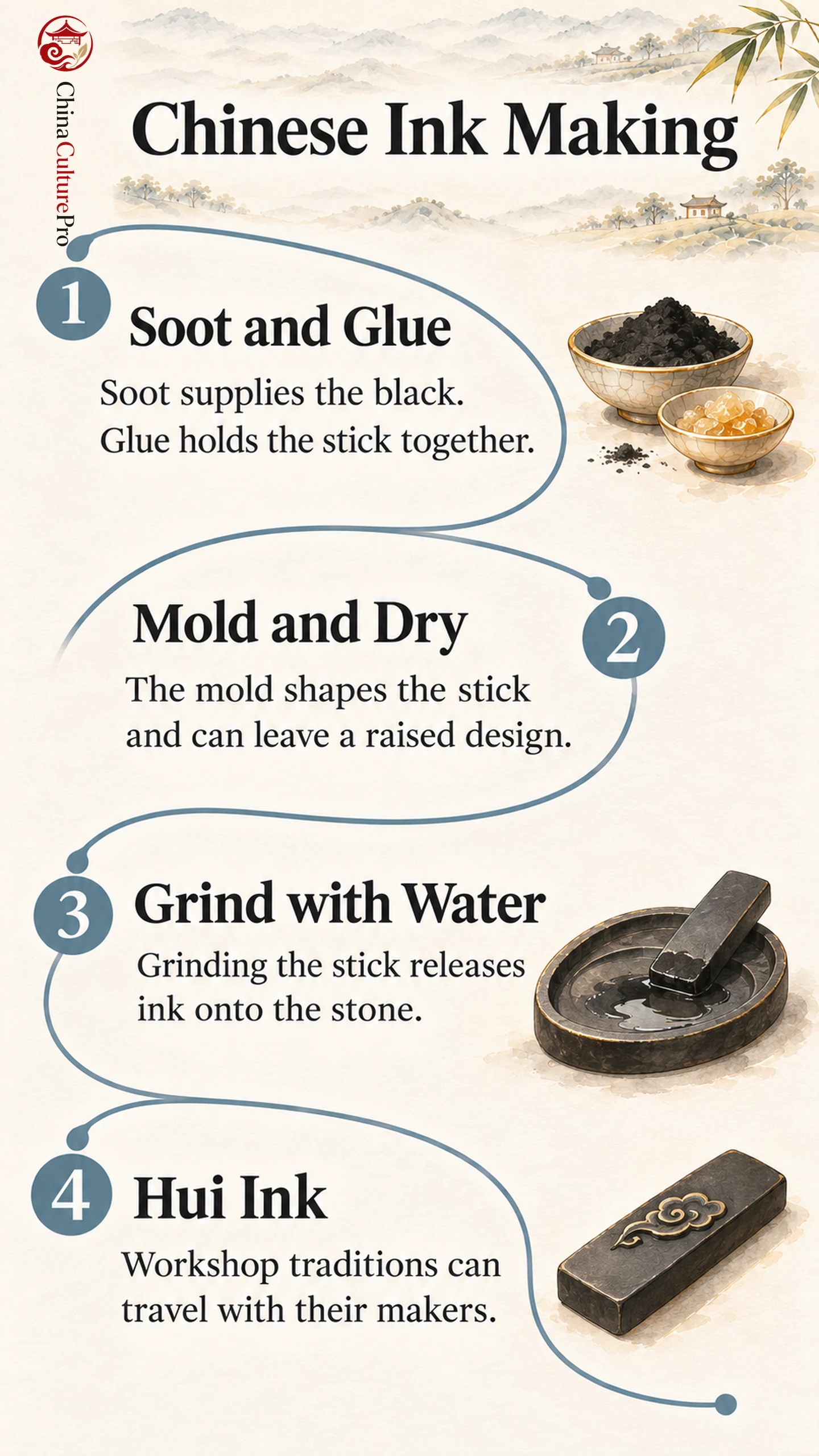
- Soot: Fine carbon particles give the ink its black color.
- Glue: A binder holds the dry stick together.
- Water and stone: Grinding releases ink for a brush to pick up.
The stick can be stored dry. Grinding prepares the ink as it is needed.
A black stick with a gold design might look like a small sculpture. The decorated face shows the work of the mold and finishing tools. The working end reveals how the same object supplies ink for writing and painting.
Pine Soot, Lampblack and Glue
Pine soot (松烟, sōngyān) comes from burning pine material and collecting the fine black deposit. Oil soot (油烟, yóuyān), often called lampblack in descriptions of ink, comes from burning oils. The Hui workshop records describe preparing and collecting soot from different sources, including tung oil. The collected particles supply the color. The soot’s name tells you what was burned.[1][2]
Traditional animal glue binds the particles into a coherent mass. Without a binder, the collected soot remains loose. Workshops can choose different glues and formulas. The soot source alone is a poor guide to the exact shade or sheen on paper because the stick and the way the artist prepares it both affect the result.[1][2][4]
From Soot to a Dried Inkstick
After collection, the soot is mixed with binder and the mass is worked until it can take shape. The maker presses it into a mold. A carved mold can shape the entire stick and impress a design on its face. Drying is a separate stage. The Cao Sugong workshop account describes turning the sticks during drying and tracing designs with gold as part of the finish.[2][3]
A molded emblem belongs to the object’s surface, and may tell you something about a maker or intended use. Gold on raised decoration is distinct from the black writing material. Shops can produce multiple designs from different molds while following a similar sequence of collecting soot, mixing, shaping and drying.[3][4][6]
Grinding Ink on an Inkstone
The grinding area of an inkstone has a fine texture that abrades the stick in the presence of water. The resulting liquid gathers on the stone, sometimes in a recessed well. The guide to Chinese inkstones distinguishes the working surface from the place that holds the ink. The artist can draw the brush through the collected ink.[4]
Water changes the concentration of the black particles picked up by the brush. A more concentrated ink can give a dark stroke, while dilution allows lighter washes. In Chinese calligraphy and Chinese ink painting the brush and paper also influence how that ink moves and dries. Ink, brush, paper and stone are grouped as the Four Treasures of the Study.[4]
Hui Ink and the Evidence on a Stick
Hui ink (徽墨, huīmò) takes its name from the historical Huizhou region. The national inventory describes workshops in Anhui and also records a Cao Sugong branch that developed in Shanghai after the business relocated there in 1864. The locations tell the story of a regional craft that traveled with makers and businesses. Both records document workshop skills within Chinese intangible cultural heritage and describe variation among workshops.[1][3]
The Smithsonian lists an inkstick from the Hu Kaiwen shop as used and assigns it a date of 1821–1850 or possibly later. It records soot and glue with gold pigment and lacquer. Another nineteenth-century stick from the same shop is catalogued as soot and glue with gold pigment. Those details describe the individual objects. They show how a stick can carry a surface finish and still serve as a writing tool.[5][6]
FAQs About Chinese Ink Making
Is Chinese ink made from pine soot alone?
Traditional black sticks can use soot collected from pine or oil. The soot is worked with a binder so the mixture can hold together as a dry stick.
Why is an inkstick ground with water?
Water receives the material released as the stick is ground. The amount of water affects the concentration and the shade the brush puts on paper.
Does a gold design make the ink gold?
Gold pigment can decorate a molded surface. That decoration is separate from the black ink prepared at the working end of the stick.
Does every Chinese ink come from an inkstick?
An inkstick is a solid form prepared on an inkstone. Ready-made liquid ink is also available for brushes.
Sumber
[1] Museum Digital Warisan Budaya Takbenda Tiongkok. Hui Ink Making Techniques
[2] Academy of Chinese Studies. Traditional Hui Inkstick Craftsmanship
[3] China Intangible Cultural Heritage Digital Museum. Hui Ink Making: Cao Sugong Inksticks
[4] Smithsonian National Museum of Asian Art. Four Treasures of a Scholar’s Studio
[5] Smithsonian National Museum of Asian Art. Inkstick (Used), F1983.12.2
[6] Smithsonian National Museum of Asian Art. Inkstick, F1983.12.26