

Quick Answer: How Are Chinese Brushes Made?
A Chinese brush (毛笔, máobǐ) has a shaped bundle of fibers held in a handle. In traditional workshops, makers sort and align hair, form a tapered head, secure the base and fit it into the handle. A final inspection removes fibers that would interfere with the point.[1][2][4]
- Fiber: The maker selects hair for qualities such as softness and spring.
- Head: The bundle’s length, profile and density influence the mark.
- Handle: The shaft holds the head steady and can have its own finish.
The name of a fiber is one clue. The finished head gives it a working shape.
Press a wet brush against paper and its point spreads. Lift it and the tip gathers again. That movement depends partly on the fibers the maker selects and how they are arranged in the head.
Goat, Weasel, Hare and Mixed Hair
| Traditional material name | Apa yang digambarkan |
|---|---|
| Goat hair (羊毫, yángháo) | Often makes a softer head with capacity for ink. |
| Weasel hair (狼毫, lángháo) | Traditional name for hair from the weasel’s tail, often used for a firmer feel. |
| Purple hare hair (紫毫, zǐháo) | Dark hair associated with hare, used in some springy brush heads. |
| Mixed hair (兼毫, jiānháo) | Combines softer and firmer fibers in one head. |
Hair from the same animal can vary by length, thickness and the condition of its tip. The workshop account describes separating fibers for different parts of the head. A long bundle can bend differently from a short one made with the same kind of fiber. The guide to Chinese calligraphy brushes covers how those choices affect writing.[2][4]
From Loose Hair to a Finished Brush Head
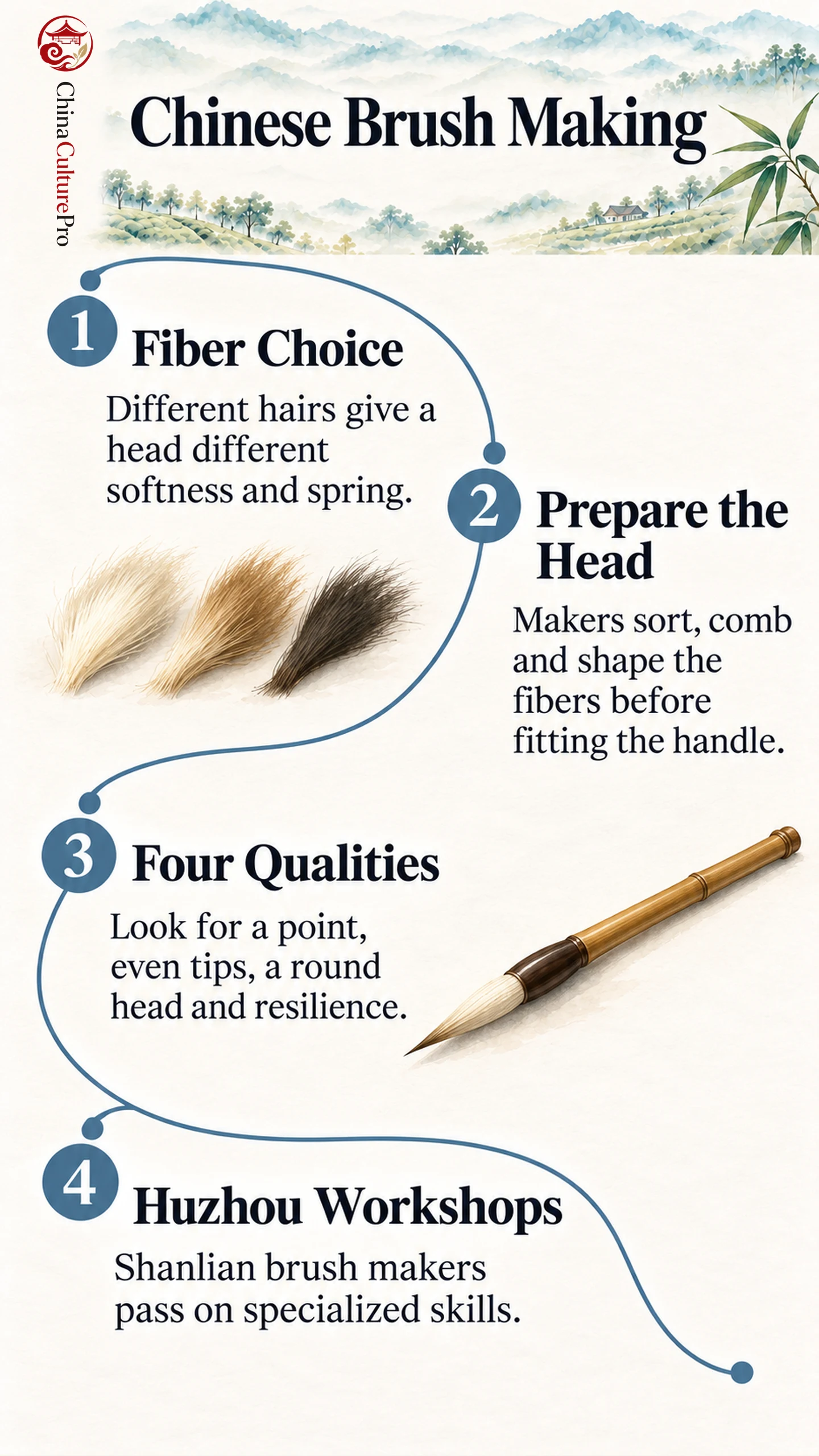
The preparation known as wet sorting (水盆, shuǐpén) includes washing, selecting, combing and shaping the hair. That work lets the maker align the tapered tips and build a bundle of the intended size. Fibers without usable tips can be picked out. In a mixed head, the placement of the different fibers is part of the design.[2]
The formed bundle is secured at its base and mounted in the shaft. In the Shanlian account, workers tie the base and use resin before fitting the head to a prepared handle. Another specialist inspects the mounted head and picks out broken or stray hairs. A brush with a neatly finished handle still depends on this closer inspection at its working end.[1][2][3]
What the Four Brush Qualities Mean
Huzhou workshop records describe four qualities. A point means the wet tips gather into a fine end. Evenness is visible when the tips are spread. A full, round head keeps its volume around the shaft. Resilience describes how the head responds to pressure and gathers again as pressure eases.[1][3][5]
These qualities can serve different marks. A fine point helps with a narrow line. A head that holds more ink can lay a broad stroke or wash. In Chinese ink painting and Chinese calligraphy the effect also depends on pressure, ink and the absorbency of the sheet. The guide to Xuan paper explains one widely used family of supports.[4]
Huzhou Brush Making and Historical Examples
The Huzhou brush (湖笔, húbǐ) is associated with Shanlian in Zhejiang. The national inventory records the specialization of the workers and the craft’s inclusion in 2006. The practitioner record for Qiu Changming describes expertise in selecting and refining finished heads and teaching apprentices. This is part of the living skill recorded in Chinese intangible cultural heritage.[1][3]
A Qing brush in the Palace Museum has a bamboo shaft, a cap and a purple-hair head. Its decorated inscription wishes the owner success in the imperial examinations. A Smithsonian set has brushes with inscribed ivory holders. The inscriptions tell part of each object’s history, while the head does the writing. A brush in use belongs alongside ink, paper and inkstone in the Four Treasures of the Study.[4][5]
FAQs About Chinese Brush Making
Does langhao mean real wolf hair?
In traditional brush terminology, langhao refers to weasel hair. Check the maker’s fiber description when reading an English label.
Are softer brushes always larger?
Softness describes the response of the fibers. Head length and width describe size. A small head can be soft and a large head can be firm.
Can one brush be used for painting and calligraphy?
Many brushes can serve both. Point, fullness, spring and the scale of the intended mark affect how well a particular brush suits the task.
What makes a Huzhou brush different?
The name points to a Huzhou regional tradition, especially Shanlian. Its documented practices include careful fiber sorting and inspection by specialist workers.
Sumber
[1] Museum Digital Warisan Budaya Takbenda Tiongkok. Huzhou Brush Making Techniques
[2] China Intangible Cultural Heritage Digital Museum. The Making of a Huzhou Brush
[3] China Intangible Cultural Heritage Digital Museum. Qiu Changming: Huzhou Brush Making Practitioner
[4] Smithsonian National Museum of Asian Art. Four Treasures of a Scholar’s Studio
[5] The Palace Museum. Bamboo-Handled Purple-Hair Brush with Examination Inscription