
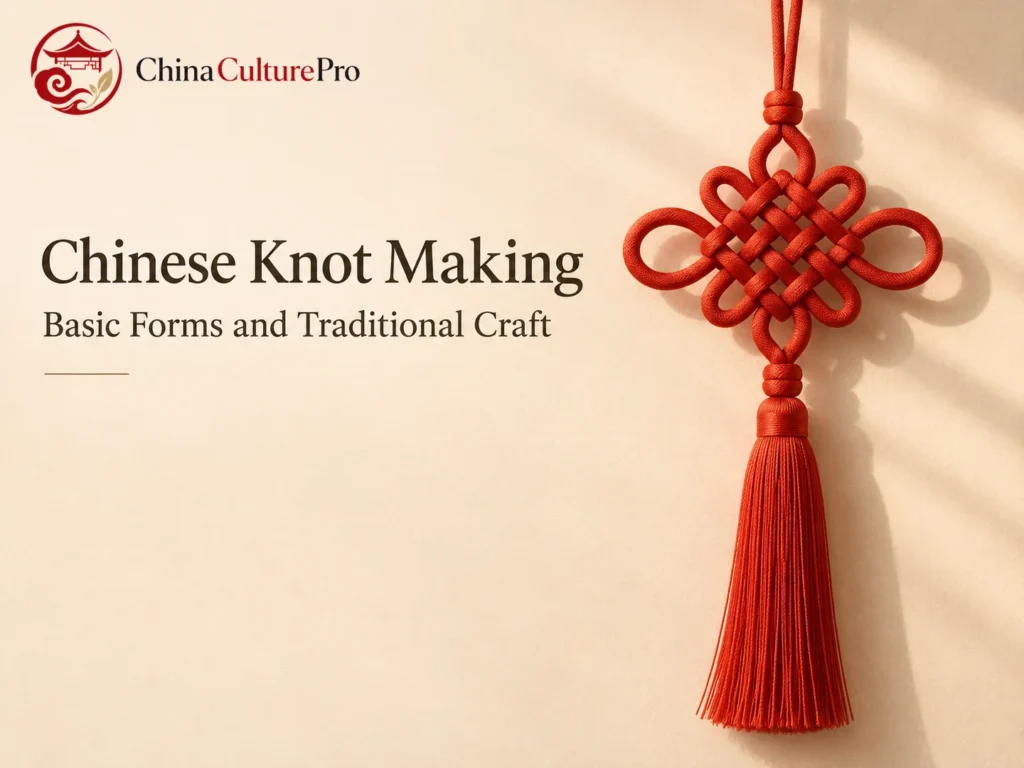

Quick Answer: What Is Chinese Knot Making?
A Chinese knot (中国结, Zhōngguó jié) is a decorative form made by interlacing cord. A piece can consist of one knot or several knots arranged with other elements. The way the cord crosses, turns and tightens gives each form its outline.[1][2]
- Knot body: The crossings hold the main shape.
- Loops: Exposed turns can form a border, a pair of lobes or a hanging point.
- Finish: A knot can be combined with a tassel, pendant or another knot.
To identify a form, trace the cord before interpreting the color or decoration.
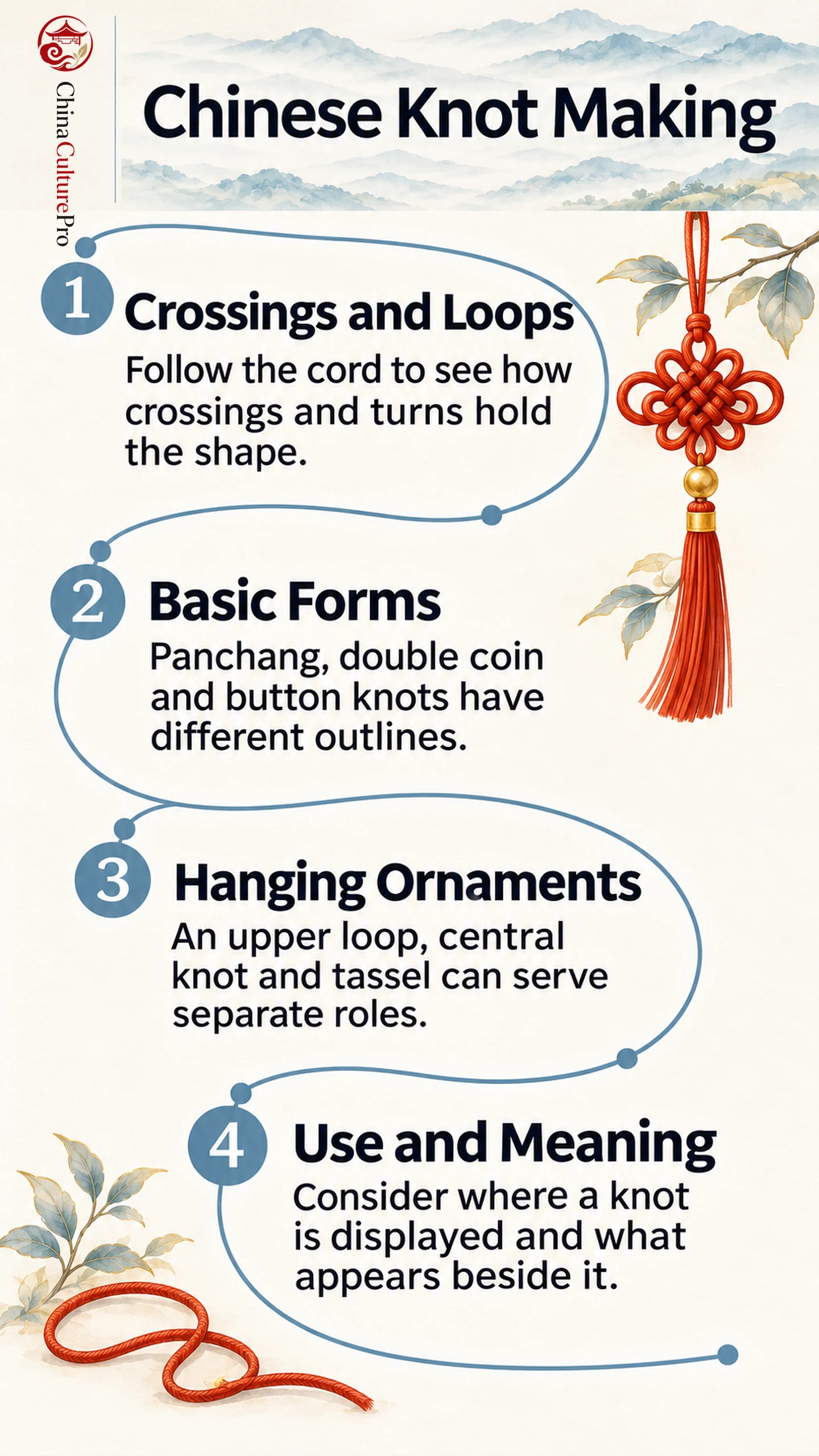
Two pieces of red cord can look alike until you follow where the strands cross. One might form two low loops, while another creates a layered center and a ring of turns. Those differences help you recognize the knot and understand how it is used.
How Crossings, Loops and Tension Shape the Knot
A crossing describes which part of the cord lies over another. A loop is a turn in the cord that leaves an opening or projects from the body. The same cord may create several crossings before it leaves the knot. Start at a visible loop and follow the path toward the center.[2]
Making and finishing also involve different decisions. A maker can arrange the cord loosely to see the path, then adjust the loops and tighten the form. The visible shape depends on how the slack is distributed. Two loops that are meant to look alike can end up different sizes if one takes more cord than the other.[2][3]
Cord has properties that shape the result, as materials do in other Chinese traditional crafts. Wider cord can make each crossing easier to see. A flexible cord can follow a narrow turn. As you compare samples, check whether a change comes from the path or from the cord itself.
Three Basic Forms: Páncháng, Double Coin and Button
| Bentuk | Ciri yang perlu diperhatikan |
|---|---|
| Páncháng knot (盘长结, pánchángjié) | Repeated turns interlace through a broad center and form loops around the edge. |
| Double coin knot (双钱结, shuāngqiánjié) | Two overlapping round shapes give the form a low, paired outline. |
| Button knot (纽扣结, niǔkòujié) | A compact raised body gathers the cord into a rounded form that can serve as a decorative closure. |
The names describe different kinds of form. A páncháng design spreads repeated crossings across a flat body. A button knot gathers the cord into a rounded shape. For a double coin knot, look for the paired outline before counting any other loops elsewhere in the ornament.[1][2][3]
From One Knot to a Hanging Ornament
A hanging ornament has parts with different jobs. An upper loop can attach it to a support. A larger knot can form the center, while a tassel adds strands that hang free below. A small connector may sit between them. The central knot can often be identified without including every decorative addition.[1][3][7]
Cordwork can also be part of another object. The dictionary gives lanterns and pendants for fans as examples. The attachment matters in each case. A pendant hangs from its support, while a closure has to meet a matching loop. A similar knot body can serve different roles depending on the rest of the piece.[1]
Knot Motifs, Festive Use and Craft Teaching
Red hanging knots are familiar among Chinese New Year decorations. A Spring Festival exhibition of Xinjin (新津, Xīnjīn) cordwork described several forms, including páncháng and double coin knots. A Haidian teaching event recorded participants practicing red cord ornaments. The examples connect knot names and techniques to documented settings.[4][7]
A knot shape can also appear as an image. A Qing box in the Smithsonian’s lacquerware collection carries an endless-knot motif. The museum’s teaching resource reads it alongside other signs associated with longevity. The carved motif represents a knot. The material and the object’s use are separate from those of a tied ornament.[5][6]
Read the display context when interpreting an auspicious wish. Look for the occasion and the motifs next to the knot. A longevity wish on a carved box and a festive cord hanging can use related forms in different settings. Both can appear in accounts of living heritage.[4][6][7]
FAQs About Chinese Knot Making
Do Chinese knots have to be red?
Red is familiar in festive displays. Cord color is a design choice, while the shape depends on the way the cord crosses and turns.
Is a tassel the same as a Chinese knot?
A tassel is made of hanging strands. It can be attached to a knot, and the two elements serve different visual roles.
Is an endless-knot image always made from cord?
An endless-knot image can be drawn, woven or carved. The Smithsonian’s lacquer box carries a carved example.
Does one Chinese knot have only one meaning?
A name may suggest an association. The object, the surrounding motifs and the occasion help establish how a knot is being used.
Sumber
[1] Taiwan Ministry of Education. Chinese Knot
[2] Chinese Knotting Home Page. Glossary: Decorative Knot Parts
[3] Chinese Knotting Home Page. The Chinese Knotting Home Page
[4] China Intangible Cultural Heritage Digital Museum. Celebrating Spring Festival at the China Intangible Cultural Heritage Museum
[5] Smithsonian National Museum of Asian Art. Box Decorated with Images of Spring and Longevity
[6] Smithsonian National Museum of Asian Art. Lucky Symbols in Chinese Art
[7] Haidian District Government. Teaching Traditional Cord Knots in Haidian