
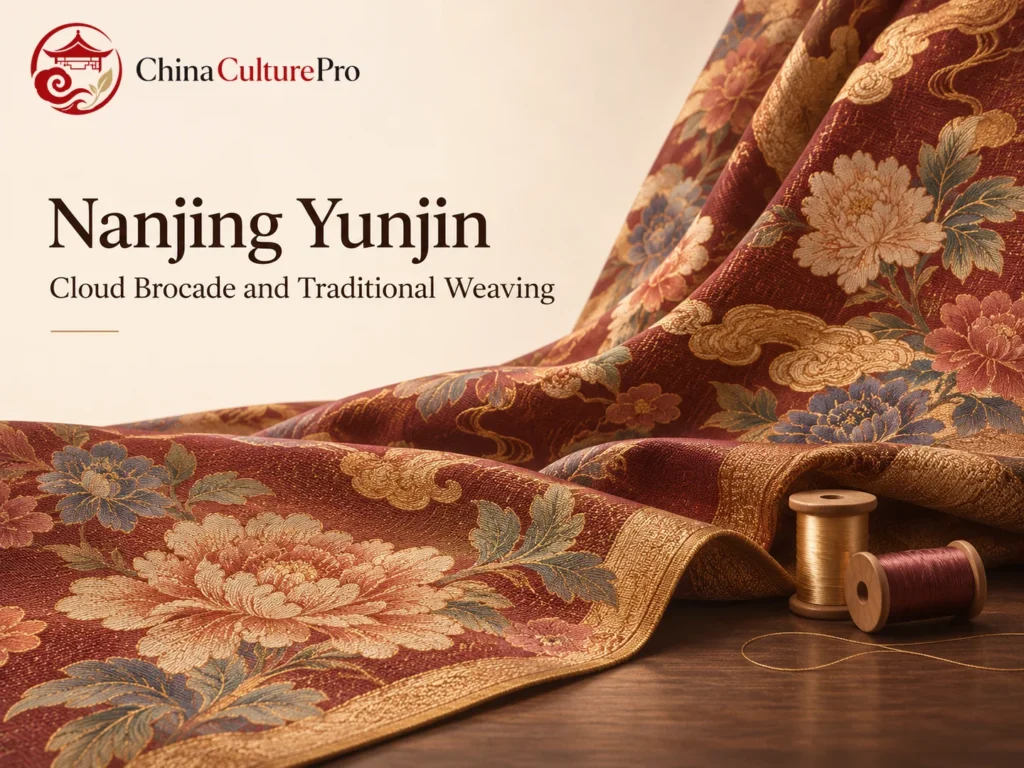

Quick Answer: What Is Nanjing Yunjin?
Nanjing Yunjin (南京云锦, Nánjīng yúnjǐn), often called cloud brocade, is a patterned silk weaving tradition from Nanjing, Jiangsu. In its traditional drawloom practice, two workers coordinate the threads that create the cloth and its design.[1][2]
- Loom: One person works above to select threads, while another weaves below.
- Pattern: Colored and decorative threads can contribute different effects to the cloth.
- Use: The repertoire includes court textiles and work made for contemporary uses.
The regional name describes a craft tradition with several kinds of fabric.
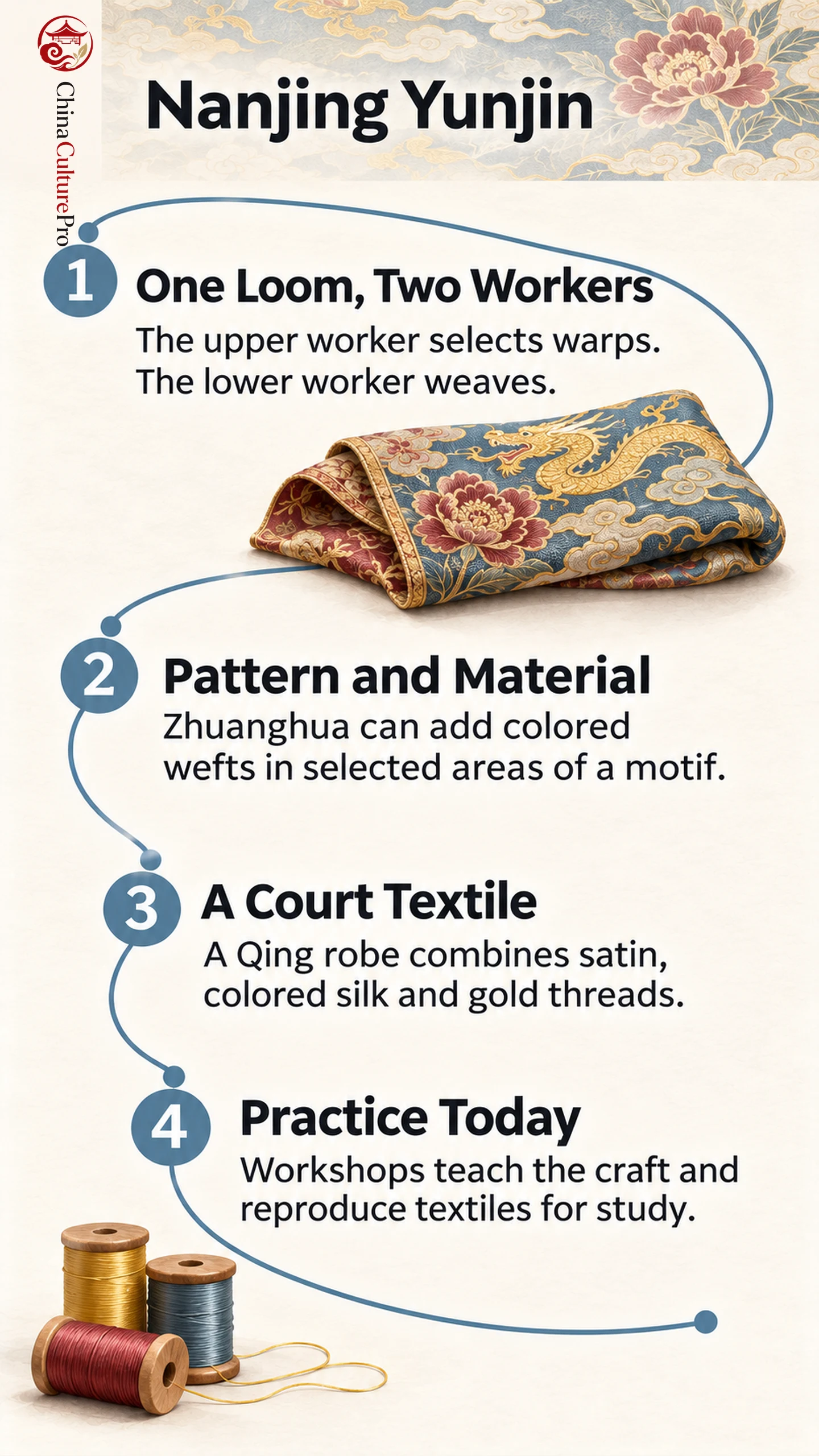
A bright flower on a Yunjin cloth starts with a plan for lifting threads. On a traditional Nanjing loom, one person works above the other. Their coordination connects the drawn design with the colored threads you see in the finished fabric.
How Two Weavers Work at One Loom
The upper worker selects groups of warp threads according to the pattern. Below, the weaver passes the weft across the selected threads. The weaver needs the intended group of warp threads raised before passing a given weft. The sequence connects the two roles. The UNESCO record describes songs that help workers remember and coordinate those movements.[1][2][3]
The drawing tells the workers what they are aiming for. The way the loom is set up determines which selections they can make during weaving. This division of work has a counterpart in the documented loom practice of Shu brocade, a separate Sichuan tradition. The wider guide to Chinese silk weaving explains warp and weft across other structures.[1][2][6]
Pattern Preparation, Zhuanghua and Materials
The design is worked out before weaving begins. Drafting identifies the pattern, while preparing the loom translates it into selections the upper worker can make. Those selections determine where particular threads will show. Pattern planning and color placement are related decisions. One establishes where a motif can appear. The other affects how it looks.[1][2]
Zhuanghua (妆花, zhuānghuā) is a patterned Yunjin category. Colored pattern wefts can be worked in particular sections over a ground, so different parts of a motif can receive different colors. Some ends are visible on the reverse. In kesi silk tapestry, localized wefts instead build areas of the cloth itself across continuous warps. When a label describes local wefts, check whether they make the ground itself or add a motif over it.[3][4][7]
UNESCO’s craft record mentions silk, gold and peacock-feather yarn among materials used in Yunjin. An individual textile may include only some of them. Read its material description before interpreting every bright strand as metal.[1]
The national inventory distinguishes several groups within Yunjin, including fabrics classed for their metal-thread work and the group called zhuanghua. That is why the regional name alone does not tell you how a pattern thread runs. A more specific textile description can identify both the ground and the patterning method.[2][3]
A Qing Court Robe in the Palace Museum
The Palace Museum records a lined robe with flying phoenixes, dated to the Qianlong reign of the Qing dynasty. The catalogue attributes it to the Jiangning (江宁, Jiāngníng) weaving office in present-day Nanjing. It identifies the fabric as zhuanghua satin, with colored silk and round gold threads forming patterns on the ground.[4]
The description also identifies a plain silk lining. The label records a garment with two layers. Within its outer cloth, the satin ground and phoenix pattern use different threads and structures. Read those fields separately in museum collection records when a short title names both a textile and a garment.[4]
The robe description notes several kinds of color gradation. Some of its changes in tone come from arranging colored threads within the woven motif. Read them alongside the gold detailing, since sheen and the change from one shade to another can come from different choices.[4]
How Workshops Preserve and Recreate Textiles
The Nanjing handweaving practice entered China’s national intangible cultural heritage inventory in 2006. UNESCO inscribed the craftsmanship on its Representative List in 2009. The first is a Chinese national listing. The second is an international inscription.[1][2]
Workshops also reproduce textiles for study and display. In 2020, the Hunan Provincial Museum reviewed six reproductions made by the Nanjing Yunjin Research Institute from finds at the Mawangdui (马王堆, Mǎwángduī) Han tombs. The project documents a modern workshop working from older textile evidence. The report’s date describes when the project was completed. The Han date describes the material evidence on which the reproductions were based.[5]
FAQs About Nanjing Yunjin
Is all Nanjing Yunjin made with gold thread?
Gold thread appears in documented pieces, including the Palace Museum robe. Silk and other decorative yarns can also be used, depending on the fabric.
Is zhuanghua another name for every Yunjin textile?
Zhuanghua is one category within the broader Yunjin tradition. A record using that term is identifying a particular kind of patterned textile.
Is Nanjing Yunjin a type of embroidery?
In Yunjin, the pattern forms on the loom. In Chinese embroidery a needle adds stitches to an existing cloth.
What does the UNESCO listing cover?
UNESCO lists the craftsmanship of Nanjing Yunjin brocade. It records the weaving practice and its transmission, including the coordinated work of the two loom workers.
Источники
[1] UNESCO. Craftsmanship of Nanjing Yunjin Brocade
[2] China Intangible Cultural Heritage Digital Museum. Handwoven Nanjing Yunjin Zhuanghua on a Wooden Loom
[3] China Intangible Cultural Heritage Digital Museum. Handwoven Nanjing Yunjin Zhuanghua on a Wooden Loom: Extension
[4] The Palace Museum. Lined Zhuanghua Satin Robe with Flying Phoenixes
[5] Hunan Provincial Administration of Cultural Heritage. Completion of the Mawangdui Han Tomb Textile Reproduction Project
[6] China Intangible Cultural Heritage Digital Museum. A Study of Shu Brocade Weaving Techniques
[7] The Palace Museum. Continuous Warp and Discontinuous Weft