


Quick Answer: How Do You Read a Chinese Museum Label?
Start with the title, date and medium. Then find the accession number or object number, which identifies the piece within the institution’s collection. A credit line records how the museum acknowledges an acquisition. Earlier ownership usually appears in a separate provenance entry.[1][2][6]
- Look at the object: Compare its form, size and material with the label.
- Keep dates separate: Read the estimated date of manufacture and the acquisition information independently.
- Find the record: Search the institution’s collection by the complete object number.
The short gallery label and the online record serve different purposes. Use them together.
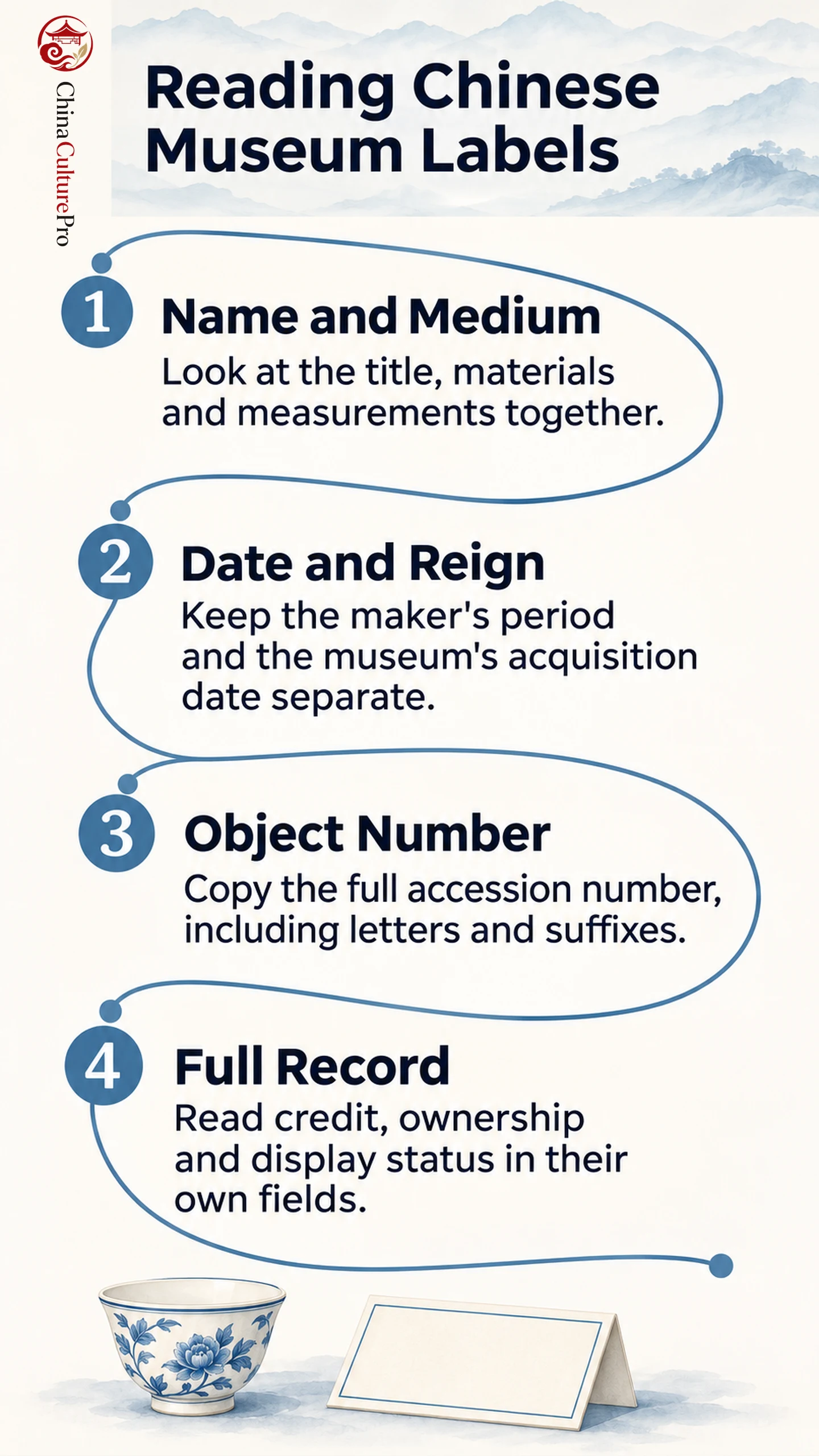
A museum label might give a date range, a donor’s name and a two-word title. Each tells you something different. Use the title to orient yourself, then follow the catalogue number to learn more about the specific object.
Read the Object Name and Medium Together
A title may describe a shape, a decoration or an intended function. In Chinese art collections, it may appear alongside a more descriptive Chinese title. Use the medium field to separate the body from the finish. A porcelain vessel can carry several surface treatments, and the wording may tell you where each one sits.[1][2]
A chicken cup (鸡缸杯, jīgāngbēi) in the Metropolitan Museum of Art shows why the fields are useful together. The title refers to the depicted birds. The medium identifies porcelain with cobalt blue below the glaze and colored enamels above it. The cup is 4.1 cm high, a useful check against the impression made by a large gallery image.[2]
Look for which dimension was taken. The diameter of the cup’s rim and the diameter of its foot describe different features. A single number marked “diameter” on another catalogue entry may use a different reference point.[1][2]
What Dynasty, Reign and “Circa” Tell You
The Ming dynasty is a broad historical period. A reign gives a narrower interval within it. For the Met cup, “Chenghua mark and period” means the piece bears a mark naming the Chenghua (成化, Chénghuà) reign, and the catalogue also dates the cup to that reign, 1465–1487.[2]
Compare an unmarked jar (zhadou, 渣斗, zhādǒu) in the Smithsonian collection. The label discusses dates from the Chenghua reign to as late as the Zhengde reign. It notes that scholarly opinions differ. In your notes, record the physical mark and proposed date separately. The mark field describes what appears on the object, and the period field gives the museum’s dating.[3]
Look for qualifiers such as “ca.” or “probably” before recording a date. They carry information about the precision of the estimate. For example, the Smithsonian’s bronze ewer is dated to about 1100–1050 BCE. An estimated range can be useful even when the maker is unknown.[1][4]
Use the Accession Number to Find the Full Record
Take the museum name and full accession number from the label. Try those together in the museum’s collection search. Keep any letters, hyphens or part suffixes, because a record may describe an object made up of several pieces.
One Smithsonian page calls a lidded bronze ewer a guang (觥, gōng), while the collection record uses “gong” in its title. Both give F1961.33a-b as the accession number. The shared identifier lets you connect the teaching material with the fuller description of this example of Chinese bronze vessels even when the English wording differs.[4][5]
The fuller record distinguishes the absence of an original inscription from later stickers and painted markings. It also gives the dimensions in height, width and depth, which helps match the vessel to a second record. An image of the underside could therefore show numbers that belong to the piece’s collecting history. Read the field name before treating the marks as part of the original design.[4]
If the object number is missing from a photo of the label, search by institution, material and a distinctive phrase from the title. Compare the dimensions and the object image before copying the number. Several entries can share a name as broad as “vase.”[1]
Read Credit Lines, Provenance and Display Status Separately
| Поле | What it tells you |
|---|---|
| Credit line | How the museum acknowledges a gift, purchase or other acquisition. |
| Provenance | The object’s known ownership or custody history, including gaps in the published account. |
| Exhibition history | Past displays involving the object. |
| Display status | The institution’s current indication of whether or where it is shown. |
The Met chicken cup’s credit identifies a purchase made using a gift in 1987. That date belongs to the museum’s acquisition record. Read each phrase in the credit line before assuming that everyone named once owned the cup. To trace earlier owners, look for the provenance entry and its supporting references. The guide to Chinese antiquities provenance explains why a dated acquisition is only one point on that timeline.[2][6]
Before planning to see a particular piece, check the display field for the collection and gallery. An image and an exhibition history can remain online when the object is in storage or on loan.
FAQs About Chinese Museum Collections
Why can the same Chinese museum object have two English names?
Museums may translate the original name differently or choose either a form name or a longer description. Compare the collection and accession number before assuming they describe separate pieces.
What does “circa” mean on an object label?
It means “approximately.” Record the qualifier with the year or range so your notes preserve the catalogue’s uncertainty.
Can an accession number tell you how old an object is?
Use the date or period field. A collection number identifies a record, and any year-like digits can reflect the institution’s numbering system.
Why can I find a piece online when it is not on display?
A collection database documents holdings over time. Gallery displays change independently. Look for a separate display field or current exhibition listing.
Источники
[1] Getty Research Institute. Getty Vocabulary Editorial Guidelines: List of Fields
[2] The Metropolitan Museum of Art. Chicken cup, 1987.85
[3] Smithsonian National Museum of Asian Art. Slops jar (zhadou), F1951.12a-c
[4] Smithsonian National Museum of Asian Art. Ritual wine ewer (gong) with masks, dragons, and real animals
[5] Smithsonian National Museum of Asian Art. Lidded ritual ewer (guang)
[6] Smithsonian Institution. Provenance