
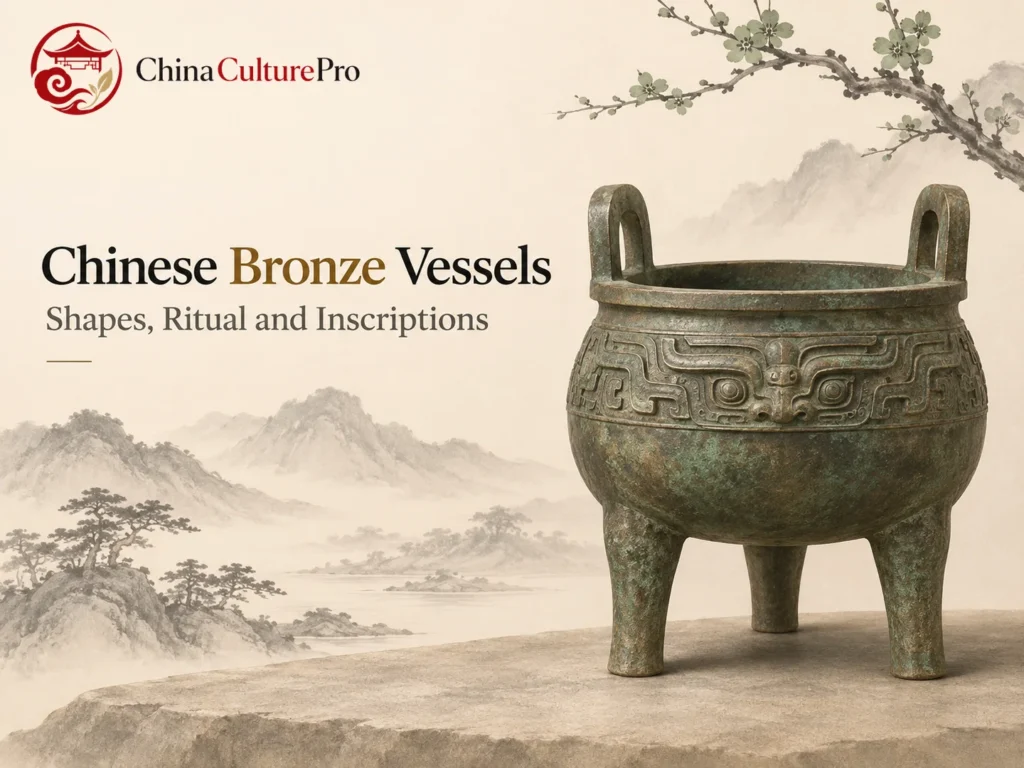

Quick Answer: What Are Chinese Bronze Vessels?
Chinese bronze vessels are containers cast in a copper alloy. Many famous Shang and Zhou examples belong to ceremonies involving food or drink offerings to ancestors. Their form, surface and inscriptions give different kinds of evidence about the way they were used.[1][2]
- Shape: Legs, feet, spouts, posts and covers help distinguish common vessel types.
- Making: Sectioned clay molds and an inner core could create the exterior and hollow interior in the same casting.
- Writing: An inscription may identify a group, dedicate an object or commemorate an event.
Use shape as a starting point and read the catalogue for the specific date and context.
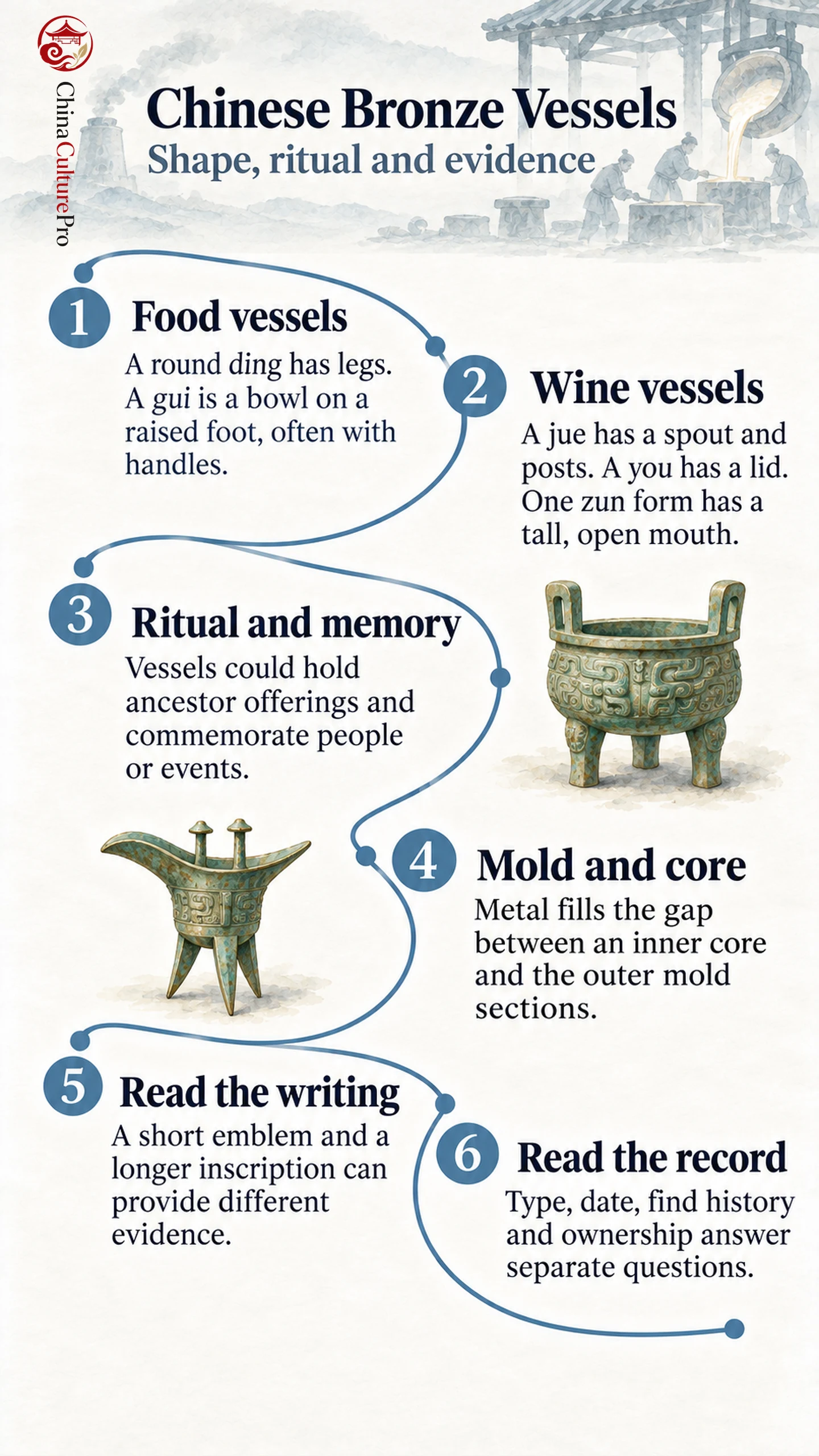
A tripod, a handled bowl and a tall wine container may share a display case. Compare their outlines, then look for clues to how each vessel was cast and what its inscription records.
Ding, Gui, Jue, You and Zun by Shape
Museum labels often pair a Chinese type name with an English description. Compare each shape before reading its attributed use.
| Vessel type | Внешние признаки | Typical association or example |
|---|---|---|
| Ding (鼎, dǐng) | A round example stands on three legs. | Food vessel. A twelfth-century BCE example has a cast emblem inside.[1] |
| Gui (簋, guǐ) | A bowl on a raised foot, often with handles. | Food offerings. A Western Zhou example takes the form of a deep handled bowl.[2] |
| Jue (爵, jué) | Three legs, a projecting spout and two posts above the rim. | A vessel associated with serving warmed wine in ritual.[3] |
| You (卣, yǒu) | A container with a separate lid. | A wine container. Two lidded examples occur in a late eleventh-century BCE group.[4] |
| Zun (尊, zūn) | One familiar form is a tall container with an open mouth. | A tall example appears with two covered wine containers in a late eleventh-century BCE group.[4] |
Offerings, Ancestors and Commemoration
In the Shang dynasty, ritual vessels held offerings for ancestors. A vessel’s food or drink role describes one part of a ceremony. A food container might also carry the emblem of a family or group. Such writing connects a practical shape to the people who commissioned or used it.[1]
During the Western Zhou period, vessels also provided durable surfaces for recording events. An inscribed object could serve in ancestor rites and preserve a record of a political or military event. Other objects such as carved jade belonged to overlapping ritual contexts and were worked by different methods.[2]
How Piece-Mold Casting Shaped the Surface
In piece-mold casting, artisans made an outer mold in sections around a model. They reassembled the mold around a smaller core. Molten bronze filled the gap between the core and the outer sections, forming the walls of the vessel. After the bronze cooled, the mold could be broken away and the surface finished.[5]
The core defines the cavity, and the inner face of the outer mold defines the exterior. Some raised ribs align with mold joins. A rib can help you think about how sections met, while the decoration still has its own visual organization.[5]
An animal-mask pattern often called taotie (饕餮, tāotiè) is visible on a Shang tripod. Paired eyes, horns or other facial details draw attention to its symmetry. The later name describes the motif. Its original meaning in a given ritual remains open to interpretation.[1]
What Inscriptions Can Tell Us
Look for writing where the museum record locates it. On the Shang tripod described above, an emblem was cast on the interior. The emblem may help group the vessel with related pieces. It gives less detail about an event than a longer text.[1]
The Li gui (利簋, Lì guǐ) provides a more explicit historical record. The inscription inside its base records King Wu’s conquest of the Shang. It is part of the evidence for placing the vessel at the beginning of the Western Zhou. The text supplies historical evidence in addition to the vessel’s form.[6]
Rubbings allow researchers to study an inscription outside a display case. A rubbing records the visible signs, and a transcription renders them in readable form for comparison. The translation adds interpretation. Read the three alongside the vessel’s collection record when they are available.[2]
How to Read a Bronze Vessel in a Museum
Read the type, material, date and ownership fields in the museum catalogue. A type name can recur in different centuries. A record for a particular vessel gives you an accession number and a statement of the evidence used for its date.
A group said to come from one tomb can contain different inscriptions and styles. In one late eleventh-century BCE assemblage, a few inscriptions match while others differ. Its reported discovery and the museum’s proposed arrangement carry different kinds of certainty. That distinction is central to reading Chinese antiquities provenance.[4]
FAQs About Chinese Bronze Vessels
What is the difference between a ding and a gui?
A round ding often has legs. A gui commonly has a bowl-like body with handles and a raised base. Both names occur on food vessels.
Were all bronze vessels used to hold wine?
Food and drink vessels can occur together. A ding or gui is commonly associated with food, while a jue, you or zun may be associated with wine.
Were the inscriptions painted onto the bronze?
Many historic inscriptions were formed in the casting. Read the record for the technique of the individual example, especially if it was made or altered in a later period.
Does a Shang-style vessel shape establish the date?
The shape helps identify a type. Later ritual objects can repeat earlier forms, so use additional evidence such as manufacture, inscriptions and archaeological context.
Источники
[1] Seattle Art Museum. Ding, 49.152
[2] Ashmolean Museum. Ritual Food Vessel, or Gui, with Inscription
[3] The Metropolitan Museum of Art. Ritual Wine Warmer (Jue), 12.134.32
[4] The Metropolitan Museum of Art. Ritual Wine Container (Yu) and Related Vessels
[5] National Museum of Asian Art, Smithsonian Institution. Piece-Mold Casting
[6] National Museum of China. “Li” Bronze Gui (Food Container)