

Quick Answer: What Is Kesi?
Kesi (缂丝, kèsī) is a Chinese silk tapestry technique. The warp runs continuously through the design. Colored wefts turn back at the edges of local areas. Where two colors meet, the weft threads can turn back and leave a narrow slit.[1][2]
- Warp: Continuous threads support the different parts of the image.
- Weft: Local colors interlace with the warp and build the fabric.
- Use: Historical examples include pictorial panels and covers for scrolls.
Look at how the colored areas meet before interpreting the shape of a particular textile.

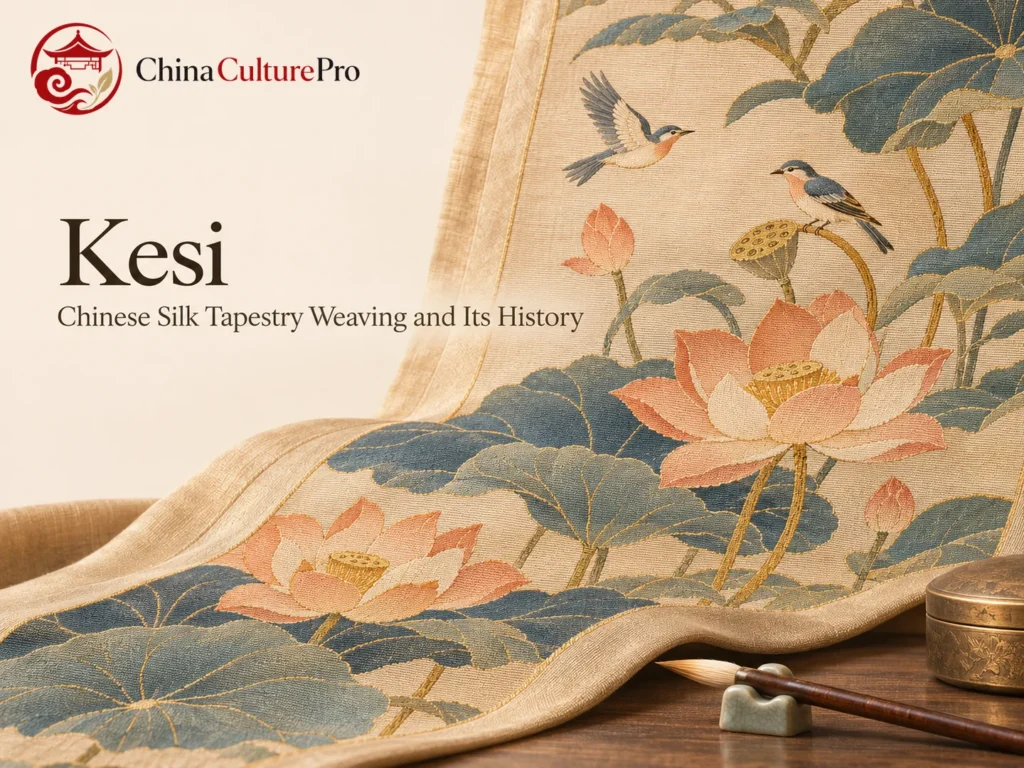
A duck or a lotus on a kesi textile can look painted from a distance. Up close, the edge is made of threads turning back as the color changes. Those turns explain how the picture becomes part of the fabric.
Continuous Warp and Local Weft
The warp is held along the length of the work. The wefts travel across it. In kesi, a weft can reach the edge of its color area and turn back without crossing the full width. This structure is called continuous warp and discontinuous weft (通经断纬, tōngjīng duànwěi). Separate wefts can form neighboring shapes, such as a leaf and the ground beside it, across the continuous warp.[1][2]
Small shuttles can carry different colors. The weaver can switch between them where the design changes. A change in weft makes part of the design while also building the textile. The guide to Chinese silk weaving places this construction among other ways of forming patterns on a loom.[1][5]
Slits, Color Boundaries and the Reverse
A narrow slit can form where two wefts turn around nearby warps without joining. It can look like a cut line, especially along a more upright boundary. Other boundaries can be joined by interlocking the adjacent wefts. An open slit and a joined boundary can occur in the same kind of tapestry.[1][2]
A design can be legible on both faces. The two sides can still differ in how neatly the weft ends are finished. The Met’s textile study records both examples with loose ends on the back and a robe with ends wrapped and trimmed close. A photograph of the front shows only part of that evidence.[2]
Historical Kesi: Pictures, Scroll Covers and Furnishings
The Shanghai Museum records a Southern Song silk tapestry by Zhu Kerou (朱克柔, Zhū Kèróu) depicting young ducks in a lotus pond. The pictorial area is just over one meter in each direction. The catalogue lists ducks, other birds, insects and several plants. The weave makes the individual patches of color that a viewer reads together as birds, water and plants.[3]
A silk tapestry with animals, birds and flowers in the Met collection is dated to the eleventh or twelfth century. It entered the collection as the cover for a handscroll. The record establishes that the cover and painting were paired when they came into the museum. The date of the textile and the date when it was paired with the painting are separate questions in museum collection records.[4]
A mid-Qing throne in the Palace Museum offers a later example of a different use. Its back and arms include inset kesi panels with dragons and waves. The woven images are part of the furniture’s design, while the wooden frame supplies its structure. That record separates the textile from the support in which it is seen.[8]
Suzhou Weaving and the Place of Kesi Among Silk Crafts
The Suzhou kesi entry describes wooden looms and small bamboo tools. It is listed in China’s national inventory from 2006. The safeguarding account discusses the Suzhou practice as part of the broader silk craftsmanship recognized by UNESCO in 2009. The local craft entry and the wider intangible cultural heritage element describe different scopes.[5][6][7]
| Technique | What makes the image |
|---|---|
| Kesi tapestry | Local wefts form areas of the cloth itself on continuous warps. |
| Supplementary-weft patterning | Additional wefts add a pattern to a woven ground. |
| Вышивка | A needle adds decorative stitches to cloth that has already been made. |
Some Nanjing Yunjin textiles also use locally worked pattern threads. To distinguish them from tapestry, ask whether those threads form the cloth or decorate a separate ground. In Chinese embroidery the design can be added later with a needle.[1][2]
FAQs About Kesi
Does kesi mean that the cloth is cut?
The textile is woven. A slit can appear where neighboring wefts turn back, giving the boundary a cut-like look.
Does every kesi piece have visible slits?
Some boundaries show narrow slits. Others can be joined. The pattern can also conceal small openings when you look at it from a distance.
Is kesi a type of embroidery?
Kesi makes the image as the cloth is woven. Embroidery adds stitches to an existing ground.
Are the two faces of kesi always identical?
The design can appear on both sides, while the ends of the threads and the finish can differ.
Источники
[1] The Palace Museum. Continuous Warp and Discontinuous Weft
[2] The Metropolitan Museum of Art. Chinese Textiles: An Introduction
[3] Shanghai Museum. Zhu Kerou: Young Ducks in a Lotus Pond
[4] The Metropolitan Museum of Art. Scroll Cover with Animals, Birds, and Flowers, 1983.105
[5] China Intangible Cultural Heritage Digital Museum. Suzhou Kesi Weaving Techniques
[6] China Intangible Cultural Heritage Digital Museum. Safeguarding Suzhou Kesi Weaving Techniques
[7] UNESCO. Sericulture and Silk Craftsmanship of China
[8] The Palace Museum. Zitan Throne with Inset Kesi Panels