
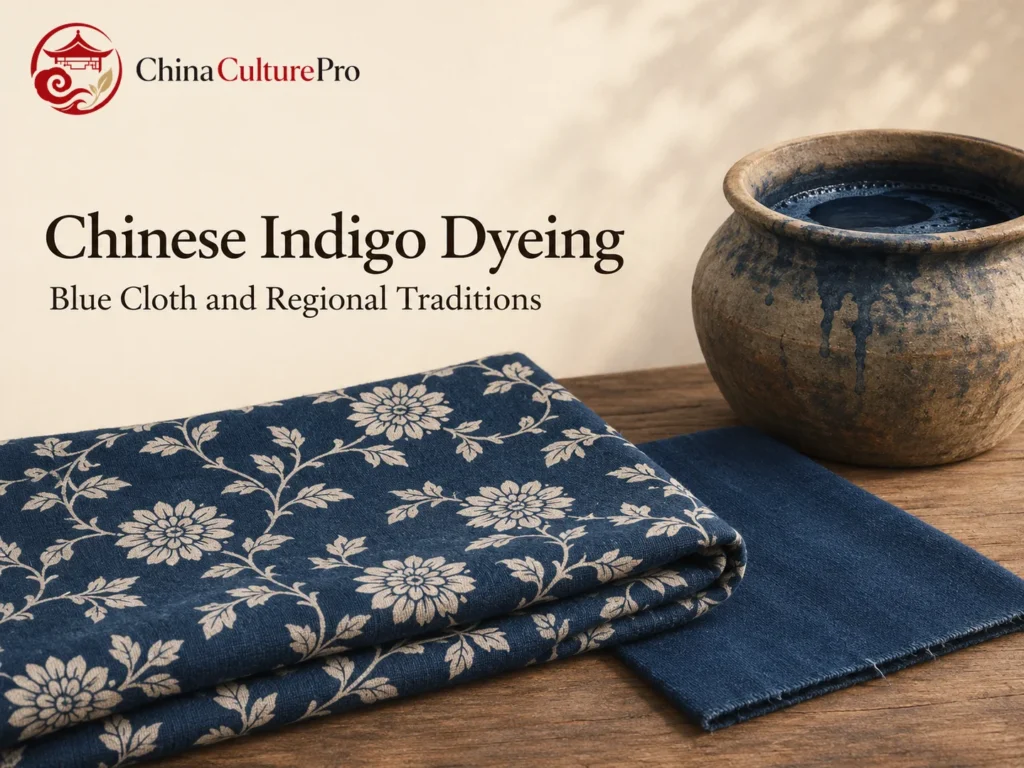

Quick Answer: What Is Chinese Indigo Dyeing?
Chinese indigo dyeing uses indigo (靛蓝, diànlán) to color textiles blue. The cloth takes up a soluble form of the dye in a vat. After the cloth leaves the vat, contact with air develops the blue color. A design can be made separately by limiting where the dye reaches the cloth.[1][3][4]
- Dye: Indigo supplies the blue.
- Resist: Paste, ties or wax can leave selected areas lighter.
- Regional work: Stencil printing and tie-dye use different ways to reserve areas of cloth.
A blue-and-white pattern alone leaves open questions about its dye, method and place.
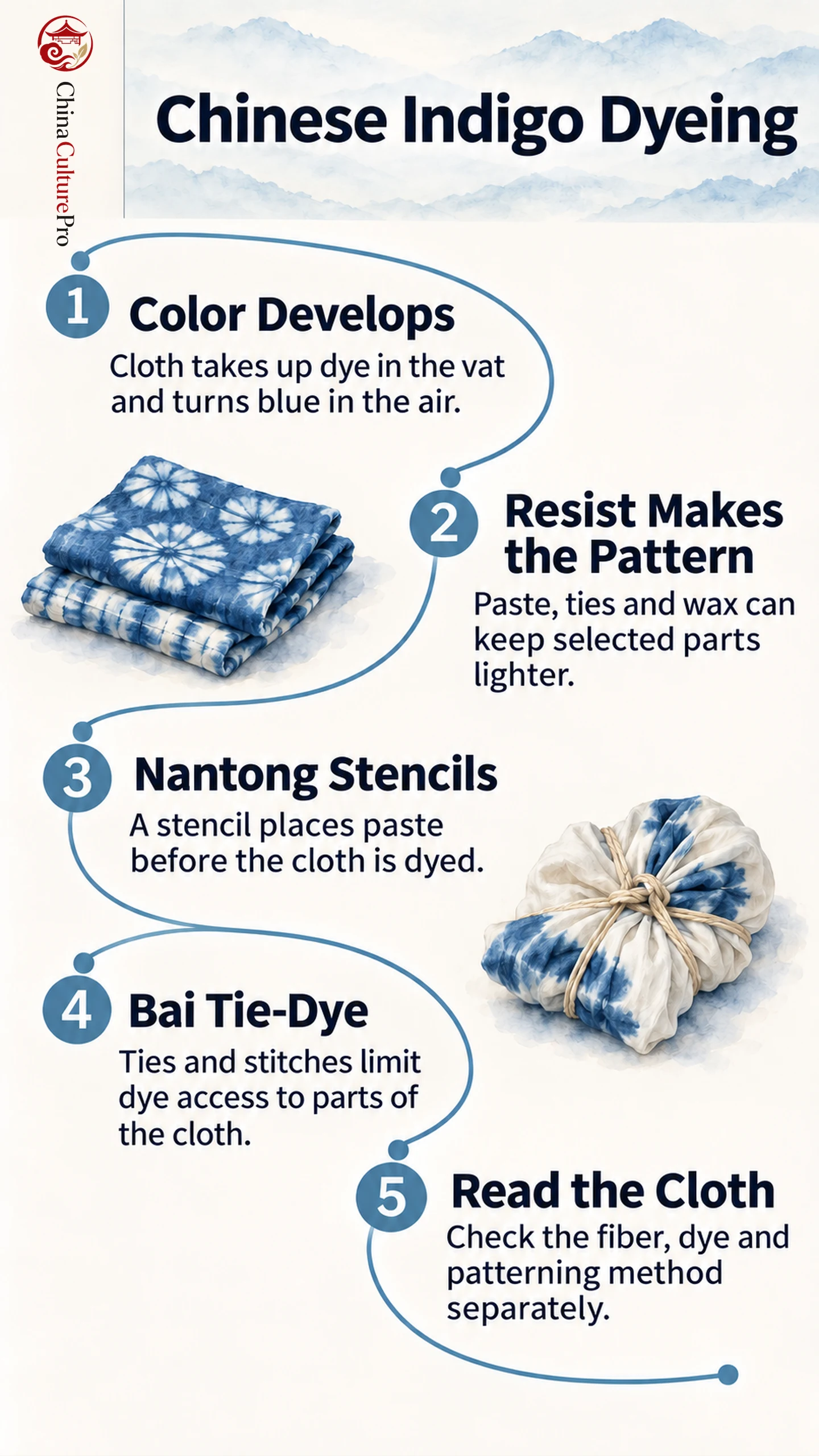
A cloth can leave an indigo vat looking greenish and turn blue in the air. The pale parts of a pattern tell a second story. They show where paste, wax or tied folds reduced the dye’s access to the cloth.
Why Indigo Changes Color in the Air
The familiar blue form of indigo is largely insoluble in water. In a dye vat it is converted to a soluble form that can enter the textile. In air, oxygen converts it back to the blue pigment, which is largely insoluble in water. The shift from greenish or yellowish tones can be visible as the color develops.[1]
Repeated contact with the dye and air can deepen the color. The resulting shade depends in part on how much dye the cloth takes up across the dyeing cycles. A deep blue therefore describes a result, while the workshop record can help explain how it was achieved.[1][3]
How Resist Creates Pale Patterns
| Метод | What shapes the pattern |
|---|---|
| Paste resist | A stencil guides paste onto selected parts of the fabric. Those areas resist dye and can appear pale when the paste is removed. |
| Tie resist | Stitching, folding and tying compress parts of the cloth, limiting how much dye reaches them. |
| Wax resist | Wax covers areas the maker wants to keep lighter. Fine cracks may let a small amount of dye through. |
In a dyed textile, the resist shapes where the color appears. In woodblock printing a block can instead transfer ink to the surface. A relief block can deliver the color directly. In stencil resist, the stencil places a barrier and the vat supplies the color.[3][4]
For Chinese batik, wax acts as the barrier. Indigo is one dye that can be used with it. The dye and the wax therefore name different parts of the process.[4]
Nantong Blue Printed Cloth
Nantong (南通, Nántōng), Jiangsu, is associated with blue printed cloth (蓝印花布, lányìn huābù). Workshop accounts describe pushing resist paste through a cut stencil onto the cloth. Dye colors the exposed areas. After dyeing, removing the paste reveals the lighter pattern.[2][3]
The Nantong inventory records flowers, animals and geometric designs on household textiles such as quilt covers, wrapping cloths and headscarves. A stencil makes it possible to repeat a motif. The quality of its edges also depends on how the maker applies the paste. Preparing the pattern and managing the dye are distinct skills within traditional crafts.[2][3]
A local account of Erjia, a workshop town in Nantong, describes preparing dye material from harvested plants. That happens before the maker uses a vat or places a stencil on cloth. For one piece of blue printed fabric, cultivation, dye preparation, printing the resist and dyeing can leave different kinds of records.[7]
Bai Tie-Dye in Dali
Bai (白族, Báizú) tie-dye is documented around Dali, Yunnan, including Zhoucheng (周城, Zhōuchéng). Tying and stitching can protect selected parts before dyeing. Where dye reaches partway into a compressed area, a softened edge can appear. A pale center and a softer surrounding edge can record different degrees of dye access.[4][5]
The practitioner record for Zhang Shishen (张仕绅, Zhāng Shìshēn) describes learning from his mother and experimenting with tying methods and plant dyes. The domestic heritage entry names a local practice, while the practitioner’s account documents choices made by a particular person.[5][6]
How to Read a Blue Textile
Check the textile’s fiber, dye and pattern technique separately in a collection record. A label may identify a cotton ground and a resist process without establishing the source of the blue dye. Pale areas with a consistent repeat can point you toward a stencil, while soft transitions may suggest folds or ties. Both readings need evidence from the piece or its documentation.[1][3][5]
If a label describes a plant source, keep that claim separate from the identification of indigo itself. More than one plant can yield the same blue colorant. Even identifying that colorant does not necessarily establish the species that supplied it.[1]
FAQs About Chinese Indigo Dyeing
Is indigo dyeing the same as batik?
Indigo is a dye. Batik uses wax to control which areas take up dye. An indigo textile can use batik or a different patterning method.
Why can indigo cloth look green before it turns blue?
The cloth can carry a soluble form of the dye when it comes out of the vat. Exposure to oxygen brings back the familiar blue form.
Are all blue-and-white textiles made with indigo?
A blue-and-white palette alone leaves the dye uncertain. Check a catalogue’s material description or other documentation.
Are Nantong blue printed cloth and Bai tie-dye the same technique?
Nantong examples use a stencil to place a paste barrier. Bai tie-dye uses ties or stitches to control access to the cloth.
Источники
[1] Heritage. Let the Lead Tags Talk: Terms on Carnuntum Tesserae Referring to Textiles, Colours and Dyeing in the 2nd Century CE
[2] China Intangible Cultural Heritage Digital Museum. Nantong Blue Printed Cloth Printing and Dyeing Techniques
[3] China Intangible Cultural Heritage Digital Museum. Traditional Blue Printed Cloth in Workshop Practice
[4] China Intangible Cultural Heritage Digital Museum. Nantong Blue Printed Cloth
[5] China Intangible Cultural Heritage Digital Museum. Bai Tie-Dye Techniques
[6] China Intangible Cultural Heritage Digital Museum. Zhang Shishen
[7] China Intangible Cultural Heritage Digital Museum. The History and Present Practice of Blue Printed Cloth