
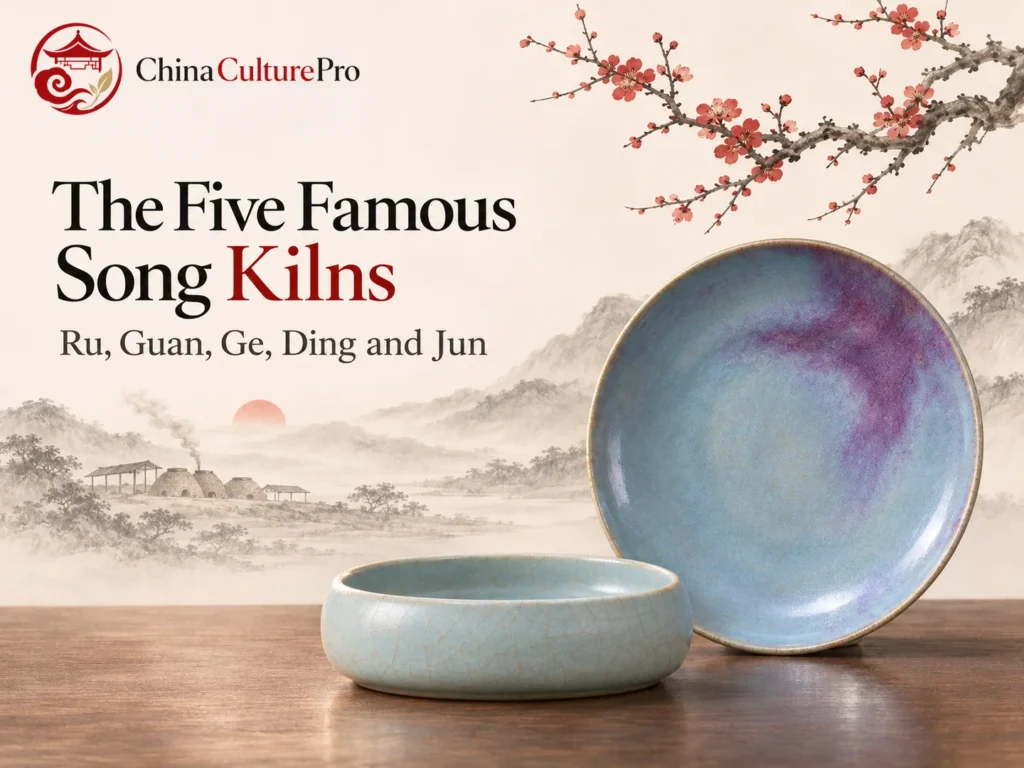

Quick Answer: What Are the Five Famous Song Kilns?
The Five Famous Kilns (五大名窑, wǔ dà míngyáo) are a traditional group of ceramic wares associated with the Song dynasty (960–1279). The names are Ru (汝, Rǔ), Guan (官, Guān), Ge (哥, Gē), Ding (定, Dìng) and Jun (钧, Jūn).[1]
- Celadon: Ru and Southern Song Guan are known for glazed surfaces in the blue-green range.
- Crackle: Ge is especially associated with two scales of lines in the glaze.
- Other finishes: Ding is best known for ivory-white wares, while Jun includes opalescent blue and purple glazes.
The group helps organize a comparison. Each label has its own history of production, court use and dating.[5]

Begin with the glaze, rim and foot you can see on a vessel. Then read the museum record for its attributed place and date. That order makes the five names useful even when two pieces look similar.
How the Five Wares Compare
Use these typical features as points of comparison. The place and date clues describe documented examples or groups within the wider history of Chinese porcelain.
| Ware | Типичное изображение | What a record can establish |
|---|---|---|
| Ru | Pale blue to blue-green glaze, sometimes with fine crackle. | Late Northern Song court wares are associated with Qingliangsi (清凉寺, Qīngliángsì) in Henan.[7] |
| Guan | Thick celadon glaze over a darker body, often with prominent crackle. | Southern Song official production is associated with kilns in present-day Hangzhou (杭州, Hángzhōu), including Jiaotanxia (郊坛下, Jiāotánxià).[2] |
| Ge | Lustrous glaze with networks of broader dark lines and finer pale ones. | The exact kiln origin of the classic transmitted group remains disputed.[3] |
| Дин | Ivory glaze and, on some bowls and basins, carved or incised decoration. | A Northern Song basin preserves a metal band over a rim left bare for firing.[4] |
| Jun | Opalescent blue glaze, sometimes with lavender or purple patches. | Henan kilns made varied Jun wares. Some numbered flower vessels are catalogued as early Ming.[2] |
Why These Five Are Grouped Together
The modern set draws on a long history of collecting and writing about earlier ceramics. The lists found in older texts vary. The modern combination appears in twentieth-century scholarship. Publications in the 1950s already used the now familiar group, though it is difficult to identify a single person who settled the list. Its familiarity tells us about the history of taste as well as the objects it gathers together.[5]
Court patronage also took different forms. Official Southern Song Guan production served the court. Ru’s court association concerns a particular group of late Northern Song wares. The much larger Jun category includes wares made for a broader clientele.[2][7]
Song ceramic production extended far beyond these names. Longquan celadon and other regional traditions deserve their own place in Chinese porcelain history. The five-name list is one way of entering that history.
What the Glaze, Rim and Foot Can Tell You
Small traces on the underside of a piece can tell you how potters supported it in the kiln. On Ru wares from Qingliangsi, small unglazed spots can mark where a support held the vessel during firing. Elsewhere the glaze extends over the base.[7]
A Ding basin dated to the eleventh or twelfth century shows a different method. Its mouth was left unglazed so it could be set upside down during firing. The metal band now covers that edge. Inside, the carved lotus and foliage remain visible through the ivory glaze. The rim and the interior design therefore tell you about different stages of making the same object.[4]
Crackle belongs to the glaze. On a Ge-type surface, the effect often called “gold thread and iron wire” describes two scales and tones of cracks. It is a visual description. A label still needs evidence for its attribution and date.[3]
Why Ge and Jun Labels Need Particular Care
For Ge, the question is how to connect transmitted objects to a production site. The classic group survives in collections. Excavated pieces with similar crackle give researchers material for comparison. The matching appearance of a fragment is one line of evidence. Its excavation context and the ceramic body matter too.[3]
For Jun, the scope of the ware name matters. A blue-glazed dish with purple splashes and a numbered flowerpot can both be described as Jun, even when they are catalogued centuries apart. One collection dates its purple-splashed dish to the Jin dynasty and its numbered hexagonal flowerpot and stand to the early Ming.[2]
When reading a Jun label, look for the form, the date range and qualifiers such as “official” or “numbered.” A base number may relate to size in this group.[2] Compare the object with the guide to Chinese porcelain marks before interpreting a number as a date.
Reading a Museum Record for a Song-Style Object
Start with the record’s ware type, production date and production place. A bronze-shaped vase with greenish-gray crackle, museum number PDF.11, makes the distinction concrete. It is classified as Guan-type and dated to about 1912–1930. Its production place is listed as possibly Jingdezhen (景德镇, Jǐngdézhèn). The museum preserves an earlier published Qing attribution in the notes.[6]
That record shows how a later maker could revisit a much earlier glaze and a bronze vessel form. Read Jingdezhen porcelain for the context of that proposed production place, and Chinese museum collections for the distinction between the label on display and the fuller catalogue entry.
FAQs About the Five Famous Song Kilns
Were the five famous kilns all run by the Song court?
Their institutional relationships varied. Southern Song Guan is an official court ware, while categories such as Jun cover objects produced for several markets. The later five-name grouping brings those different histories together.
What is the difference between Guan and Ge ware?
Guan is an official ware designation with documented Southern Song production sites. Ge conventionally refers to wares associated with two scales of crackle, and the production origin of the classic transmitted group remains debated.
Is all Jun ware from the Song dynasty?
Jun is a broader ware name with multiple periods and vessel groups. Read the date for the individual piece, particularly for numbered flower vessels and other later examples.
Does every Ding bowl have a metal rim?
Metal bands occur on some Ding pieces with exposed firing rims. The shape and manufacturing method of the individual bowl determine which evidence is visible.
Источники
[1] National Museum of China. Ancient Chinese Porcelain Art
[2] British Museum. Room 95 Chinese Ceramics Large Print Guide
[3] The Palace Museum. The Palace Museum Ge Ware Exhibition
[4] The Metropolitan Museum of Art. Basin with Lotus Decoration, 26.292.98
[5] Sabrina Rastelli. The Concept of the Five Famous Wares of the Song Dynasty: A Modern Invention
[6] British Museum. Guan-Type Vase, PDF.11
[7] The Palace Museum. Pure Elegance: A Special Exhibition of Ru Ware in The Palace Museum