
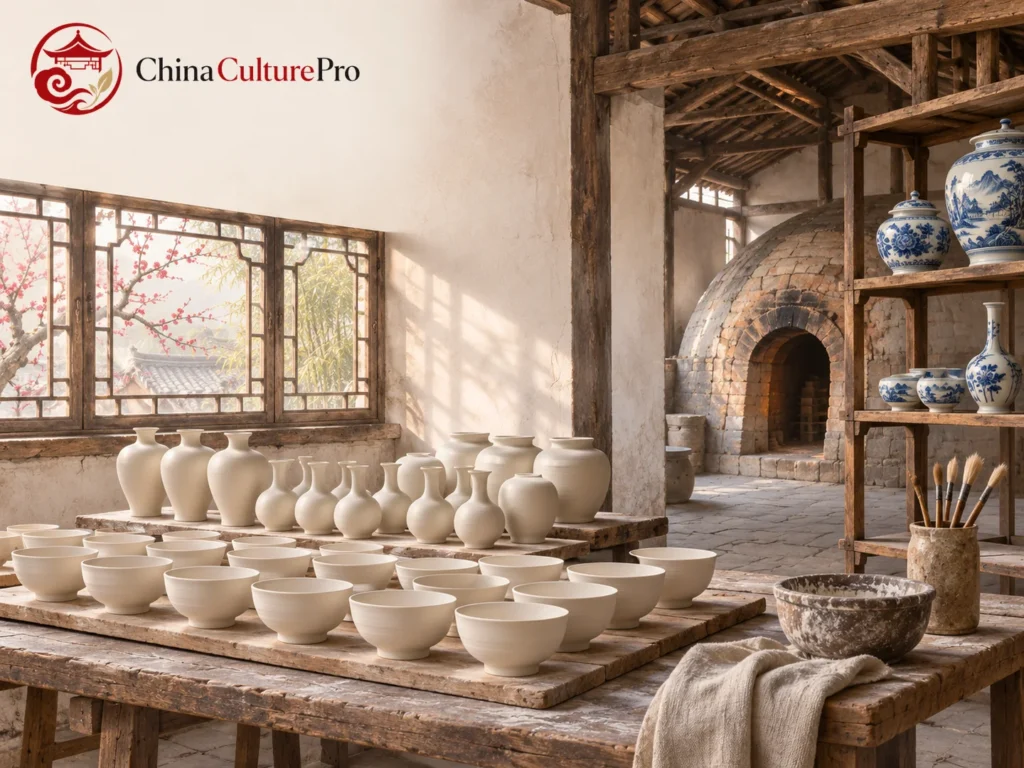

Quick Answer: Why Is Jingdezhen Known for Porcelain?
Jingdezhen (景德镇, Jǐngdézhèn) became a major center of Chinese porcelain because suitable raw materials, fuel, waterways and skilled workshops supported production over many centuries. Its makers supplied the imperial court as well as private buyers. They produced pale glazed, cobalt-painted and enameled wares. [1][2][3][4]
- The kilns depended on resources beyond town. Porcelain stone, kaolin and wood entered a production system linked by waterways. [1][2][5]
- Different workshops served different buyers. Court commissions existed alongside commercial production for China and overseas markets. [2][3][4]
- The heritage property covers an industrial landscape. UNESCO’s five components include a town production center, an ancient kiln site, two mining sites and a source of fuel. [1][2][5]
Follow the materials to the workshops and the finished wares to their buyers.

A finished cup gives little hint of how far its materials traveled before firing. In Jingdezhen, quarrying, clay preparation, fuel, workshop labor and water transport all helped determine what the kilns could produce.
Why the Materials and Location Mattered
Jingdezhen in Jiangxi had access to porcelain stone, kaolin clay and wood for firing. Early potters used processed porcelain stone. Adding kaolin later gave them a way to change how the body worked before firing and to make it whiter after firing. The availability of two materials helped the city develop its place in the history of Chinese porcelain. [1][2][3]
Raw materials had to move from their sources to workshops. Water routes connected places where workers obtained stone and fuel with places where they shaped, decorated and fired vessels. Wharves and sections of the Changjiang River survive alongside workshop and kiln sites. At the scale of the town, the evidence includes places associated with commercial activity and associations of craftspeople and merchants. The production center drew on a landscape larger than the town itself. [1][2][5]
The recipe also helps explain distinctions between ceramic bodies. Porcelain stone and kaolin belong to the material shaped into a vessel. A pale blue glaze or cobalt painting goes onto its surface. The choice of clay and the appearance of the decoration answer separate questions. [2][3][6]
From Qingbai to Painted Porcelain
Early Jingdezhen workshops made qingbai (青白, qīngbái), a porcelain with a pale, often bluish glaze. A twelfth-century vase in the Met’s collection uses the glaze on a flower-shaped body. The coating gives the vase its faint blue color. The shaped body supplies the flower silhouette. [3][6]
By the Yuan period, Jingdezhen potters were making accomplished blue-and-white porcelain. Cobalt was painted beneath a clear glaze. The David Vases, made at Jingdezhen, carry a temple dedication from 1351. That inscription documents established production by that date. It also gives a specific use for a pair of elaborately painted vessels. [2][3][7][8]
The workshops expanded their repertory through the Ming and Qing. Ming porcelain includes underglaze painting and wares that use colors added over a glaze. Later enamel palettes give examples of more changes in materials and decoration. Earlier techniques could remain in use alongside new ones. [1][2][3][4]
Court Kilns, Commercial Workshops and Skill
Jingdezhen included production for the imperial court and commercially operated workshops. Court commissions could specify what was to be made, while private workshops served several domestic and overseas markets. As the industry expanded, specialized work made it possible to organize production across several parts of the town. [1][2][3][4]
Making a single piece could involve preparing the raw material, forming the shape, applying decoration and firing it. A potter working on the body had to leave the surface suitable for the painter or glazer. The kiln crew then had to fire the body and glaze together without losing the intended effect. The surviving workshop and kiln evidence helps place a finished object in that system. A base inscription or other porcelain marks may add context, but the form, technique and production evidence also matter. [1][2][3][7]
Excavations at the imperial kiln site brought up heaps and pits with fragments of pieces that were rejected, including examples with defects in color and glaze. Those fragments show what potters tried to make, even when a piece never went to the court. The same excavations recorded more than one kiln form. Read together, the kilns and sherds reveal production choices that a finished object alone may hide. [9]
How Jingdezhen Reached Other Markets
The Smithsonian documents orders made for Japanese tea practitioners and courts in places now called Vietnam and Thailand. European trade also brought requests for familiar forms or patterns. A vessel made in Jingdezhen could have a shape devised for people far from the workshops. [3][4][8]
A late seventeenth-century cruet in the V&A’s collection imitates the form of a glass oil-and-vinegar vessel. It uses porcelain and painted blue in a shape related to a different material and market. The David Vases offer another case from the same city. Their inscription records a gift for a temple in China, and their form draws on bronze vessels. The cruet and the vases show how Jingdezhen potters adapted shapes from other materials for different uses. Together the objects show how manufacture, intended use and destination can vary independently. [7][8]
The Five World Heritage Components
UNESCO inscribed the Jingdezhen Handicraft Porcelain Industry Sites in 2026. The property consists of five components that represent parts of the production system. [1][2][5]
| Компонент | Part of the porcelain system |
|---|---|
| Town Area Porcelain Production Center | Urban production and workshop organization |
| Hutian Ancient Kiln Site | Early kiln activity and evidence of bluish-white ware |
| Gaoling Porcelain Clay Mining Site | Source of porcelain clay |
| Changling Porcelain Stone Mining Site | Source of porcelain stone |
| Jiaotan Firewood Production Area | Fuel production for firing |
Read the two mines and fuel area alongside the kiln sites. Gaoling and Changling point to different ingredients in the body. Jiaotan shows that firing depended on a source of fuel beyond the workshops. Hutian and the town area preserve evidence of production from different parts of Jingdezhen’s history. [1][2][5]
FAQs About Jingdezhen Porcelain
Was all Jingdezhen porcelain made for the imperial court?
Court commissions were an important part of production. Commercial workshops also supplied domestic and overseas markets. [1][2][3][4]
Is Jingdezhen porcelain always blue and white?
Its makers produced qingbai and other glazed wares, underglaze cobalt wares and many types of enameled porcelain. [1][2][3][6]
What does the Jingdezhen World Heritage listing include?
Five components show the urban workshops and kiln activity, two raw material sources and a firewood production area. The listing records how the places worked as a system. [1][2][5]
Источники
[1] UNESCO World Heritage Centre. Jingdezhen Handicraft Porcelain Industry Sites
[2] UNESCO World Heritage Centre. Decision 48 COM 8B.16
[3] National Museum of Asian Art. Jingdezhen
[4] The British Museum via Smarthistory. Chinese Porcelain: Production and Export
[5] UNESCO World Heritage Centre. Jingdezhen Handicraft Porcelain Industry Sites: Maps
[6] The Metropolitan Museum of Art. Vase in the Shape of a Flower
[7] The British Museum. Chinese Ceramics Gallery Guide
[8] Victoria and Albert Museum. Chinese Blue-and-White Ceramics
[9] Quan Kuishan. The Archaeological Findings from the Imperial Kiln Site of the Ming-Qing Dynasty in Jingdezhen