

Quick Answer: How Do Famille Rose and Famille Verte Differ?
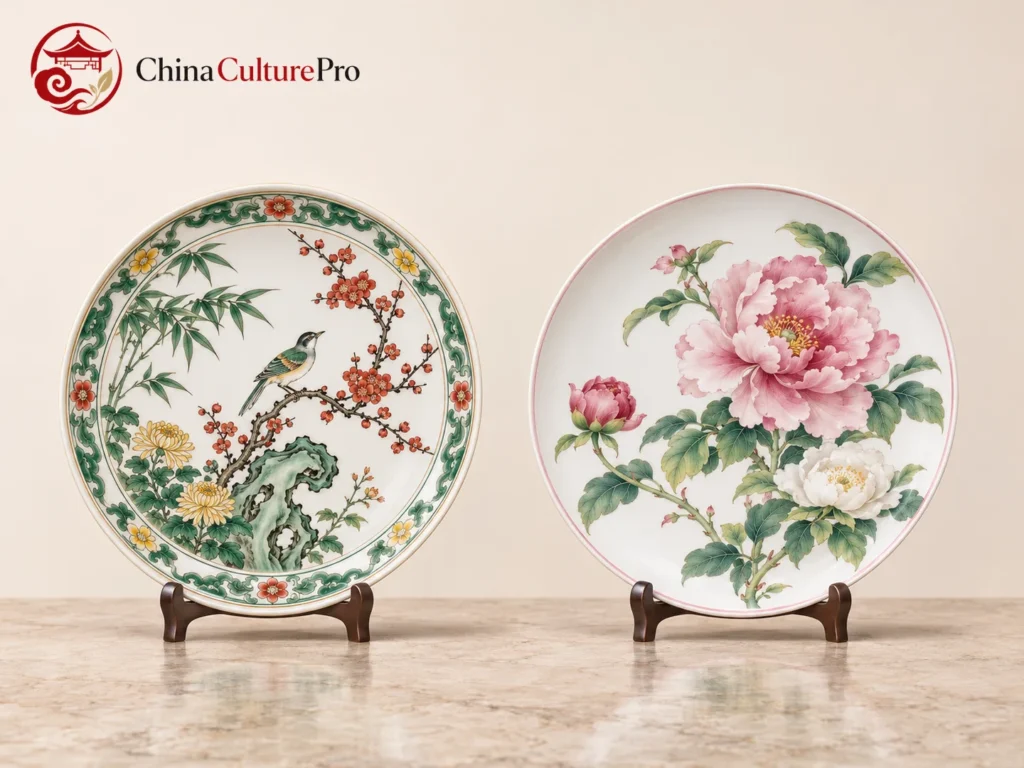
Famille verte and famille rose are names for palettes of colored enamels on porcelain. Famille verte is associated with translucent greens and other colors. Famille rose uses an expanded palette in which opaque white and pink make it possible to build more gradations. Both are associated with Qing wares. [1][2][3][4][5][6]
- Famille verte usually gives green a prominent role. Red, yellow, aubergine and blue can also be present. [1][3][4][6]
- Famille rose is more than a pink surface. Opaque white can lighten pink and other colors to give the painter a wider range of tones. [2][3][6][7]
- Color is a clue to decoration. An object’s date and intended market require other evidence. [4][5][7][8]
Look at how the painter used the colors as well as which colors are present.
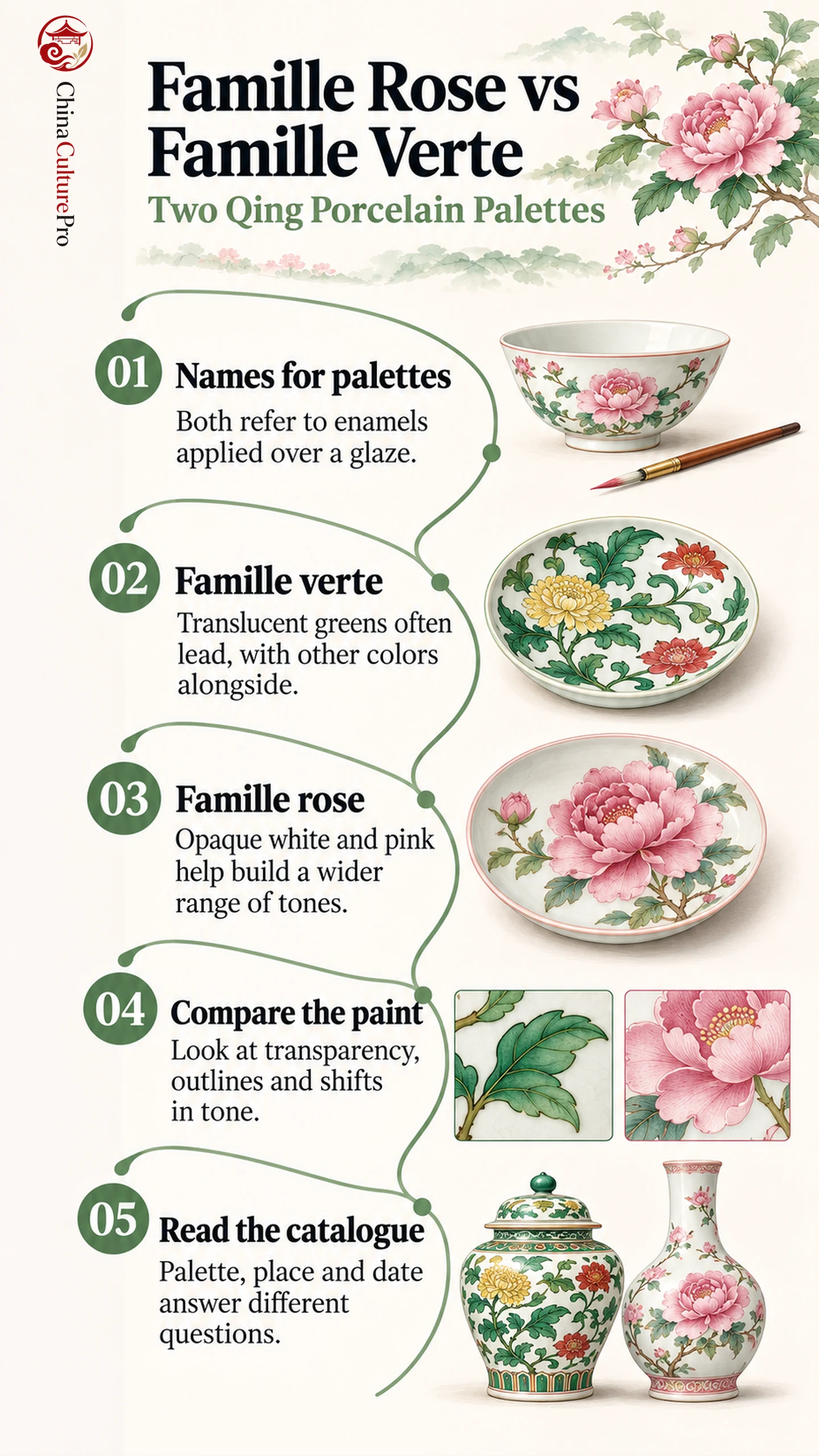
A green leaf can appear in both styles. One may be painted in a clear green enamel, while another is built from several lighter and darker tones. Looking at how the color is used gives more information than counting how much green or pink you see.
What the Two Names Describe
Both terms describe decoration on Chinese porcelain. Overglaze enamels are painted onto an already glazed surface, then fixed in a further firing. This differs from the classic method of blue-and-white porcelain, where the cobalt design lies under the clear glaze. Some objects combine color under the glaze with enamels above it. [1][2][3][6]
Famille verte means green family, and famille rose means rose family. The French names came into use in nineteenth-century European writing about ceramics, long after many of the objects they describe were made. They classify decoration rather than identify a kiln, a reign or the first use of a color. Chinese terms can describe related groups from different points of view. [1][2][8]
Famille Verte: Greens and Translucent Enamels
Famille verte is especially associated with the Kangxi reign. Green enamels often lead the palette, with iron red, yellow, aubergine or blue playing other roles. Some transparent colors let the white surface remain visible through the enamel. Dark or red outlines can make the edges of leaves, petals or feathers easier to read. [1][3][4][6]
There is a relationship to wucai (五彩, wǔcǎi), a term used for multicolored wares including earlier Ming porcelain. Some of those wares combined underglaze blue with overglaze colors. The British Museum describes later changes that expanded the available enamel colors. The history helps explain why a green-dominant Qing object can still contain details associated with earlier approaches. [3][6][8]
A Kangxi dish at the Met shows a bird-and-flower design. The museum describes its rich, transparent colors and a palette dominated by green. Green gives the painted scene its prevailing tone. The other colors keep different parts of the motif legible. The Met notes that related patterns were used for Chinese and overseas buyers. [4]
Famille Rose: Opaque White, Pink and Shading
Opaque white was one important addition to the palette. It could be combined with other colors to make lighter shades. A pink enamel based on gold expanded the range further. The same color can appear pale on one part of a petal and more saturated farther in. Using opaque white gave painters another way to build those tonal changes. The new approach developed around the end of the Kangxi reign and was used on accomplished Yongzheng wares. [2][3][5][6][7]
The Met catalogues a covered bowl as Yongzheng mark and period, with overglaze famille rose enamels. A British Museum dish from around 1720–1740 has a rose-colored reverse and a decorated front. The museum uses the term fencai (粉彩, fěncǎi), often rendered as powdered colors, in its description. Together these pieces show how the palette name can apply to different kinds of object and decoration. [5][6][7]
How to Compare the Two Palettes
| Feature to compare | Famille verte | Famille rose |
|---|---|---|
| Main visual cue | Greens often lead within a multicolored design | Opaque enamels including white and pink expand the range of tones |
| Typical effect to look for | Transparent areas of color with defined contours | Graded shades that can soften the transition across an area |
| Other colors | Red, yellow, aubergine and blue can accompany green | Green and other hues can accompany pink or be prominent in a design |
| A museum example | Met Kangxi bird-and-flower dish | Met Yongzheng covered bowl |
An individual object can have several kinds of color within the same design. Look at a leaf or flower close enough to see where the outline ends and how the color changes across it. Compare those observations with the label’s wording, which can identify the technique separately from the colors you see. [1][3][4][5][6]
Qing Production and Museum Labels
A palette name does not by itself establish which workshop made a piece. The British Museum identifies its ruby-backed dish as Jingdezhen porcelain. A different catalogue may give a reign attribution or describe a type of enamel without specifying a kiln. A Met dish made for the Scottish market around 1735 illustrates one export use. Its coat of arms includes a thick, dark rose enamel layered onto the design. This early example shows a different use of the color from a softly shaded flower. [4][5][6][7][9]
A museum can also distinguish decoration from the inscription. Chinese porcelain marks can supply information about the reign named on the vessel. The palette describes how the vessel was painted. Read period, mark, place and palette separately before using them to describe the vessel together. [5][6][8]
FAQs About Famille Rose and Famille Verte
Does famille rose have to be mostly pink?
The palette includes pink and opaque white, but individual works can emphasize other colors. The opaque palette and how the painter uses it tell you more than the area of pink alone. [2][3][5][6]
Can famille verte include colors other than green?
Yes. Green is often prominent, with colors such as iron red, yellow, aubergine and blue used alongside it. [1][3][4][6]
Can the palette alone date a porcelain piece?
A palette can suggest a historical context. A date attribution also depends on the object’s construction, mark where present and documented context. [4][5][6][8]
Источники
[1] Getty Research Institute. Famille Verte
[2] Getty Research Institute. Famille Rose
[3] Smithsonian Museum Conservation Institute. Technological Study of Chinese Enamel Colors
[4] The Metropolitan Museum of Art. Блюдо
[5] The Metropolitan Museum of Art. Covered Bowl
[6] The British Museum. Chinese Ceramics Gallery Guide
[7] The British Museum. Ruby-Backed Dish
[8] Fondation Baur, via Ceramics Now. The Secret of Colours
[9] The Metropolitan Museum of Art. Chinese Export Porcelain