

Quick Answer: How Did Chinese Weights and Measures Work?
Chinese weights and measures are often grouped as duliangheng (度量衡, dùliànghéng): systems for length, capacity and weighing. They supported exchange, taxation and government administration. Familiar names survived across long periods, but their actual values could change with place, purpose and the standard being used.[1][3][5]
- Category: Establish whether a quantity describes length, volume or mass.
- Relationship: Ratios between named units belong to a particular system.
- Value: A conversion into meters, liters or grams needs a dated reference.
A modern market conversion is not a universal key to an ancient text.
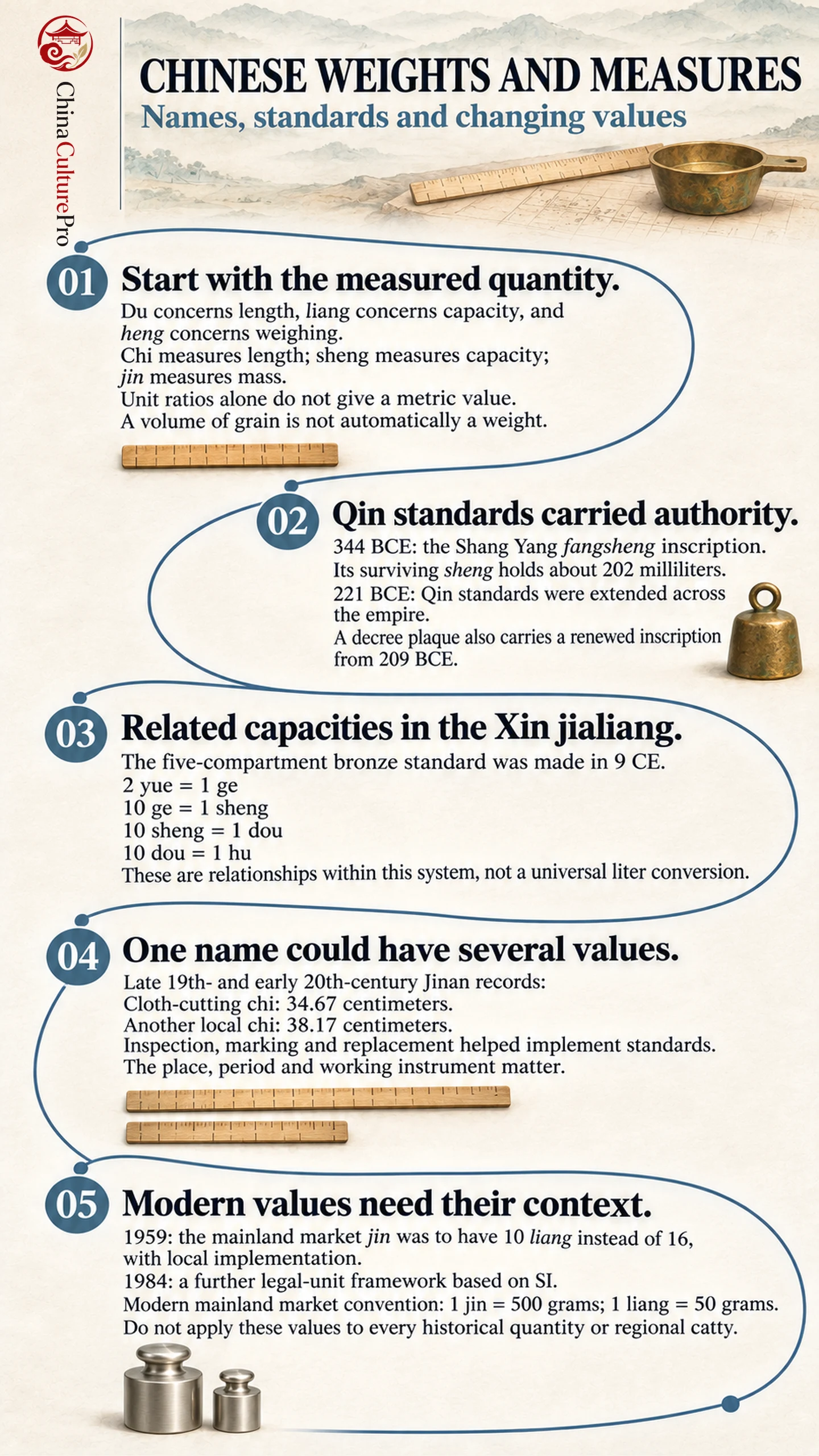
The same Chinese unit name can appear on an ancient bronze measure, in a local tax record and in a modern market. Understanding the quantity requires more than translating the word: identify its purpose, date and reference standard before attaching a metric value.
Length, Capacity and Weight Are Different Questions
The three parts of the term describe different operations. Du (度, dù) concerns length; liang (量, liàng) concerns capacity; heng (衡, héng) concerns weighing. The romanization liang can therefore represent a capacity category or a weight unit; the characters and tones distinguish them.[1]
| Категория | Примеры | What the quantity describes |
|---|---|---|
| Продолжительность | chi (尺, chǐ), cun (寸, cùn), zhang (丈, zhàng) | A measured distance or dimension. |
| Capacity | sheng (升, shēng), dou (斗, dǒu) | The volume a vessel can contain. |
| Weight or mass | jin (斤, jīn), mass liang (两, liǎng) | How heavy a quantity is when weighed. |
A capacity of grain cannot be turned into a mass from its unit name alone: the substance and how it fills the vessel matter. Likewise, knowing that ten smaller units equal one larger unit does not reveal either unit’s size in metric terms. Ratios and absolute measurements answer different questions.[1]
Qin Standardization: Rules Carried by Objects
A bronze measure from the Qin state (秦国, Qín Guó), associated with Shang Yang (商鞅, Shāng Yāng), called a fangsheng (方升, fāngshēng), bears an inscription dated to 344 BCE. Its stated volume defines a standard sheng, and the surviving vessel holds approximately 202 milliliters. The familiar name sheng did not give it the volume of a modern liter.[2]
After unification in 221 BCE, Qin Shi Huang (秦始皇, Qín Shǐhuáng) extended Qin standards across his empire. The vessel received a later imperial inscription. Other bronze plaques carried standardization decrees; a surviving example includes both the 221 BCE decree and an addition from 209 BCE under the next emperor.[2][3]
The inscriptions made an approved standard visible on objects used to measure or weigh. They show continuity from earlier Qin practice as well as the reach of imperial authority. The decrees record an administrative requirement, rather than a survey proving complete uniformity in every transaction.[3]
The Xin Jialiang: Related Units in One Instrument
Under Wang Mang (王莽, Wáng Mǎng), the Xin dynasty (新朝, Xīn Cháo) produced a bronze jialiang (嘉量, jiāliàng) in 9 CE as an official capacity standard. Five measuring compartments embodied linked units. Their relationship was:[1][4]
- Two yue (龠, yuè) equaled one ge (合, gě).
- Ten ge equaled one sheng.
- Ten sheng equaled one dou.
- Ten dou equaled one hu (斛, hú).
The largest compartment occupied the main upper body, with another beneath and smaller measures at the sides. Each compartment gave a named unit a physical capacity. Its inscriptions also present the reasons for establishing the standard. Bronze vessels and inscriptions can therefore document administrative ideals as well as practical measurement.[1][4]
Why the Same Unit Name Could Have Different Values
Variation could exist within one place, not just between dynasties. Records for late nineteenth- and early twentieth-century Jinan list a cloth-cutting ruler whose chi was 34.67 centimeters and another named local ruler whose chi was 38.17 centimeters. Several weighing systems and grain measures circulated alongside official standards.[5]
The distinction between a prescribed unit and a working instrument matters. Jinan’s later reforms included inspecting measures, marking acceptable instruments and withdrawing others. Standardization required administration, replacement and checking, as well as announcing a definition. [5]
Metric Reform and Reading Historical Quantities
Modern reform changed both reference values and unit relationships. The 1959 order retained the metric-based market system, shizhi (市制, shìzhì), while directing that a jin be divided into ten liang rather than sixteen. Local authorities were to determine the timing and steps of implementation. The 1984 order established a further framework of legal units based on the International System of Units.[6][7]
In the modern mainland market convention, one jin equals 500 grams and one liang equals 50 grams. These figures must be labeled with that context. They cannot be applied automatically to an ancient bronze weight, a Qing fiscal account or every place where the word catty appears.[8]
When reading an older quantity, ask which period and locality it belongs to, what material was being measured, and which official or commercial standard the document assumed. For silver accounts, distinguish weight from monetary value. Silver ingots could be labeled in taels, an English rendering of liang, rather than being individual coins of that denomination. Their monetary role belongs to the wider history of currency and exchange.[1][9]
FAQs About Chinese Weights and Measures
Was a jin always 500 grams?
No. Five hundred grams describes the modern mainland market jin, not every historical or regional unit carrying that name.[5][8]
Does an ancient sheng mean one liter?
Not automatically. The Shang Yang vessel’s sheng holds about 202 milliliters; a modern liter conversion would misread that artifact.[2]
Was a liang or tael a coin?
Liang is a weight unit, not inherently a coin denomination. A silver account requires its own monetary context.[1]
Were all Chinese measurements decimal?
No. Although many relationships used tens, the Han account has sixteen liang to a jin, and the capacity sequence includes two yue to a ge.[1]
Источники
[1] Book of Han, chapter 21. Treatise on Pitch Standards and Calendars
[2] Shanghai Museum. Shang Yang’s Square Sheng Measure
[3] National Museum of China. Bronze Plaque with Decrees of Qin Shi Huang and Qin Er Shi
[4] National Palace Museum. Jialiang
[5] Jinan municipal gazetteer, Shandong historical archives. Legal Metrology
[6] State Council. 1959 Order on Unifying the System of Measurement
[7] State Council / State Administration for Market Regulation. 1984 Order on Uniform Use of Legal Units of Measurement
[8] Taizhou historical gazetteer office. Standard Measurement
[9] Smithsonian National Museum of American History. Sycee, China, undated