
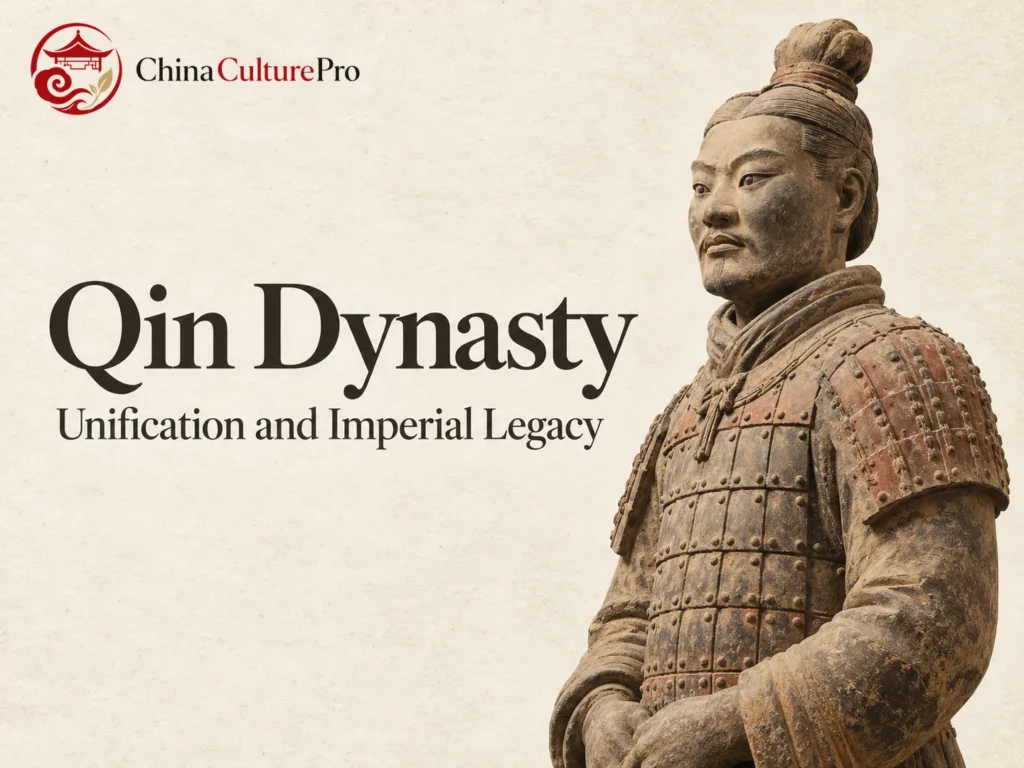

Quick Answer: What Was the Qin Dynasty?
The Qin (秦, Qín) dynasty created the first unified Chinese empire in 221 BCE. Its best-known ruler, Qin Shi Huang (秦始皇, Qín Shǐhuáng), combined military conquest with centralized administration and common standards for writing, money and measurement.[1]
- Dates: Conventionally 221–206 BCE, following a much longer history as a regional state.
- Ruler: The First Emperor died in 210 BCE; his successors lost control soon afterward.
- Government: Appointed officials connected local administration to the imperial court.
- Evidence: Inscribed measures, coins and the imperial mausoleum help explain how power worked.
Qin established a new imperial framework; it did not create Chinese civilization from nothing or make regional cultures identical.
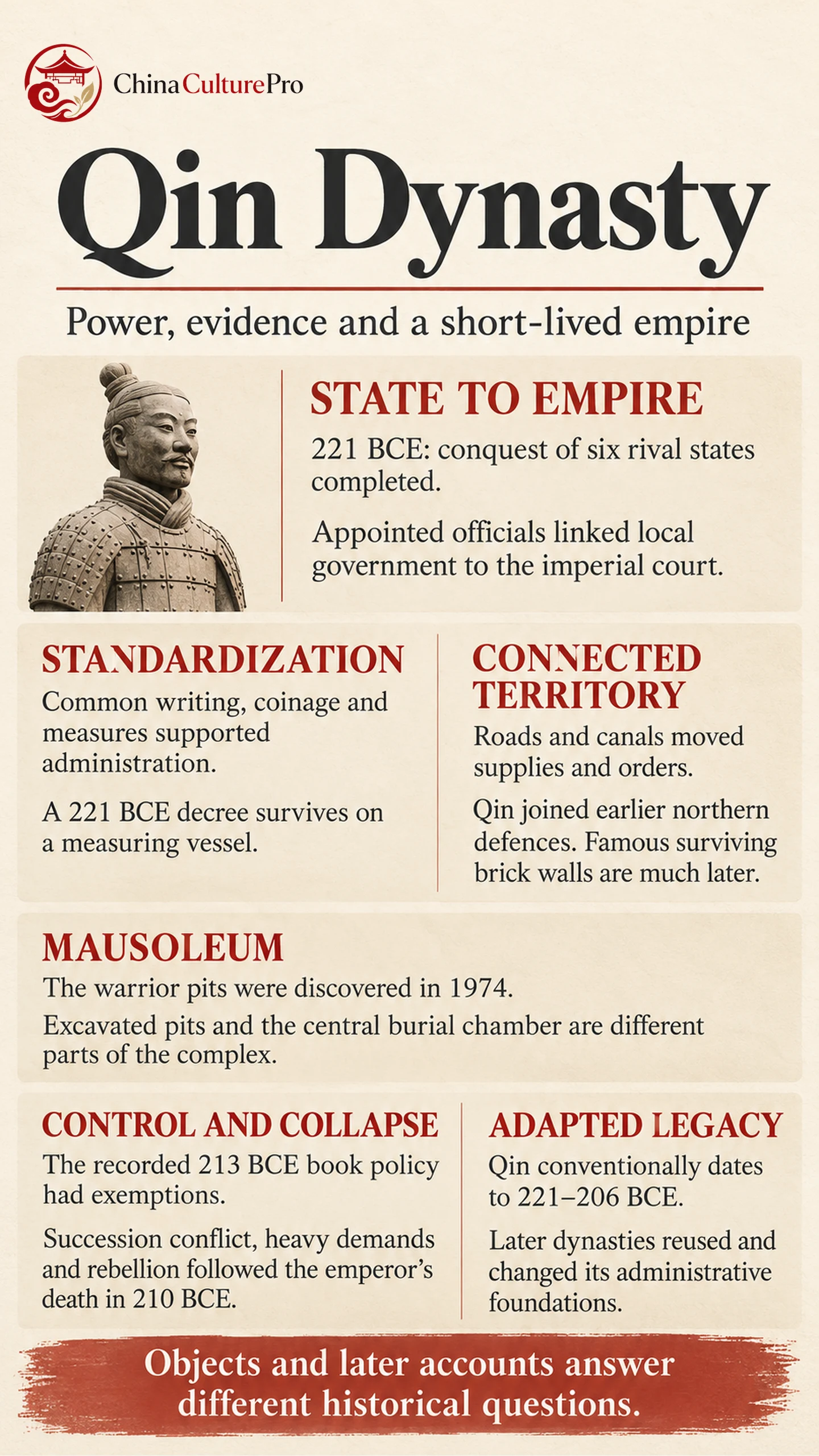
The Qin dynasty lasted roughly fifteen years, yet its institutions influenced empires that survived far longer. Understanding that contrast requires looking beyond the familiar image of a warrior standing guard underground.
Conquest, paperwork, workshops and compulsory service all shaped the new empire. Use the broader Chinese history overview for context and the dynasty timeline to place Qin among earlier and later states.
From a Warring State to an Empire
Qin was an established kingdom before it became an empire. It developed within the political world of the Zhou dynasty, whose weakening royal authority allowed regional rulers to compete for land and people.
Earlier reforms associated with Shang Yang (商鞅, Shāng Yāng) strengthened administration and the ruler’s ability to mobilize resources. These policies belonged to the statecraft tradition usually called Legalism (法家, fǎjiā), which emphasized institutions, rewards and punishments as tools of rule. They preceded the First Emperor’s imperial reign.[9]
Between 230 and 221 BCE, Qin defeated the six remaining major rival states. Unification therefore resulted from sustained military campaigns supported by an already powerful state, rather than one proclamation suddenly ending political competition.[2]
The distinction between state and dynasty explains why objects or people described as “Qin” can predate 221 BCE. The imperial dynasty is a particular phase of a much longer political history.
Qin Shi Huang and Imperial Government
The ruler commonly known as Qin Shi Huang was Ying Zheng (嬴政, Yíng Zhèng). After the conquests, he adopted the imperial title huangdi (皇帝, huángdì), presenting his authority as greater than that of the competing kings he had defeated. His reign as king had begun before he called himself emperor.[2]
The First Emperor’s biography belongs within this institutional change. Government extended outward from the capital, Xianyang (咸阳, Xiányáng), through appointed officials. The commandery and county system (郡县制, jùnxiànzhì) made territorial administration answerable to the central court.[2]
Appointments mattered because authority no longer depended principally on distributing the conquered realm among hereditary regional royal houses. Officials had duties within an administrative hierarchy, making taxation, orders and military demands easier to coordinate across former state boundaries.
Centralization did not mean every local practice disappeared. It describes how the government claimed and organized power. Whether an order reached a community, how officials applied it and how people responded are separate historical questions.
Standardization Preserved in Objects
Standardization becomes easier to understand when connected to surviving objects rather than a list of abstract “achievements.” An oval measuring vessel carries an imperial decree dated to the ruler’s twenty-sixth year, corresponding to 221 BCE. The inscription links conquest, the imperial title and the instruction to make inconsistent measures agree.[3]
The date is revealing: “twenty-sixth year” counts his reign before unification, too. It does not mean the Qin empire had already existed for twenty-six years.
Common measures could make grain deliveries, levies and exchanges more comparable across territories. The decree records the government’s intention; an individual inscribed vessel does not prove every transaction immediately followed the new standard.
Currency offers another material connection. The banliang (半两, bànliǎng) coin is represented by surviving Qin examples. Read alongside the decree, such objects show how imperial authority entered routine economic activity.[4] The wider history of Chinese currency explains how coinage changed afterward.
Writing was also standardized for administration. This concerns written forms, not the creation of one spoken language or universal literacy.[1] The later history of Chinese calligraphy styles shows that written expression continued to develop.
Roads, Canals and Northern Defences
Roads and canals helped move people, supplies and information through the expanded state. They made government possible at a larger scale, while construction and maintenance demanded labor from the population.[1][9]
Northern fortifications served a different, military purpose. Around 220 BCE, Qin linked sections of earlier defensive works. Wall building therefore began before the First Emperor and continued under later rulers.[5]
The famous surviving masonry commonly associated with the Great Wall belongs largely to much later building, especially the Ming (明, Míng) dynasty. A photograph of a brick wall with monumental watchtowers should not automatically illustrate Qin construction.[5]
Read Great Wall history as the history of changing frontier systems. Treating every surviving section as one unchanged Qin monument erases both earlier states and later construction.
The Mausoleum and the Terracotta Army
The imperial mausoleum near modern Xi’an, at the foot of Lishan, included an extensive funerary landscape. Warrior pits formed part of that complex alongside other burials, structures and accompanying objects. The soldiers, horses, chariots and weapons reveal the resources invested in representing imperial power after death.[6]
The famous 1974 discovery concerned the terracotta warriors. It should not be described as the first time anyone knew that the emperor’s burial mound existed. Nor should the excavated pits be confused with the central burial chamber.[6][8]
The figures combine recognizable military categories with individual features. That does not establish that each was a portrait of a particular living soldier.[1] Their making belongs to the history of large workshops, skilled labor and funerary representation, explored further in the Terracotta Army guide.
Descriptions of mercury rivers inside the emperor’s chamber come from historical accounts. They are not equivalent to archaeologists entering the chamber and documenting its complete contents.[8] Keeping that boundary clear allows the site to remain remarkable without turning literary descriptions into excavated facts.
Political Control, Rebellion and Collapse
Qin’s standardizing ambitions also extended to acceptable learning. In the account of the 213 BCE book-burning policy, the minister Li Si (李斯, Lǐ Sī) recommended suppressing writings used to challenge present government by invoking the past. Certain official holdings and technical subjects, including medicine, divination and agriculture, were exempted.[7]
The surviving text is transmitted through the later historian Sima Qian (司马迁, Sīmǎ Qiān), writing under the succeeding Han (汉, Hàn) dynasty. That later setting matters when assessing speeches, motives and the emperor’s reputation. It calls for source criticism, rather than either accepting every dramatic detail literally or dismissing coercion altogether.[7]
After the emperor died in 210 BCE, court conflict and weak succession combined with rebellion. Heavy demands for taxes, soldiers and construction labor, together with punitive government, help explain the loss of support. The collapse had several connected causes, rather than one decisive bad law.[9]
The dynasty’s fall opened another struggle for power. The conventional Han starting date of 206 BCE does not mean a stable new empire instantly controlled the realm that year; victory and imperial consolidation followed in 202 BCE.[9]
What Later Dynasties Inherited
Qin demonstrated how a ruler could govern conquered territories through offices, common standards and connected infrastructure. The Han dynasty retained important administrative foundations while changing policies and the language used to justify government.[1][9]
Continuity should therefore mean adaptation, not an assertion that one Qin system operated unchanged for two thousand years. Later courts reorganized institutions, negotiated regional power and faced different economic conditions.
Qin’s legacy contains both organizational capacity and its human cost. Inscribed measures explain an ambition to coordinate; funerary workshops reveal concentrated resources; accounts of punishment expose the pressures that accompanied rule. Reading these kinds of evidence together gives a fuller explanation than choosing between an “innovator” and a “tyrant.”
FAQs About the Qin Dynasty
Was Qin the first Chinese dynasty?
No. Earlier ruling houses included Zhou and others. Qin is distinguished as the first unified imperial dynasty, beginning in 221 BCE, rather than the beginning of Chinese states or culture.
Why do some timelines end Qin in 207 BCE?
Published chronologies use different endpoints for the dynasty’s final collapse. For example, the measuring-vessel catalog uses 207 BCE, while the overview cited here uses 206 BCE. This article follows the familiar 221–206 BCE convention.[1][3]
Did the First Emperor destroy every book?
No. The recorded suppression targeted particular writings and their circulation, with exemptions for official holdings and technical subjects. Its severity should not be confused with the literal disappearance of all written knowledge.[7]
Was the Terracotta Army a real fighting force?
It was a funerary representation of military power, made from clay figures and associated equipment. The figures help illuminate military organization and craft, but they were not living troops buried in their ordinary formation.[1][6]
Источники
[1] Smithsonian National Museum of Asian Art. Qin dynasty, 221–206 BCE
[2] Emperor Qinshihuang’s Mausoleum Site Museum. Unifying All under Heaven: Qin Government
[3] National Palace Museum. Oval Liang Measure by Imperial Decree of the 26th Year
[4] National Museum of China. Banliang Coin
[5] Центр всемирного наследия ЮНЕСКО. Великая Китайская стена
[6] UNESCO World Heritage Centre. Mausoleum of the First Qin Emperor
[7] Columbia University, Asia for Educators. Memorials by Li Si, as Recorded by Sima Qian
[8] Metropolitan Museum of Art. Qin Dynasty, 221–206 BC
[9] Honolulu Community College. China and East Asia to the Han Dynasty