

Quick Answer: What Were the Five Dynasties and Ten Kingdoms?
The Five Dynasties and Ten Kingdoms (五代十国, Wǔdài Shíguó) was an era of competing states between the fall of the Tang and the consolidation of Song rule. Five dynasties succeeded one another in northern China from 907 to 960. Regional kingdoms existed alongside them, and the last of the conventional ten fell in 979.[1][2][3][4]
- Northern succession: The five courts ruled in sequence, usually from Kaifeng or Luoyang.[1][2][3]
- Regional kingdoms: Most lay in the south. One survived in the north around Taiyuan.[3][4]
- Song consolidation: A new dynasty took power in 960 and incorporated other states over the following two decades.[3][4]
The northern succession and regional conquests give the period two common endpoints.[1][3][4]

A dynasty chart shows when courts changed hands. A painted riverbank, an ewer and a printed Buddhist text preserve activities that continued while the map changed.[1][6][7][8]
Why the Period Has Two End Dates
In 907, the last emperor of the Tang dynasty lost his throne. Regional military governors had already built up power, and several states had begun taking shape. The new regime in the north ruled part of the former Tang territory, alongside other military and regional authorities. Historians use 907 as the conventional opening date of the period, even though some of the regional regimes had earlier roots.[1][2][3]
The northern sequence ends in 960, when the Song replaced the last of the Five Dynasties. The broader period ends in 979, when the Song conquered the last kingdom in the conventional group of ten. Powerful neighboring states continued to rule territory outside the Song at both dates.[1][3][4][5]
The Five Northern Dynasties in Order
Zhu Wen (朱温, Zhū Wēn), who had become a military governor under the Tang, founded the first of the five. Military leaders could displace a ruler while retaining cities, officials and armies that had served his court. The dates below follow a common chronology of the northern succession.[1][2][3]
| Dynasty | Common dates, CE | Main seat |
|---|---|---|
| Later Liang (后梁, Hòu Liáng) | 907–923 | Kaifeng and Luoyang |
| Later Tang (后唐, Hòu Táng) | 923–936 | Luoyang |
| Later Jin (后晋, Hòu Jìn) | 936–947 | Kaifeng |
| Later Han (后汉, Hòu Hàn) | 947–950 | Kaifeng |
| Later Zhou (后周, Hòu Zhōu) | 951–960 | Kaifeng |
Northern courts also depended on alliances outside their own territory. In 936, Shi Jingtang (石敬瑭, Shí Jìngtáng) secured Khitan support in the struggle that established Later Jin. The agreement led to the transfer of the Sixteen Prefectures (燕云十六州, Yānyún Shíliù Zhōu), which included the region around present-day Beijing. Control of that frontier remained an issue between the Liao dynasty and the later Song.[2][4][5]
The Ten Kingdoms and Their Centers
The conventional ten include courts in the Sichuan Basin, along the Yangtze and on the southeastern coast. The list also includes a northern exception. The table uses the best-known centers or areas to locate the states. Borders and seats could change during a kingdom’s history.[2][3][4]
| Kingdom | Main center or area |
|---|---|
| Former Shu (前蜀, Qián Shǔ) | Chengdu and the Sichuan Basin |
| Later Shu (后蜀, Hòu Shǔ) | Chengdu and the Sichuan Basin |
| Wu (吴, Wú) | Yangzhou and the lower Yangtze |
| Southern Tang (南唐, Nán Táng) | Present-day Nanjing and the lower Yangtze |
| Wuyue (吴越, Wúyuè) | Present-day Hangzhou and nearby coastal areas |
| Min (闽, Mǐn) | Fuzhou and areas of present-day Fujian |
| Chu (楚, Chǔ) | Changsha and areas of present-day Hunan |
| Southern Han (南汉, Nán Hàn) | Guangzhou and parts of the far south |
| Jingnan (荆南, Jīngnán) | Jiangling on the middle Yangtze |
| Northern Han (北汉, Běi Hàn) | Taiyuan and parts of present-day Shanxi |
Former Shu and Later Shu ruled much of the same region at different times. Wu gave way to Southern Tang in the lower Yangtze. Northern Han survived around Taiyuan after the court of Later Han lost power. Several seats changed hands while other courts remained in power. The list brings those histories together across the period.[2][3][4]
Painting, Poetry and Buddhist Printing
Regional courts sponsored distinct kinds of work. Li Yu (李煜, Lǐ Yù), the last ruler of Southern Tang, became known for ci (词, cí), lyric poetry written to established tune patterns. His verse remained a subject of literary criticism in the Song. The political fall of his court and the later circulation of its literary forms followed different timelines.[3][10]
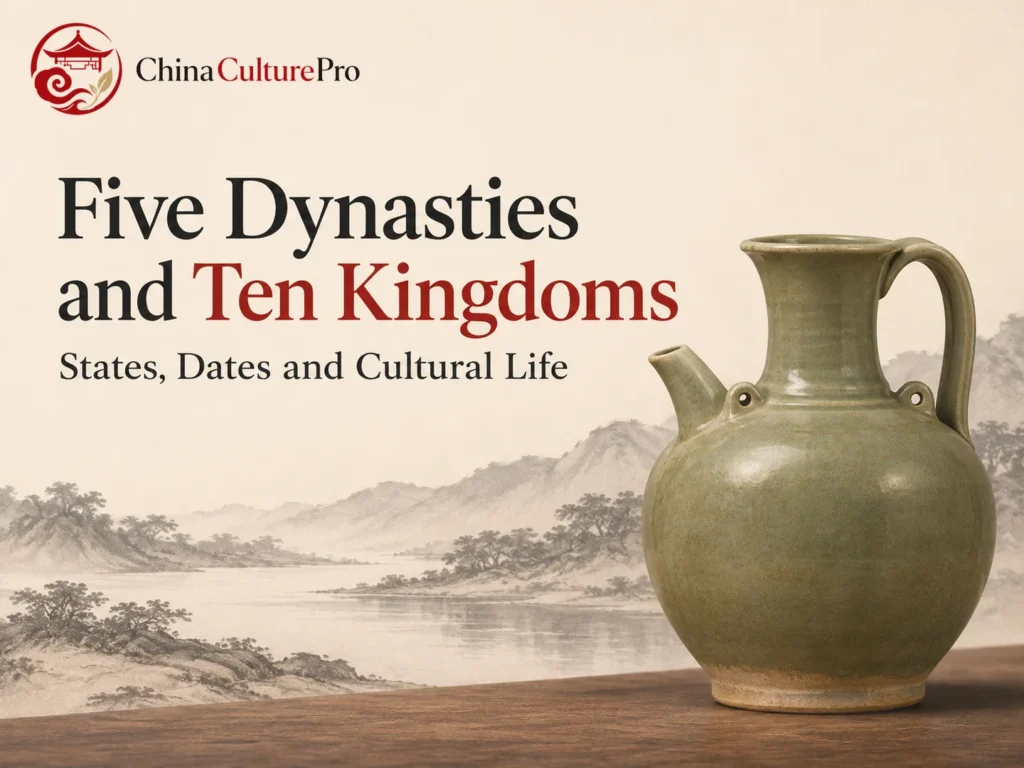
Painters associated with Southern Tang helped shape traditions of landscape painting. Riverbank, a large ink landscape attributed to Dong Yuan (董源, Dǒng Yuán), is one example through which later viewers have discussed the style. A green-glazed stoneware ewer with small loop handles illustrates Yue ware (越窑, Yuèyáo) from the period.[3][6][7]
In Wuyue, Qian Chu (钱俶, Qián Chù) sponsored the production of Buddhist texts. A printed scroll dated 975 has an illustration and an inscription identifying the ruler and describing the deposition of copies in a pagoda. Woodblocks allowed the same text and image to be reproduced together. Copies placed in a pagoda served as offerings tied to that site.[8][9]
How the Song Expanded
Zhao Kuangyin (赵匡胤, Zhào Kuāngyìn) took power from Later Zhou in 960 and founded the Song dynasty. His forces conquered Later Shu in 965 and Southern Han in 971. Southern Tang fell around the turn of 975–976. Wuyue submitted in 978. The Song conquered Northern Han in 979 under Zhao’s successor.[3][4][11]
These events brought the states in the conventional ten under Song rule in stages. The Song still faced the Liao to the north. The founding date, the last conquest in the roster and the continued frontier divide are separate markers in the Chinese dynasties timeline.[1][4][5][11]
FAQs About the Five Dynasties and Ten Kingdoms
Why do some timelines end in 960 and others in 979?
The Five Dynasties in the north ended when the Song took power in 960. The wider period is commonly dated through 979, when the Song conquered Northern Han, the last of the conventional Ten Kingdoms.[1][3][4]
Were all the Ten Kingdoms in southern China?
Most were based in southern or central regions. Northern Han, centered on Taiyuan in present-day Shanxi, is the northern exception in the conventional list.[3][4]
What was the period known for besides political division?
Regional courts supported poets, painters and Buddhist institutions. Surviving objects and texts include green-glazed Yue ware, works associated with landscape painting and printed Buddhist scrolls sponsored by the Wuyue court.[3][6][7][8][9][10]
Источники
[1] University of Toronto Cheng Yu Tung East Asian Library. Five Dynasties and Ten Kingdoms Chronology
[2] Cambridge University Press. The Five Dynasties
[3] Berkshire Publishing. Five Dynasties and Ten Kingdoms
[4] Cambridge University Press. Founding and Consolidation of the Song Dynasty
[5] Journal of Chinese History. Defensive Woodland on the Song–Liao Border
[6] The Metropolitan Museum of Art. Riverbank, Attributed to Dong Yuan
[7] The Metropolitan Museum of Art. Yue Ware Ewer with Lug Handles
[8] Shih-shan Susan Huang. Early Buddhist Illustrated Prints in Hangzhou
[9] University of Hawai‘i Press. Regional Buddhist Cultures in Southern China
[10] Journal of Chinese Humanities. Li Yu and Ci Poetry in Song Literary Criticism
[11] Cambridge University Press. The Reunification of China: Campaign Chronology