


Quick Answer: What Was the Jurchen Jin Dynasty?
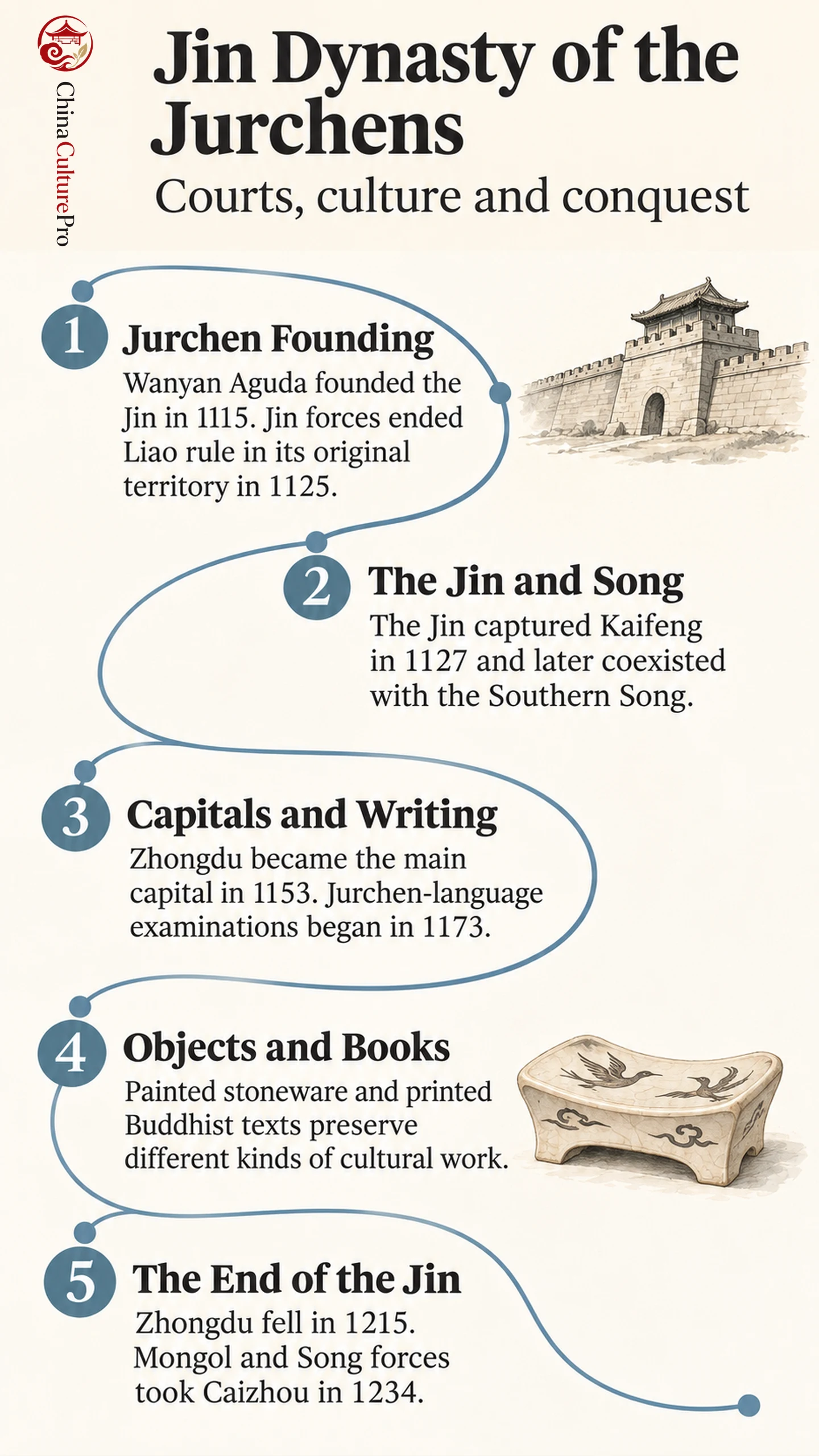
The Jurchen Jin dynasty (金朝, Jīn Cháo) was founded by the Jurchens (女真, Nǚzhēn) in 1115. It defeated the Liao, captured the Northern Song capital and ruled much of northern China alongside the Southern Song. Mongol and Southern Song forces brought down its last stronghold in 1234.[1][2][3][11][12]
- Northern power: The Jin expanded from the northeast and moved its main capital to the area of present-day Beijing in 1153.[1][3][4]
- Government and culture: The court used Jurchen writing and introduced examinations in that language. Ceramic and printed works preserve evidence of artistic and religious life.[5][6][7][9][10]
- The dynasty’s end: The loss of the northern capital in 1215 preceded the last defeat by almost two decades.[1][11][12]
The Jurchen Jin was a separate state from the earlier Western and Eastern Jin dynasties.[1][2]
A palace examination, a painted stoneware pillow and a Buddhist book give three ways to study life under Jin rule.[7][9][10]
Jurchen Origins and the Fall of the Liao
Wanyan Aguda (完颜阿骨打, Wányán Āgǔdǎ) united Jurchen groups in the northeast and founded the Jin in 1115. The new court went to war against the Khitan Liao dynasty. The Jin and the Song cooperated against the Liao for a time, although they had different interests in the frontier and its former cities.[1][3][4]
By 1125, the Jin had captured the Liao emperor and ended the dynasty’s rule in its original territory. The Jin inherited areas governed through different institutions and had to govern cities, farming districts and military households. It used existing offices and administrative practices alongside institutions the Jurchens brought to the expanding state.[1][3][5]
Kaifeng, the Southern Song and the New Border
After the Liao defeat, the Jin turned against the Song dynasty. Jin forces captured Kaifeng and took two Song emperors into captivity in 1127, an event called the Jingkang Incident (靖康之变, Jìngkāng zhī Biàn). The Song court re-formed in the south. This is the political break between Northern and Southern Song.[1][2][3]
The Jin and Southern Song coexisted from 1127 to 1234. A settlement in 1141–1142 established a boundary along part of the Huai River and formalized payments from the Southern Song. Warfare returned at intervals. Farther west, Western Xia continued to rule a separate territory. Different frontier relationships shaped the Jin’s western and southern borders.[1][3][4]
Capitals, Writing and Examinations
The early court ruled from Shangjing (上京, Shàngjīng), near present-day Harbin. In 1153 the main capital moved to Zhongdu (中都, Zhōngdū), in the area of present-day Beijing. The move brought the court closer to many of the northern cities and farming regions it governed. The state also used other designated capitals and regional seats.[1][3][4][5]
Jurchen script (女真文, Nǚzhēnwén) gave the court and its readers a way to write the Jurchen language. Its forms drew on writing traditions familiar in the region, including Khitan and Chinese. Historical records distinguish large and small Jurchen scripts, and surviving inscriptions preserve some of that written practice.[1][6][7]
In 1173, under Emperor Shizong (金世宗, Jīn Shìzōng), the court held its first Jurchen-language examinations for the highest literary degree. The first examinations included a metropolitan and a palace stage. The new route to office depended on schools and texts that could prepare people to read and write Jurchen. Other examinations and routes to office also continued.[5][7][8]
Ceramics and Buddhist Printing
A Jin-period stoneware pillow shows a falcon attacking a swan. Its dark painting sits over a light slip beneath a clear glaze. These features are characteristic of the decorative technique used on this example of Cizhou ware (磁州窑, Cízhōuyáo). The hunting subject also appears on other objects associated with northern courts. The pillow puts a courtly hunting theme on an object made using an established northern ceramic technique.[3][9]
The Zhaocheng Jin Tripitaka (赵城金藏, Zhàochéng Jīnzàng) preserves part of a Buddhist canon printed from carved woodblocks. Blocks were carved at Tianning Temple in Xiezhou, in what is now Shanxi. The edition dates approximately to 1149–1173. A woman named Cui Fazhen (崔法珍, Cuī Fǎzhēn) helped fund the project with other believers. The edition drew on an earlier printed canon while preserving texts absent from some other editions.[10]
The Mongol Conquest of the Jin
Mongol campaigns began in 1211. The Jin court moved from Zhongdu to Kaifeng in 1214, and Mongol forces captured Zhongdu in 1215. The Jin continued to govern territory from the south for years. At Kaifeng, the court faced further campaigns before losing that seat as well.[1][4][11][12]
Mongol and Southern Song forces took the last Jin stronghold at Caizhou (蔡州, Càizhōu) in 1234. The Southern Song continued to rule in the south. The conquest of the Jin was one stage of the longer Mongol expansion that later led to the Yuan dynasty.[1][3][11][12]
FAQs About the Jurchen Jin Dynasty
Which Jin dynasty was founded by the Jurchens?
The Jurchens founded the Jin dynasty that ruled from 1115 to 1234. It is distinct from the earlier dynasties usually called Western Jin and Eastern Jin.[1][2]
Did the Jurchen Jin rule at the same time as the Song?
Yes. The Jin overlapped with the Northern Song before taking Kaifeng in 1127. It then ruled northern territories alongside the Southern Song until the Jin fell in 1234.[1][2][3][12]
What survives from the Jin dynasty?
Surviving evidence includes inscriptions in Jurchen, records of government and education, painted stoneware and printed Buddhist texts. Each preserves a different aspect of Jin rule and cultural life.[5][6][7][9][10]
Источники
[1] Cambridge University Press. The Chin Dynasty
[2] The Metropolitan Museum of Art. China, 1000–1400 CE
[3] Cambridge University Press. Inner Asian Rule: The Liao, Xi Xia, Jin and Yuan
[4] Ghent University Academic Bibliography. The Jin Revisited: New Assessment of Jurchen Emperors
[5] The Journal of Asian Studies. The Influence of Jurchen Rule on Political Institutions
[6] Unicode Working Group. Toward an Encoding of the Jurchen Script
[7] T’oung Pao. The Road to Literary Culture: Jurchen-Language Examinations
[8] Cambridge University Press. Schooling, State and Society in Song and Jin
[9] The Metropolitan Museum of Art. Pillow with a Falcon Attacking a Swan
[10] Library of Congress. The Zhaocheng Jin Tripitaka
[11] Cambridge University Press. The Cambridge History of the Mongol Empire
[12] The Journal of Chinese Military History. Review of Destruction of the Three Capitals