
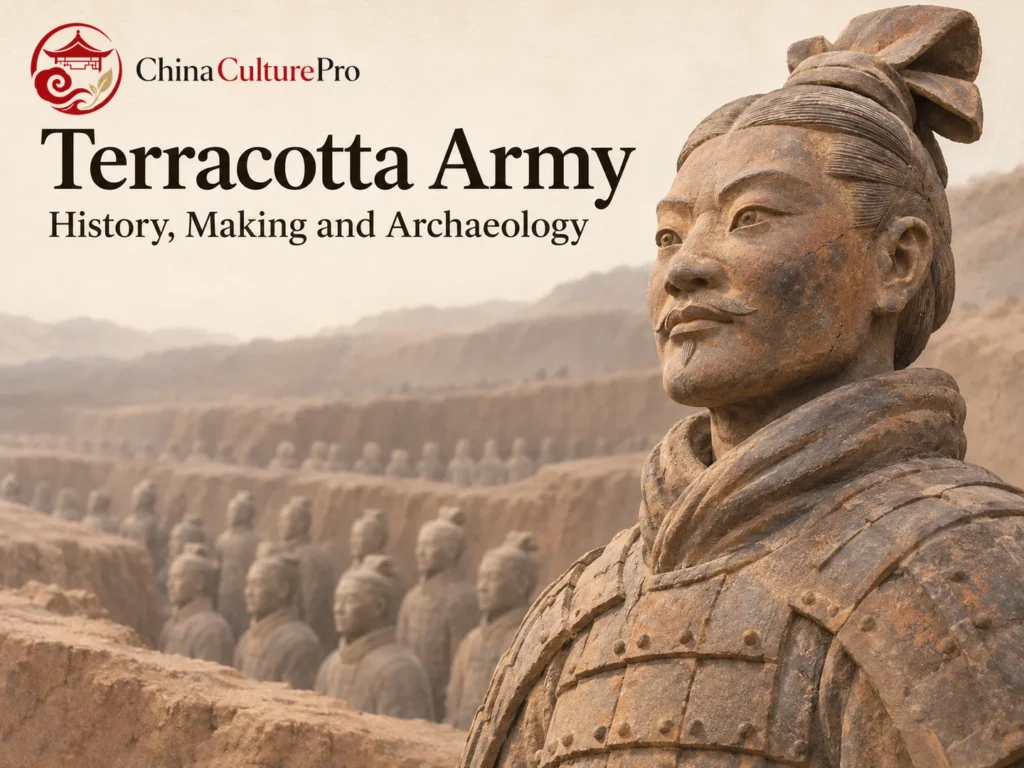

Quick Answer: What Is the Terracotta Army?
The Terracotta Army (兵马俑, Bīngmǎyǒng) is a group of life-size fired-clay soldiers and horses made for the burial complex of Qin Shi Huang (秦始皇, Qín Shǐ Huáng), China’s first emperor. The army occupied separate pits within a much larger mausoleum complex near present-day Xi’an.[1][2]
- Discovery: People digging a well in 1974 found fragments that led archaeologists to the first major pit.[2]
- Making: Workshops made the figures near the site. Artisans shaped and fired the clay, then finished it with lacquer and color.[5][6][8]
- Evidence: Formations, bronze weapons and ceramic details illuminate military representation and craft organization in the Qin dynasty (秦朝, Qín cháo).[1][5][7]
The army is one part of the mausoleum. The figure totals quoted for its pits are estimates based on excavation and the layout of buried remains.[1][2][3]
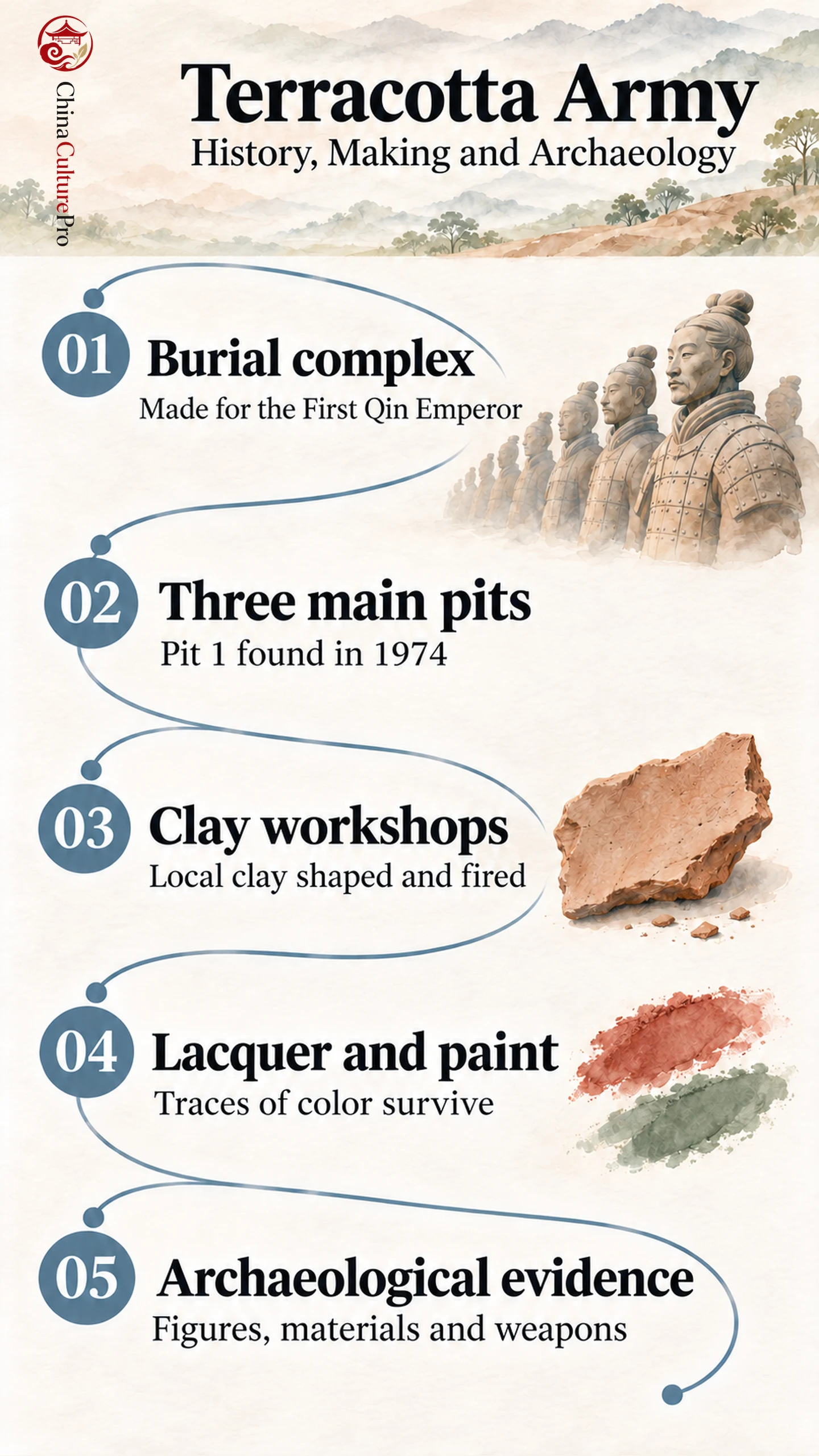
A warrior’s face catches the eye, but a clay fragment can answer a different question. Under a microscope, its grains can help archaeologists compare raw materials and workshop practices. Bronze fittings and traces of color carry their own evidence. Together, these objects make the army a source for Chinese history as well as a monument to the first emperor.[1][5][6][7]
Why the Qin Emperor Built the Mausoleum
Work on the mausoleum of Qin Shi Huang (秦始皇陵, Qín Shǐ Huáng Líng) began before the king of Qin completed his conquest of rival states in 221 BCE. The project continued through his reign as emperor. Its plan places the burial mound within two enclosing walls and the terracotta soldiers in separate accompanying pits. The wider complex also contains other burials, structures and deposits, including bronze chariots.[1]
The scale and arrangement of the complex bring elements of imperial power into a burial setting. UNESCO compares its double-walled layout with that of Xianyang (咸阳, Xiányáng), the Qin capital. This comparison gives the complex a place in the history of both ancient Chinese capitals и Chinese imperial tombs. The army’s outward-facing formation is consistent with a protective role in the funerary landscape created for Qin Shi Huang.[1]
What Archaeologists Found in the Three Main Pits
In March 1974, people digging a well at Xiyang village in Lintong came across clay fragments. Survey and trial excavation established the scale of the first pit. Archaeologists subsequently found other pits with different formations and contents.[2][3][4]
| Pit | Что в него входит |
|---|---|
| Pit 1 | The largest of the three, with long lines of figures and remains of horses, chariots and bronze weapons.[2] |
| Pit 2 | Several formations, including archers, cavalry and units with chariots and infantry.[3] |
| Pit 3 | A smaller group with a chariot and horses. Some scholars interpret its layout as a command post for the other two pits.[4] |
The site museum estimates that Pit 1 contains about 6,000 clay figures and horses. That number was extrapolated from the density and arrangement of figures in investigated areas. The finds give an excavated sample, and the estimate describes the possible total within the pit.[2]
How Workshops Made and Painted the Figures
Artisans combined methods to create figures with similar basic forms and varied details. Torsos could be built up in coils, and components such as heads, arms and hands were shaped separately before assembly. Moulds helped repeat selected forms. Finishing by hand allowed changes in features such as facial hair and dress.[8]
Researchers studying the clay compared small sections under a microscope. Their results support local manufacture and suggest that clay was prepared centrally and supplied to different workshops. The samples contained added sand, unlike the finer paste of the floor bricks used for comparison. The clay fabric also provides evidence that the large figures were deliberately fired. This combination of shared preparation and specialized work helps explain how a single project could produce so many large sculptures.[5]
The figures were lacquered and painted. Preserved traces include reds, greens, blues and other colors. When an excavated figure comes out of damp soil, its lacquer layer can shrink as moisture evaporates. Paint can then lift away with the lacquer. A figure that appears mostly earth-colored today can therefore preserve only a fraction of its original painted surface.[6]
What the Figures and Weapons Reveal
The positions of figures and finds record how the makers represented an army. Kneeling and standing archers, horses, armor and bronze weapons offer separate clues to military equipment and formation. An archer’s pose shows how the maker represented the soldier. The grouping of archers and other units shows how the burial ensemble arranged them. Those are different kinds of evidence for the military practices and ideals of the Qin dynasty.[1][3][7]
Weapons also illustrate how scientific testing can change an explanation. Chromium found on some bronze surfaces was once taken as evidence of deliberate corrosion protection. A 2019 study found that traces were associated with contact with lacquered material, rather than with how well the metal had survived. The researchers proposed that burial conditions also helped preserve some of the bronze.[7]
What the Archaeology Can Establish
Placement, tool marks and material residues each answer a different question. Where the warriors were placed helps explain their role in the mausoleum. How their clay was prepared helps explain labor organization. Variation in faces demonstrates the scope for individual finishing. Matching a statue to a historical person would require evidence linking that figure to a particular sitter.[1][5][8]
FAQs About the Terracotta Army
How many figures are in the Terracotta Army?
The three main pits contain thousands of soldiers and horses. The site museum estimates about 6,000 for Pit 1 alone, based on the distribution of excavated figures.
Were the warriors originally painted?
Yes. Pigment traces survive over a lacquer layer, though exposure after excavation can cause the lacquer and paint to flake away.
Did the warriors represent real soldiers?
The warriors show realistic uniforms, poses and varied faces. These details are evidence of how workshops depicted soldiers. A convincing likeness alone leaves the identity of any possible sitter uncertain.
Источники
[1] UNESCO World Heritage Centre. Mausoleum of the First Qin Emperor
[2] Emperor Qin Shihuang’s Mausoleum Site Museum. Pit 1
[3] Emperor Qin Shihuang’s Mausoleum Site Museum. Museum Guide to the Terracotta Army Pits
[4] Emperor Qin Shihuang’s Mausoleum Site Museum. Pit 3
[5] Patrick Sean Quinn and colleagues. Building the Terracotta Army
[6] Technical University of Munich. Conservators Preserve the Paint Layers of the Terracotta Army
[7] Marcos Martinón-Torres and colleagues. Study of Surface Chromium on Terracotta Army Bronze Weapons
[8] British Museum. The Making of the Terracotta Figures