

Quick Answer: How Did Yangshao and Longshan Differ?
Yangshao culture (仰韶文化, Yǎngsháo Wénhuà) and Longshan culture (龙山文化, Lóngshān Wénhuà) are archaeological labels used for Neolithic communities in northern China. Yangshao is generally earlier and is known for painted earthenware. Longshan sites include fine black pottery and some larger, enclosed settlements.[1][2][3][7][8][9]
- Dates: Yangshao is often placed around 5000–3000 BCE. A broad Longshan range is about 3000–1900 BCE.[1][7][12]
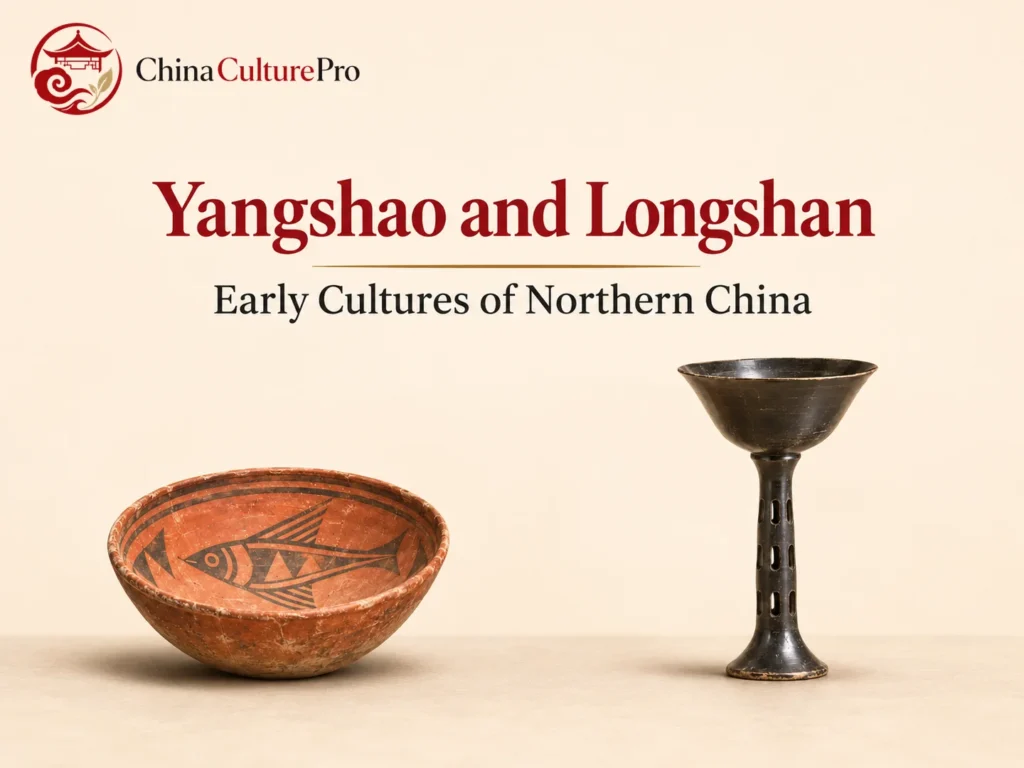
- Pottery: Red painted bowls and thin black stem cups are characteristic examples from the two traditions.[5][6][7]
- Settlements: Excavated houses, kilns, ditches and earthworks show how communities organized daily life and larger construction projects.[4][8][9]
Dates and vessel types vary by site and region.[1][2][8][12]

A painted bowl can show where a design was visible to its users. A black stem cup can show what a potter achieved by thinning and polishing clay. The settlements where such objects were found provide a wider setting for both kinds of work.[4][5][6][8]
Yangshao and Longshan at a Glance
The names group artifacts and sites with recurring characteristics. Archaeologists use the two labels at different scales. For example, one museum chronology begins Yangshao around 4800 BCE, while broader comparisons round its start to about 5000 BCE. Dating a specific site requires evidence from that locality.[1][2][3][12]
| Признак | Yangshao | Longshan |
|---|---|---|
| Broad dates | About 5000–3000 BCE | About 3000–1900 BCE |
| Geographic emphasis | Middle Yellow River and Wei River regions, with related sites farther west | Shandong and other parts of northern China, with distinct regional traditions |
| Characteristic ceramics | Painted earthenware with geometric or animal designs | Fine black wares, including some very thin stem cups |
| Settlement evidence | Villages with houses, storage pits, kilns and ditches | Settlements of varied sizes, including larger walled or moated centers |
The ceramics column highlights distinctive objects that help readers identify the traditions. Ordinary storage and cooking vessels were part of both.[1][2][3][4][6][7][8][9][12]
Yangshao Villages and Painted Pottery
Banpo (半坡, Bànpō), near present-day Xi’an, preserves traces of houses, storage pits, pottery kilns and burials. The residential area was enclosed by a ditch. The layout gives evidence of how some activities were separated, with space for dwellings, making pottery and burying the dead.[3][4]
A painted basin associated with Banpo has repeated human-face and fish designs inside the vessel. Their position matters. A viewer looking down into the vessel would have seen the repeated faces and fish around its inner wall. Similar bowls were found used as covers for children’s burial jars. This tells researchers something about how vessels were used and placed, while the exact meaning of the designs remains open.[4][5]
Longshan Blackware and Larger Settlements
Fine Longshan blackware includes slender stem cups sometimes described as eggshell pottery. The name refers to the thin walls. Experimental work suggests that potters could trim clay with a sharp edge while the vessel rotated. Polishing the surface before firing helped give some vessels their sheen. Some of the finest stem cups have been found in larger or more richly equipped burials.[2][6][7]
At Chengziya (城子崖, Chéngzǐyá) in Shandong, archaeologists studied the construction and filling of a moat. Dating the deposits suggests that people continued to occupy the site through the transition to the succeeding Yueshi culture (岳石文化, Yuèshí Wénhuà). The evidence allows a change in pottery to be read alongside continuity in settlement. Farther west, Taosi (陶寺, Táosì) in southern Shanxi was occupied around 2300–1900 BCE. Its enclosures grew across phases, and its burials preserve substantial differences in furnishings. These were regional developments within a broad late Neolithic setting.[8][9]
What Food Evidence Shows
Evidence from human remains can help reconstruct diets over years of life. At Xiazhai (下寨, Xiàzhài) in Henan, carbon and nitrogen isotope analysis indicated a millet-based diet for people buried during a late Yangshao phase. Individuals associated with a later Shijiahe (石家河, Shíjiāhé) phase had diets with evidence of both millet and rice.[10]
Millet again made up much of the diet in the later group, which included late Longshan and early Bronze Age remains. Because the remains came from the same site, the sequence shows how food use there changed over time. It also documents the continued importance of millet across different archaeological phases.[10]
How to Read the Transition
Pottery, houses and burials change at different rates. A shift in vessel forms may show a change in techniques or practices. A large enclosure documents a different scale of work from a household pit or kiln. Each type of evidence has its own chronology.[1][2][3][8][9]
Other Neolithic regions developed their own traditions, such as Hongshan farther northeast and Liangzhu in the lower Yangtze. Erlitou (二里头, Èrlǐtóu) belongs to the later growth of Bronze Age centers in the Central Plains. Reading Yangshao and Longshan within the broader history of Chinese prehistory keeps each community in its regional and archaeological setting.[1][2][3][11]
FAQs About Yangshao and Longshan
Which came first, Yangshao or Longshan?
Yangshao generally came earlier. A broad comparison places Yangshao around 5000–3000 BCE and Longshan around 3000–1900 BCE. Regional dates and local transitions vary.[1][7][12]
What is eggshell pottery?
Eggshell pottery is a term for exceptionally thin-walled vessels. Some Longshan black pottery cups have very thin walls and highly polished surfaces. They represent a specialized type within a larger range of pottery.[2][6][7]
Did Longshan replace Yangshao everywhere?
The labels describe regional patterns with different local histories. Some settlements show several phases of occupation, and neighboring regions developed their own pottery and settlement traditions.[1][2][8][10][12]
Источники
[1] Princeton University Art Museum. China Timeline
[2] The Metropolitan Museum of Art. Neolithic Period in China
[3] Smithsonian National Museum of Asian Art. Neolithic Period
[4] China Culture. Banpo Site
[5] National Museum of China. Painted Pottery Basin with Fish and Human Face Design
[6] National Museum of China. Thin-Walled Black Pottery Stem Cup
[7] The Metropolitan Museum of Art. Longshan Beaker
[8] Journal of Archaeological Science: Reports. Moat Construction and Sedimentation at Chengziya
[9] Archaeological Research in Asia. Taosi as a Prehistoric Political Center
[10] Acta Anthropologica Sinica. Isotope Evidence from Xiazhai, Henan
[11] Cambridge University Press. Erlitou and Erligang: Early State Expansion
[12] Anthropological Science. Approximate Chronology of Neolithic Northern China