

Quick Answer: What Was a Chinese Pawnshop?
A dangpu(当铺,dàngpù)was a pawnshop: a business that lent money against belongings left as security. The borrower could recover the pledged item by meeting the agreed repayment conditions. Pawning therefore differed from an immediate sale. [1]
- The pledge: Clothing, cloth, jewelry and other valuables could secure a loan.
- The record: A ticket or account connected the item with the transaction.
- The premises: Shops needed space for assessment, records and protected storage.
- The outcome: Repayment and recovery differed from leaving an item unredeemed.
Practices changed across periods and places. Historical pawnshops were neither all identical nor merely secondhand shops with another name. [1][2][3]
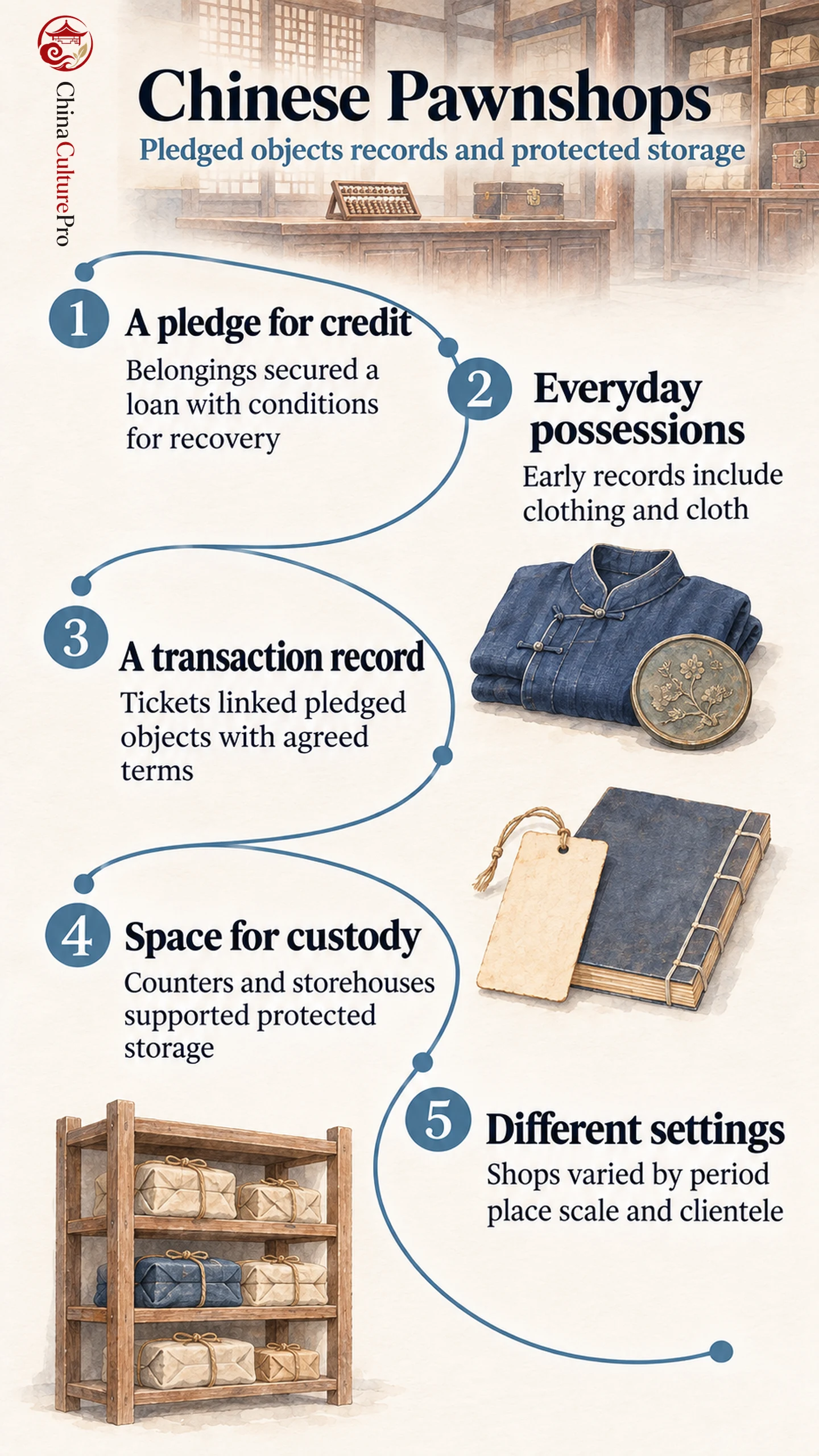
A folded garment, a handwritten ticket and a locked storeroom tell different parts of pawnshop history. Together they show how belongings could become temporary sources of cash. Within Chinese history, these transactions connect household possessions with credit, commercial skill and the organization of urban space.
Belongings, Loans and Redemption
Diandang(典当,diǎndàng)describes the pawning activity. In the historical agreements presented by one contract exhibition, movable belongings were pledged for cash, with the item, amount and term specified. Recovery depended on fulfilling the transaction’s conditions; nonredemption could lead to the pledged goods passing to the shop. [1]
Keep three things separate: the object deposited, the loan advanced and the amount needed to redeem it. None is automatically the object’s full retail value. Also distinguish a redeemed pledge from a later sale of unredeemed goods. The latter does not mean the customer initially entered an ordinary retail transaction.
This is the historical mechanism, rather than a statement of present-day lending rules or remedies.
An Early Record: A Tang Pawnshop Account Book
An exceptional group of seventh-century account pages reveals transactions at a Chang’an pawnshop. The paper survived at Astana near Turfan through reuse in a tomb figurine. Its archaeological survival was accidental, not the preservation of a complete business archive. [2]
Entries identify pledged objects, borrowers, dates, loan amounts and repayments, with some personal details. Clothing and cloth predominate. A mirror and strings of pearls also appear, showing that the business was not restricted to one class of possession. [2]
This evidence establishes specific early practices. It does not identify the first pawnshop, a single inventor or an institution that remained unchanged for the next millennium.
What a Pawn Ticket Recorded
A dangpiao(当票,dàngpiào)was a transaction document associated with pledged goods. Museum accounts describe it as evidence connecting the two parties, rather than simply a decorative shop receipt. Records could identify an item, a sum and the terms relevant to its recovery. [1][4]
Do not assume all surviving tickets are easy to read. An account of the Yuanli site museum describes specialized handwriting and variant forms used in pawnshop records, with interpretation needed to make them accessible. That is evidence for a professional documentary practice, not proof that every difficult character had one universal secret meaning. [4]
The distinction from paper money is fundamental: a pawn ticket referred to a particular credit transaction, rather than serving as general currency.
Counters, Screens and Secure Storehouses
The preserved Tak Seng On premises in Macao make storage visible. Established in 1917, the shop combined a front business block with a substantial rear storehouse. Its high counter, protective barriers and robust construction formed part of an arrangement intended to safeguard pledged goods. The museum’s restoration helps explain that early Republican setting. [3]
A Hong Kong building appraisal offers a related but distinct example. At Tak Sang, a screen protected customers from the view of passersby, while a raised counter and barriers provided security. Privacy and protection were functions of the layout; these features should not be assigned a single psychological explanation everywhere. [5]
Shanghai’s Yuanli site, built in 1932, preserves another local story. Restored business and storage areas explain how transactions and custody occupied different spaces. [4]
Pawnshops Within Merchant and Credit Networks
A pawnshop did not operate outside the wider economy. Research on Shanxi merchants places pawnshops alongside money shops, draft banks and other institutions, each with distinct business models and customers but also connected flows of capital. That is a picture of differentiated financial activity, not one generic “ancient bank.” [6]
The broader history also extends beyond metropolitan streets. A major historical study covers late imperial and Republican pawnshops in both cities and the countryside. The urban shopfront is an accessible starting point, not the full geographic story. [8]
These relationships belong within Chinese merchant culture, while regional and institutional differences still need to be retained.
Household Needs and Unequal Bargaining Power
Pledging ordinary garments shows how everyday possessions could support borrowing. However, a ledger naming an object and a borrower does not always reveal the household’s reason for needing cash. It cannot automatically establish famine, personal irresponsibility or permanent poverty. [2]
Nor were all shops focused on tiny household pledges. Yuanli’s museum account describes business involving substantial jewelry and artworks. That example complicates the assumption that every customer and every loan occupied the same social position. [4]
The transaction brought together parties with different needs and expertise. The borrower wanted usable cash; the shop assessed an object it would hold as security. Both the availability of credit and the possibility of losing a possession belong in the account.
Reading Pawnshop History Through Surviving Evidence
Use several kinds of evidence together. A ledger shows recorded transactions; a ticket connects parties and goods; a storehouse shows the physical demands of custody. A reconstructed museum scene helps explain those functions but should not be mistaken for an untouched original interior.
Scale matters too. One study uses records of financial institutions across 137 Shandong counties to investigate historical patterns. Its regional sample is useful precisely because it is defined; it does not describe every Chinese locality or every borrower’s experience. [7]
Pawnshop signs offer another route into the subject, while market culture places the business among surrounding exchanges. As with other topics, separate documentary history from later storytelling.
FAQs About Chinese Pawnshops
Was Pawning the Same as Selling?
No. A pledge secured borrowing and could be recovered under the agreed conditions. Outright sale transferred the object through a different transaction. [1]
Were Pawnshops Used Only for Jewelry?
No. Early account pages include clothing and cloth as well as other goods. Different shops served different kinds of customers and possessions. [2]
Were All Chinese Pawnshops the Same?
No. Their clientele, scale, institutions, premises and documentary practices varied. A Tang account book and a twentieth-century shop need separate contexts. [6]
Was a Pawn Ticket Paper Money?
No. It documented a particular pledge-related transaction. It should not be confused with currency intended for general circulation. [1][4]
Источники
[1] Jinan Museum. Contract Culture Exhibition Guide: Pawn Agreements
[2] Valerie Hansen and Ana Mata-Fink. Records from a Seventh-Century Pawnshop in China, in The Origins of Value
[3] Macao Cultural Affairs Bureau. Heritage Exhibition of a Traditional Pawnshop Business
[4] Jingan District News Center. Yuanli Pawnshop Site Museum after Restoration
[5] Antiquities Advisory Board. Historic Building Appraisal: Tak Sang Pawn Shop
[6] Jianbo Zhou and colleagues. Shanxi Merchants’ Multilevel Financial System in Ming and Qing Dynasties, China
[7] Jinyan Hu, Chicheng Ma and Bo Zhang. The Long-term Persistence of Informal Finance in China
[8] Chao-yu Yang; translated by T. S. Whelan. The Pawnshop in China, University of Michigan Press edition