
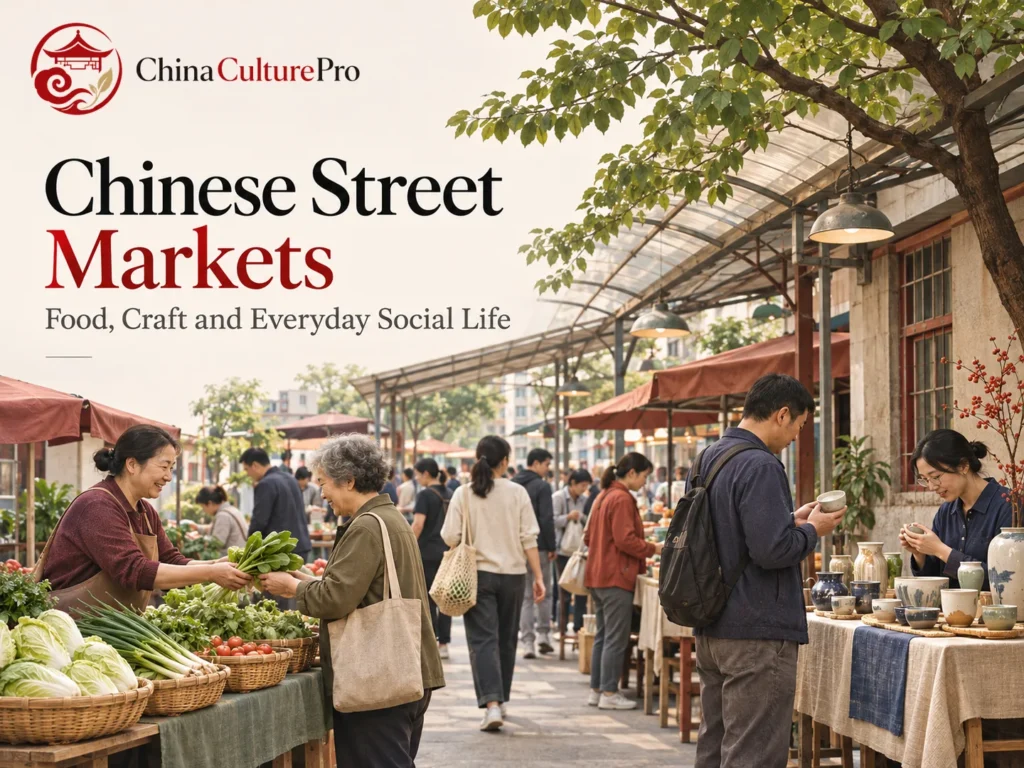

Quick Answer: What Are Chinese Street Markets Like?
Chinese street markets bring together sellers, shoppers and goods in settings ranging from neighborhood food stalls to periodic fairs and curated craft events. This guide focuses on mainland China. Some markets occupy open streets; others use covered halls, courtyards or adapted buildings. Their daily rhythms depend on the goods and communities they serve.[5][6]
- Food: Ingredient shopping and prepared snacks serve different needs.
- Craft: Markets give makers a place to display, explain and sell their work.
- Social life: Repeated encounters connect vendors, suppliers and customers.
One market may combine several of these roles. Its name alone rarely describes the whole experience.
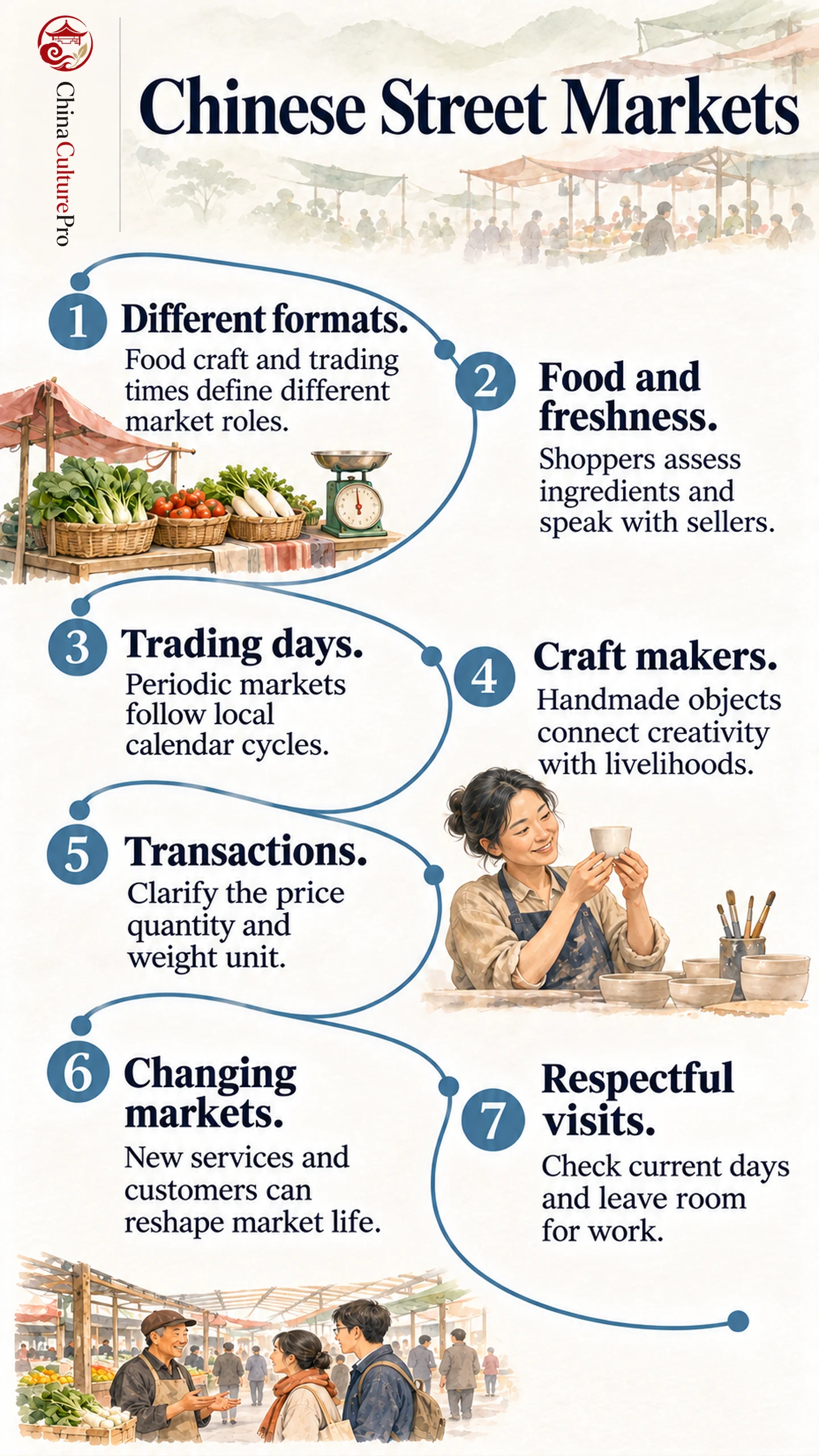
Buying vegetables, choosing a handmade cup and meeting a familiar seller all create different market encounters. Looking at what is sold, when trading happens and who returns makes these places easier to understand as part of everyday Chinese culture.
Different Markets, Different Rhythms
Market labels can describe a product range, trading time or type of event. These dimensions overlap: a morning market can also sell fresh ingredients, while a craft fair may take place after dark.
| Market label | What it helps identify |
|---|---|
| Neighborhood food market: caishichang (菜市场, càishìchǎng) | Independent stalls selling ingredients for household meals; the market may be covered.[2] |
| Morning market: zaoshi (早市, zǎoshì) | Early-day trading that can combine breakfast stalls with produce shopping.[10] |
| Periodic fair: daji (大集, dàjí) | A larger gathering on locally specified market days, with food and other goods.[4] |
| Night market: yeshi (夜市, yèshì) | Evening shopping and leisure, with the mix of food and retail varying by venue.[8] |
| Creative or craft market | A platform for contemporary handmade objects, makers and design.[5] |
Food, Freshness and Everyday Meals
Ingredient markets are closely connected with home cooking and meals. Shoppers compare vegetables, meat, fish, fruit and other ingredients across independent stalls. The selection makes regional preferences visible: what people buy helps explain what reaches their kitchen tables.[1]
Research in Sanya and Guangzhou examines freshness as something shoppers actively judge through appearance, sensory experience and trust in sellers. The market is a place where those judgments are discussed and developed. This cultural value helps explain the continued appeal of small stalls alongside other food retailers; it does not establish the safety of any individual food.[1]
Identifying unfamiliar Chinese vegetables provides one way to follow ingredient shopping. Prepared street food offers a different encounter: the customer is choosing something to eat rather than supplies for a later meal. Both activities can share a market without being identical.
Periodic Market Days and Rural Connections
Going to a periodic market is often described as ganji (赶集, gǎnjí). Instead of assuming a market opens daily, people organize a visit around its trading day. Such gatherings connect producers and consumers across surrounding settlements and belong within the changing life of rural communities.[3]
A February 2026 Qingdao guide lists Shazikou market on lunar-month dates ending in five or zero. Its coastal setting is reflected in fresh and dried seafood. The Chinese and Gregorian calendars differ, so a lunar market-day rule needs interpretation before it becomes a date on a visitor’s calendar.[4]
Other places follow different systems. Research published in 2013 documented six-day-cycle markets in Jinping County, Yunnan, where people from different ethnic communities traded goods and interacted. That research describes a particular place and period. Confirm the named market’s current calendar before visiting.[3]
Craft Markets and Contemporary Makers
Markets also provide spaces where makers meet an audience directly. Taoxichuan (陶溪川, Táoxīchuān) in Jingdezhen links contemporary market activity with the city’s ceramic production. A program published in April 2026 for the May Day holiday described young artists, art students and makers offering original ceramic jewelry, home objects and other small handmade works.[5]
This connects Jingdezhen’s ceramic traditions with current livelihoods and design. A stall can be a place to explain an object’s material, process and intended use, alongside making a sale. Markets create a meeting point between making and consuming.
A craft-market label does not establish that every object uses the same technique. Asking about who made an item and how it was produced gives more insight into craft practice than judging it only by a traditional-looking surface.
Buying, Talking and Building Familiarity
A market depends on relationships extending beyond the visible stall. Research involving 113 vendors in Sanya describes regular supplier ties alongside connections with household customers and small businesses. These networks help explain how small vendors secure goods, respond to uncertainty and continue trading.[2]
Familiarity can develop through repeated shopping and brief conversation, while a transaction may remain focused on buying and selling. A study of 38 recorded bargaining encounters in southern China examined negotiations centered on price and quantity.[1][7]
Follow the seller’s pricing arrangement: some stalls negotiate, while others use set prices. There is no useful nationwide percentage to offer. Confirm the item and quantity before agreeing to a purchase, and distinguish a price per piece from one quoted by weight.
In mainland everyday speech, jin (斤, jīn) means 500 grams; a kilogram is twice that amount. Confirm the unit in a price quote and on the scale display, so the quantity being discussed is clear.[9]
How Markets Are Changing
A renovated hall can still support market relationships. A 2024 Pudong account describes upgraded signs, electronic price information and scales, alongside community-oriented spaces. Hangtou market included an activity room, while the Pushang Neighborhood Hub connected shopping with local dishes and cooking services.[6]
The customer base can change too. A January 2025 on-site report from Harbin’s Hongzhuan Street morning market described breakfast and snack stalls replacing much of its earlier produce trade as visitor interest grew. This market’s changing role involved both its goods and the people coming to buy them.[10]
Visiting a Working Market Respectfully
Confirm the current trading day and location through the market or its local organizer. Shanghai’s May 2025 account of its market service map describes entries containing opening times, management details and types of goods. It illustrates why a specific listing is more useful than assuming that every market shares one schedule.[8]
Once there, leave space for people who are working and shopping. Ask before taking close photographs of vendors or handling delicate pieces. Use clear, polite questions about goods and prices; food names can help distinguish an ingredient from a prepared dish. Allow sellers to continue their work while you observe.
FAQs About Chinese Street Markets
Are Chinese street markets open every day?
No. Daily food markets, early-morning trading, evening markets and periodic fairs follow different arrangements. Check the named market and its current calendar.
Does wet market mean a wildlife market?
No. The term commonly refers to fresh-food markets. It should not be used as a synonym for wildlife trading.
Should you bargain at every stall?
No. Follow the pricing arrangement at the particular stall. Negotiation is one possible transaction style, not a rule for every purchase.
Are all street markets mainly for tourists?
No. Many markets serve routine household shopping and local work. Others emphasize leisure, crafts or visitors, and several roles may coexist.
Источники
[1] Shuru Zhong, Mike Crang and Guojun Zeng, Agriculture and Human Values. Constructing Freshness: The Vitality of Wet Markets in Urban China
[2] Shuru Zhong and Cynthia Werner, Economic Anthropology. The Hidden Strength of Small Business: Social Networks and Wet Market Vendors in China
[3] Masaru Nishitani and Nathan Badenoch, Southeast Asian Studies. Why Periodic Markets Are Held: Considering Products, People, and Place in the Yunnan-Vietnam Border Area
[4] Qingdao Municipal Government. A Guide to Qingdao’s Traditional Markets Before Lunar New Year
[5] Jingdezhen Municipal Government. Jingdezhen May Day Cultural Program
[6] Shanghai Municipal Government. Pudong New Area Turns Wet Markets into Smart Community Hubs
[7] Winnie W. F. Orr, Language in Society. The Bargaining Genre: A Study of Retail Encounters in Traditional Chinese Local Markets
[8] Shanghai Municipal Commission of Commerce. Reply on Supporting Market Development and Community Retail
[9] Zhongshan Market Supervision Administration. World Metrology Day: Understanding Measurement Units
[10] China Food Safety News, on-site report. Visiting Hongzhuan Street Morning Market in Harbin