


Quick Answer: What Is Guochao?
Guochao (国潮, guócháo), often translated as “China chic” or “national trend,” describes contemporary Chinese design and branding that draws on Chinese cultural references. Domestic brands are central to the discussion, but the term concerns cultural presentation as well as where a product was manufactured.[1]
- References: Historical objects, visual traditions and familiar cultural images supply material for new designs.
- Forms: Fashion, packaging and museum products bring those references into contemporary consumption.
- Meaning: Cultural identity interacts with taste, product appeal and brand storytelling.
Guochao is a broad label, rather than one historical clothing style or a certification of craftsmanship.
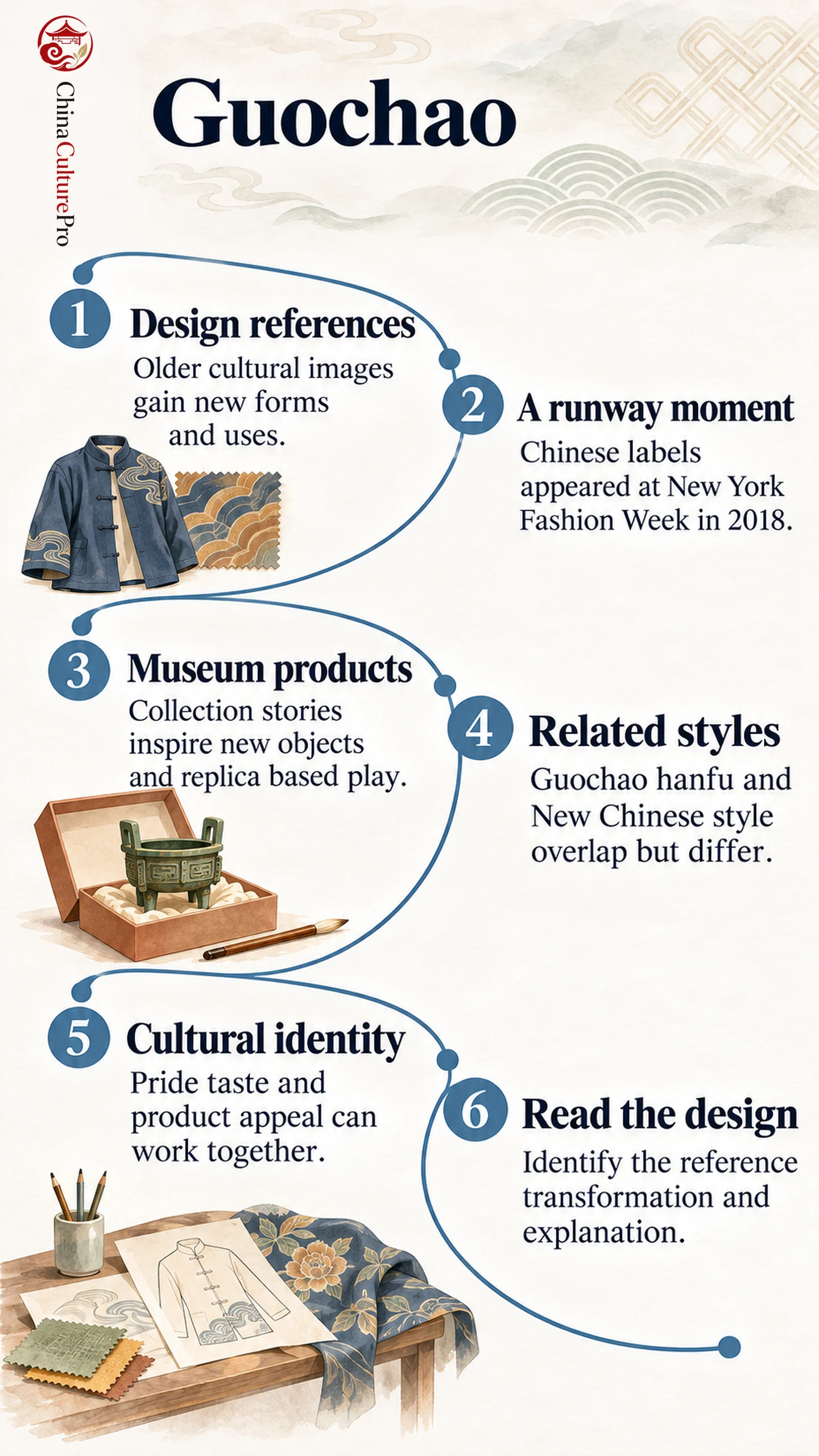
A sports jacket and a museum souvenir can draw on Chinese culture in very different ways. Guochao connects these contemporary products through design and storytelling. Understanding the term reveals one part of modern Chinese culture where heritage, fashion and consumption meet.
How Chinese References Become Contemporary Design
A cultural reference becomes part of a new design through selection and transformation. A maker might change a historical image’s scale, place lettering on sportswear or adapt an older decorative vocabulary to a modern silhouette. The resulting object belongs to present-day design even when its reference is much older.
A 2022 four-brand fashion study distinguishes two connected emphases: historical and material references associated with “guo,” and contemporary street-style mixing associated with “chao.” The cases include designer labels Angel Chen and MUKZIN alongside sportswear brands Li-Ning and Warrior Shanghai. The examples show why guochao need not have a single visual formula.[2]
The method matters. A printed image resembling Chinese embroidery is different from a stitched textile, just as decorative lettering is not automatically a work of calligraphy. Both a motif and a craft process can inform contemporary Chinese design, but they make different claims about how an object was produced.
Fashion and the 2018 Runway Moment
Li-Ning brought its sportswear to New York Fashion Week: Men’s in February 2018. It participated in Tmall China Day alongside Chen Peng, Peacebird and Clot. The event placed Chinese labels before an international fashion audience, combining sporting references with contemporary fashion presentation.[3]
The brand’s advance announcement described a Wu Dao (悟道, wùdào) theme, combining 1990s retro influences, modern utility and future-facing sportswear. The presentation brought these references into contemporary garments. The dated announcement and event report establish this particular appearance, while leaving the term’s earlier history open.[4]
Online visibility was part of the presentation itself. Viewers could buy pieces while watching the show, bringing runway presentation and digital retail together. The circulating images also extended the event’s audience.[3]
Museum Objects, Products and Play
Museums extend this relationship between cultural references and new products through cultural and creative products (文创, wénchuàng). Their collections offer identifiable objects, images and stories from which designers can work. These products range beyond miniature copies: the reference can become packaging, an accessory or an interactive experience.[6]
In December 2018, the Palace Museum published an announcement covering branded lipsticks and face masks, naming the parties responsible for development and sales. The notice specified a cooperation period from November 2018 to November 2021. Its dates identify the agreement documented there; present-day authorization or availability requires separate evidence.[5]
Henan Museum’s archaeology-inspired blind boxes provide another approach. A December 2020 report described reproduction objects enclosed in earth, which purchasers uncovered using small tools. The objects were reproductions, not genuine excavated antiquities. Here the cultural connection involved an activity as well as the object’s appearance.[7]
A souvenir can prompt interest in museum collections, while remaining distinct from the collection itself. Its packaging, explanation and connection to the source object help determine what a visitor actually learns.
Guochao, Hanfu and New Chinese Style
Guochao overlaps with clothing trends, but the labels answer different questions:
| Label | Main focus |
|---|---|
| Guochao | A broad discussion of contemporary Chinese-referenced design and branding. |
| Hanfu (汉服, hànfú) | A dress revival concerned with historical Han Chinese clothing forms and their present-day use. |
| New Chinese style (新中式, xīnzhōngshì) | Contemporary styling that selectively incorporates Chinese clothing references into everyday outfits.[8] |
The boundaries are flexible. Digital research on New Chinese style documents selective combinations of garment elements and contemporary fashion, with some overlap in the tags used for hanfu and other Chinese-inspired outfits. Wearers can disagree about historical fidelity and where one category ends.[8]
The broader history of Chinese clothing provides context for particular garments. Calling an outfit guochao does not, by itself, identify its dynasty, construction or historical accuracy.
Cultural Identity, Consumption and Online Visibility
Cultural pride is part of guochao, alongside product quality, style, familiarity and the appeal of a collaboration. A 2024 study of 479 Chinese consumers examined culturally mixed co-branding and found that responses depended on perceived relationships among the products, brands and cultural references. Its particular research setting does not describe every consumer or every purchase.[1]
The fashion cases combine Chinese cultural references with global street-style influences. Cultural recognition and international connections can operate together within the same design.[2]
For young people, clothing and objects can become ways to express taste and belonging. Yet a brand campaign, a widely shared image and a person’s reasons for buying are different kinds of evidence. None alone establishes a whole generation’s values.
How to Interpret a Guochao Product
Three questions help make a guochao design easier to interpret:
- Reference: Identify the object, garment, image or story, rather than treating every familiar-looking motif as interchangeable.
- Transformation: Look at material, shape, scale, use and the relationship between handwork and reproduction.
- Explanation: Distinguish the designer’s explanation, a museum’s documented collaboration and a retailer’s general cultural description.
These questions connect appearance with context. They also leave room to appreciate a contemporary invention on its own terms, without mistaking it for an unchanged historical object.
FAQs About Guochao
What does guochao mean in English?
Common translations include “China chic,” “national trend” and “national wave.” Each highlights part of a broad contemporary design and branding phenomenon.
Did guochao begin in 2018?
The 2018 fashion-week appearance is a prominent reference point. It should not be treated as proof of a single invention date or the first-ever use of the term.
Is guochao the same as hanfu?
No. Hanfu centers on clothing forms and revival practices. Guochao includes fashion but also branding, packaging and cultural products.
Does guochao mean rejecting foreign brands?
No. Chinese cultural references can be combined with international design languages and collaborations. Individual consumer preferences also differ.
Источники
[1] Candy Lim Chiu and colleagues, Humanities and Social Sciences Communications. Culturally Mixed Co-branding Product Framing in China
[2] Zhe Wang, Fashion, Style & Popular Culture. Implementation of Chinese-styled Branding in Global Fashion
[3] Council of Fashion Designers of America. Tmall China Day Brings Top Talent to NYFW
[4] Li-Ning, PR Newswire. Li-Ning Announces Its New York Fashion Week Appearance
[5] The Palace Museum. Announcement of Palace Museum Brand Cooperation Products
[6] Henan Museum. About Cultural and Creative Products
[7] Henan Museum, Xinhua field report. Archaeology-inspired Blind Boxes
[8] Madelon Dendooven, Ghent University. China-Chic: The People’s Republic of China’s Guochao Style